Solution & Explanation
### Related Formula
textDomain of log_e(A): A gt 0$\text{Domain of } \log_e(A): A \gt 0$
textDomain of cos^-1(B): -1 le B le 1$\text{Domain of } \cos^{-1}(B): -1 \le B \le 1$
### Core Logic
Condition 1: Logarithm domain
frac2x + 34x^2 + x - 3 gt 0$\frac{2x + 3}{4x^2 + x - 3} \gt 0$
Factorizing the denominator: 4x^2 + 4x - 3x - 3 = 4x(x+1) - 3(x+1) = (4x-3)(x+1)$4x^2 + 4x - 3x - 3 = 4x(x+1) - 3(x+1) = (4x-3)(x+1)$.
frac2x + 3(4x - 3)(x + 1) gt 0$\frac{2x + 3}{(4x - 3)(x + 1)} \gt 0$
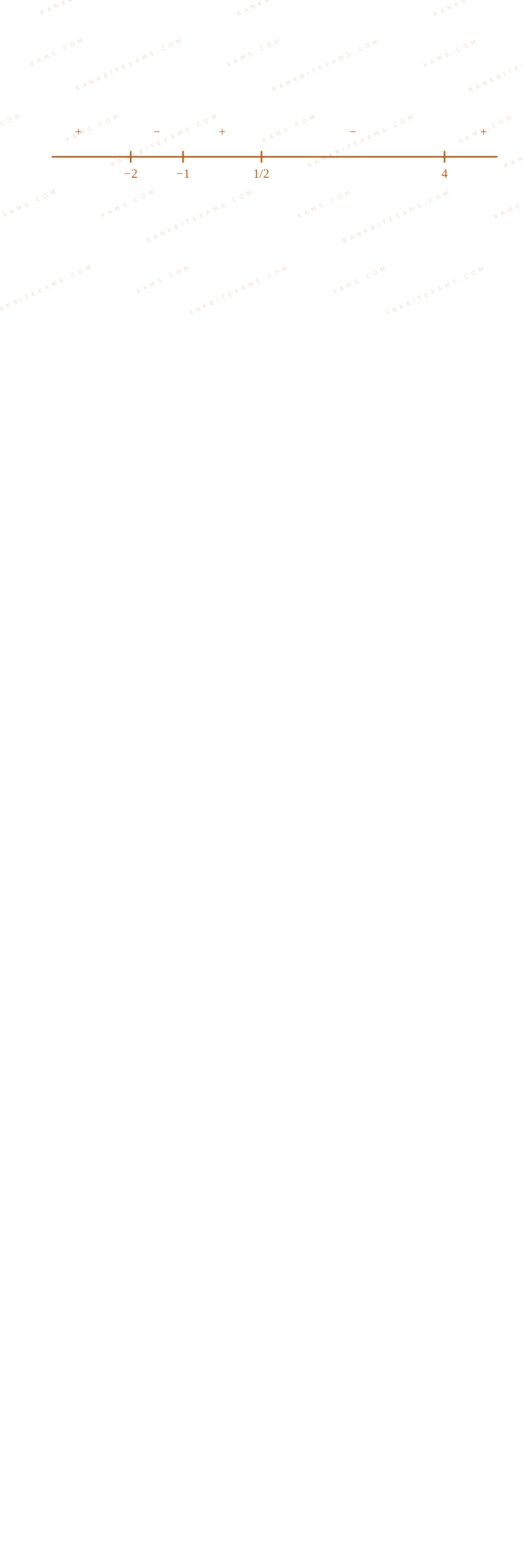
Critical points are x = -frac32, -1, frac34$x = -\frac{3}{2}, -1, \frac{3}{4}$. Using the wavy curve method:
The intervals where it is positive are left(-frac32, -1right) cup left(frac34, inftyright)$\left(-\frac{3}{2}, -1\right) \cup \left(\frac{3}{4}, \infty\right)$. Let this be set D_1$D_1$.
### Step 1: Inverse Trigonometric Domain
Condition 2: Arc cosine domain
-1 le frac2x - 1x + 2 le 1$-1 \le \frac{2x - 1}{x + 2} \le 1$
This breaks into two inequalities:
(i) frac2x - 1x + 2 ge -1 Rightarrow frac2x - 1x + 2 + 1 ge 0 Rightarrow frac3x + 1x + 2 ge 0$\frac{2x - 1}{x + 2} \ge -1 \Rightarrow \frac{2x - 1}{x + 2} + 1 \ge 0 \Rightarrow \frac{3x + 1}{x + 2} \ge 0$
Critical points are x = -2, -frac13$x = -2, -\frac{1}{3}$. The valid set is (-infty, -2) cup left[-frac13, inftyright)$(-\infty, -2) \cup \left[-\frac{1}{3}, \infty\right)$.
(ii) frac2x - 1x + 2 le 1 Rightarrow frac2x - 1x + 2 - 1 le 0 Rightarrow fracx - 3x + 2 le 0$\frac{2x - 1}{x + 2} \le 1 \Rightarrow \frac{2x - 1}{x + 2} - 1 \le 0 \Rightarrow \frac{x - 3}{x + 2} \le 0$
Critical points are x = -2, 3$x = -2, 3$. The valid set is (-2, 3]$(-2, 3]$.
Intersection for the cosine domain (D_2$D_2$): (-2, 3] cap left( (-infty, -2) cup left[-frac13, inftyright) right) = left[-frac13, 3right]$(-2, 3] \cap \left( (-\infty, -2) \cup \left[-\frac{1}{3}, \infty\right) \right) = \left[-\frac{1}{3}, 3\right]$.
### Step 2: Finding Total Domain
Total domain D = D_1 cap D_2$D = D_1 \cap D_2$:
D = left( left(-frac32, -1right) cup left(frac34, inftyright) right) cap left[-frac13, 3right]$D = \left( \left(-\frac{3}{2}, -1\right) \cup \left(\frac{3}{4}, \infty\right) \right) \cap \left[-\frac{1}{3}, 3\right]$
Since left[-frac13, 3right]$\left[-\frac{1}{3}, 3\right]$ starts strictly greater than -1$-1$, the overlap with left(-frac32, -1right)$\left(-\frac{3}{2}, -1\right)$ is empty.
Overlap with left(frac34, inftyright)$\left(\frac{3}{4}, \infty\right)$ occurs from frac34$\frac{3}{4}$ to 3$3$.
Thus, D = left(frac34, 3right]$D = \left(\frac{3}{4}, 3\right]$.
### Step 3: Calculating Final Expression
Comparing with (alpha, beta]$(\alpha, \beta]$:
alpha = frac34$\alpha = \frac{3}{4}$ and beta = 3$\beta = 3$.
We need to find 5beta - 4alpha$5\beta - 4\alpha$:
5(3) - 4left(frac34right) = 15 - 3 = 12$5(3) - 4\left(\frac{3}{4}\right) = 15 - 3 = 12$
### Pattern Recognition
Compound domains always require individual set resolution (using Wavy Curve) followed by taking the strictest absolute intersection. Identifying disjoint segments (like x lt -1$x \lt -1$ missing the cosine bound) prunes manual checking.
### Evaluation Rubric / Model Answer
null
### Chapter Mix
Class 11 Maths: Functions
More Functions Previous-Year Questions — Page 6
Q53
jee_main_2025_24_jan_morning
Functional Relations and Equations
Let f: mathbbR - \0\ to mathbbR$f: \mathbb{R} - \{0\} \to \mathbb{R}$ be a function such that
f(x) - 6fleft(frac1xright) = frac353x - frac52$f(x) - 6f\left(\frac{1}{x}\right) = \frac{35}{3x} - \frac{5}{2}$
If lim_x to 0 left( frac1alpha x + f(x) right) = beta$\lim_{x \to 0} \left( \frac{1}{\alpha x} + f(x) \right) = \beta$ for some alpha, beta in mathbbR$\alpha, \beta \in \mathbb{R}$, then alpha + 2beta$\alpha + 2\beta$ is equal to :
- A. 3$3$
- B. 5$5$
- C. 4$4$
- D. 6$6$
Solution
### Related Formula
For functional equations with inversion, substituting x to frac1x$x \to \frac{1}{x}$ establishes a solvable system of algebraic equations to isolate f(x)$f(x)$ directly.
### Core Logic
The given equation is:
f(x) - 6fleft(frac1xright) = frac353x - frac52 quad dots (1)$f(x) - 6f\left(\frac{1}{x}\right) = \frac{35}{3x} - \frac{5}{2} \quad \dots (1)$
Substitute x to frac1x$x \to \frac{1}{x}$ in equation (1):
fleft(frac1xright) - 6f(x) = frac35x3 - frac52 quad dots (2)$f\left(\frac{1}{x}\right) - 6f(x) = \frac{35x}{3} - \frac{5}{2} \quad \dots (2)$
### Step 1: Eliminate f(1/x)$f(1/x)$
Multiply equation (2) by 6$6$ and add it to equation (1):
left[ f(x) - 6fleft(frac1xright) right] + 6 left[ fleft(frac1xright) - 6f(x) right] = left( frac353x - frac52 right) + 6 left( frac35x3 - frac52 right)$\left[ f(x) - 6f\left(\frac{1}{x}\right) \right] + 6 \left[ f\left(\frac{1}{x}\right) - 6f(x) \right] = \left( \frac{35}{3x} - \frac{5}{2} \right) + 6 \left( \frac{35x}{3} - \frac{5}{2} \right)$
f(x) - 36f(x) = frac353x - frac52 + 70x - 15$f(x) - 36f(x) = \frac{35}{3x} - \frac{5}{2} + 70x - 15$
-35f(x) = 70x + frac353x - frac352$-35f(x) = 70x + \frac{35}{3x} - \frac{35}{2}$
Divide across by -35$-35$:
f(x) = -2x - frac13x + frac12$f(x) = -2x - \frac{1}{3x} + \frac{1}{2}$
### Step 2: Evaluate the Limit
We are given that the following limit evaluates to a finite constant beta$\beta$:
lim_x to 0 left( frac1alpha x + f(x) right) = beta$\lim_{x \to 0} \left( \frac{1}{\alpha x} + f(x) \right) = \beta$
lim_x to 0 left( frac1alpha x - 2x - frac13x + frac12 right) = beta$\lim_{x \to 0} \left( \frac{1}{\alpha x} - 2x - \frac{1}{3x} + \frac{1}{2} \right) = \beta$
lim_x to 0 left( left[ frac1alpha - frac13 right] frac1x - 2x + frac12 right) = beta$\lim_{x \to 0} \left( \left[ \frac{1}{\alpha} - \frac{1}{3} \right] \frac{1}{x} - 2x + \frac{1}{2} \right) = \beta$
For the limit to be a finite value, the coefficient of frac1x$\frac{1}{x}$ must vanish completely:
frac1alpha - frac13 = 0 implies alpha = 3$\frac{1}{\alpha} - \frac{1}{3} = 0 \implies \alpha = 3$
When alpha = 3$\alpha = 3$, the limit simplifies directly to the constant term:
beta = lim_x to 0 left( -2x + frac12 right) = frac12$\beta = \lim_{x \to 0} \left( -2x + \frac{1}{2} \right) = \frac{1}{2}$
### Step 3: Calculate Final Value
Substitute the determined parameters alpha$\alpha$ and beta$\beta$:
alpha + 2beta = 3 + 2left(frac12right) = 3 + 1 = 4$\alpha + 2\beta = 3 + 2\left(\frac{1}{2}\right) = 3 + 1 = 4$
### Pattern Recognition
In limit problems involving fractional components where x to 0$x \to 0$, any term like frac1x$\frac{1}{x}$ or higher negative powers must have a net coefficient of zero to guarantee existence of a finite limit value.
### Evaluation Rubric / Model Answer
null
### Chapter Mix
Class 11 Mathematics: Functions
Class 11 Mathematics: Limits and Derivatives
Q55
jee_main_2025_24_jan_morning
Symmetric Property of Functions
Let f(x) = frac2^x + 2 + 162^2x + 1 + 2^x + 4 + 32$f(x) = \frac{2^{x + 2} + 16}{2^{2x + 1} + 2^{x + 4} + 32}$ . Then the value of 8left(fleft(frac115
ight) + fleft(frac215
ight) + ldots + fleft(frac5915
ight)
ight)$8\left(f\left(\frac{1}{15}
ight) + f\left(\frac{2}{15}
ight) + \ldots + f\left(\frac{59}{15}
ight)
ight)$ is equal to :
- A. 118$118$
- B. 92$92$
- C. 102$102$
- D. 108$108$
Solution
### Related Formula
Many finite fractional sum questions involving functional terms rely on identifying an underlying symmetric summation invariant, typically of the form f(x) + f(k-x) = textconstant$f(x) + f(k-x) = \text{constant}$.
### Core Logic
First simplify the expression for f(x)$f(x)$ algebraically:
f(x) = frac4 cdot 2^x + 162 cdot (2^x)^2 + 16 cdot 2^x + 32$f(x) = \frac{4 \cdot 2^x + 16}{2 \cdot (2^x)^2 + 16 \cdot 2^x + 32}$
Factor out 4$4$ from the numerator and 2$2$ from the denominator:
f(x) = frac4(2^x + 4)2[(2^x)^2 + 8 cdot 2^x + 16] = frac2(2^x + 4)(2^x + 4)^2 = frac22^x + 4$f(x) = \frac{4(2^x + 4)}{2[(2^x)^2 + 8 \cdot 2^x + 16]} = \frac{2(2^x + 4)}{(2^x + 4)^2} = \frac{2}{2^x + 4}$
### Step 1: Establish Symmetry Pairings
Let's check the value of f(x) + f(4-x)$f(x) + f(4-x)$:
f(4-x) = frac22^4-x + 4 = frac2frac162^x + 4 = frac2 cdot 2^x16 + 4 cdot 2^x = frac2 cdot 2^x4(2^x + 4) = frac2^x2(2^x + 4)$f(4-x) = \frac{2}{2^{4-x} + 4} = \frac{2}{\frac{16}{2^x} + 4} = \frac{2 \cdot 2^x}{16 + 4 \cdot 2^x} = \frac{2 \cdot 2^x}{4(2^x + 4)} = \frac{2^x}{2(2^x + 4)}$
Now compute the sum directly:
f(x) + f(4-x) = frac22^x + 4 + frac2^x2(2^x + 4) = frac4 + 2^x2(2^x + 4) = frac12$f(x) + f(4-x) = \frac{2}{2^x + 4} + \frac{2^x}{2(2^x + 4)} = \frac{4 + 2^x}{2(2^x + 4)} = \frac{1}{2}$
Hence, whenever two input arguments sum up to 4$4$, the sum of their functional values is exactly frac12$\frac{1}{2}$.
### Step 2: Group the Finite Series Terms
Consider the terms inside the requested sequence:
frac115 + frac5915 = frac6015 = 4 implies fleft(frac115
ight) + fleft(frac5915
ight) = frac12$\frac{1}{15} + \frac{59}{15} = \frac{60}{15} = 4 \implies f\left(\frac{1}{15}
ight) + f\left(\frac{59}{15}
ight) = \frac{1}{2}$
frac215 + frac5815 = frac6015 = 4 implies fleft(frac215
ight) + fleft(frac5815
ight) = frac12$\frac{2}{15} + \frac{58}{15} = \frac{60}{15} = 4 \implies f\left(\frac{2}{15}
ight) + f\left(\frac{58}{15}
ight) = \frac{1}{2}$
This complementary pairing continues up to:
fleft(frac2915
ight) + fleft(frac3115
ight) = frac12$f\left(\frac{29}{15}
ight) + f\left(\frac{31}{15}
ight) = \frac{1}{2}$
This yields exactly 29$29$ distinct pairs. The single middle term left unpaired corresponds to:
textMiddle Term = fleft(frac3015
ight) = f(2) = frac22^2 + 4 = frac28 = frac14$\text{Middle Term} = f\left(\frac{30}{15}
ight) = f(2) = \frac{2}{2^2 + 4} = \frac{2}{8} = \frac{1}{4}$
### Step 3: Evaluate Final Expression
Compute the total value by multiplying the grouped sum by 8:
textTotal = 8 cdot left[ 29 cdot left(frac12right) + frac14 right]$\text{Total} = 8 \cdot \left[ 29 \cdot \left(\frac{1}{2}\right) + \frac{1}{4} \right]$
textTotal = 8 cdot frac292 + 8 cdot frac14 = 116 + 2 = 118$\text{Total} = 8 \cdot \frac{29}{2} + 8 \cdot \frac{1}{4} = 116 + 2 = 118$
### Pattern Recognition
Whenever a symmetric set of arguments is presented inside a summation matching frackn + fracN-kn = textconstant$\frac{k}{n} + \frac{N-k}{n} = \text{constant}$, look for an algebraic reduction of f(x)$f(x)$ that yields a uniform constant sum for symmetric pairs.
### Evaluation Rubric / Model Answer
null
### Chapter Mix
Class 11 Mathematics: Functions
Q64
jee_main_2025_28_jan_evening
Range and Onto Functions
Let f:[0,3]rightarrow A$f:[0,3]\rightarrow A$ be defined by f(x)=2x^3-15x^2+36x+7$f(x)=2x^{3}-15x^{2}+36x+7$ and g:[0,infty)rightarrow B$g:[0,\infty)\rightarrow B$ be defined by g(x)=fracx^2025x^2025+1$g(x)=\frac{x^{2025}}{x^{2025}+1}$. If both the functions are onto and S=\xin Z:xin Atext or xin B\$S=\{x\in Z:x\in A\text{ or }x\in B\}$, then n(S)$n(S)$ is equal to:
- A. 30$30$
- B. 36$36$
- C. 29$29$
- D. 31$31$
Solution
### Related Formula
For a function to be onto, its Codomain must equal its Range.
### Core Logic
First, find range A$A$ for f(x) = 2x^3 - 15x^2 + 36x + 7$f(x) = 2x^3 - 15x^2 + 36x + 7$ over [0, 3]$[0, 3]$.
Differentiating f(x)$f(x)$:
f'(x) = 6x^2 - 30x + 36 = 6(x^2 - 5x + 6) = 6(x-2)(x-3)$f'(x) = 6x^2 - 30x + 36 = 6(x^2 - 5x + 6) = 6(x-2)(x-3)$
Critical points are x=2$x=2$ and x=3$x=3$.
Evaluate f(x)$f(x)$ at boundary and critical points:
- f(0) = 7$f(0) = 7$
- f(2) = 2(8) - 15(4) + 36(2) + 7 = 16 - 60 + 72 + 7 = 35$f(2) = 2(8) - 15(4) + 36(2) + 7 = 16 - 60 + 72 + 7 = 35$
- f(3) = 2(27) - 15(9) + 36(3) + 7 = 54 - 135 + 108 + 7 = 34$f(3) = 2(27) - 15(9) + 36(3) + 7 = 54 - 135 + 108 + 7 = 34$
Thus, Range A = [7, 35]$A = [7, 35]$.
### Step 1: Find Range B for g(x)
Now look at g(x) = fracx^2025x^2025+1 = 1 - frac1x^2025+1$g(x) = \frac{x^{2025}}{x^{2025}+1} = 1 - \frac{1}{x^{2025}+1}$ over [0, infty)$[0, \infty)$.
- At x = 0$x = 0$, g(0) = 0$g(0) = 0$.
- As x to infty$x \to \infty$, g(x) to 1$g(x) \to 1$.
Since g(x)$g(x)$ is continuous and monotonically strictly increasing, Range B = [0, 1)$B = [0, 1)$.
### Step 2: Find the Integer Count of Union Set S
S = \x in mathbbZ : x in A text or x in B\ = mathbbZ cap (A cup B)$S = \{x \in \mathbb{Z} : x \in A \text{ or } x \in B\} = \mathbb{Z} \cap (A \cup B)$
A cup B = [0, 1) cup [7, 35]$A \cup B = [0, 1) \cup [7, 35]$
The integers in this set are:
- From [0, 1)$[0, 1)$: x = 0$x = 0$
- From [7, 35]$[7, 35]$: x = 7, 8, 9, dots, 35$x = 7, 8, 9, \dots, 35$
Total number of integers n(S)$n(S)$:
n(S) = 1 + (35 - 7 + 1) = 1 + 29 = 30$n(S) = 1 + (35 - 7 + 1) = 1 + 29 = 30$
### Pattern Recognition
The condition 'or' means union. Be careful not to include integers between 1$1$ and 6$6$ since they are not present in either continuous range segment.
### Evaluation Rubric / Model Answer
null
### Chapter Mix
Class 12 Mathematics: Functions
Class 12 Mathematics: Application of Derivatives
Q65
jee_main_2025_28_jan_evening
Domain of Inverse Trigonometric Functions
Let [x] denote the greatest integer less than or equal to x. Then domain of f(x)=sec^-1(2[x]+1)$f(x)=\sec^{-1}(2[x]+1)$ is:
- A. (-infty,-1]cup[0,infty)$(-\infty,-1]\cup[0,\infty)$
- B. (-infty,infty)$(-\infty,\infty)$
- C. (-infty,-1]cup[1,infty)$(-\infty,-1]\cup[1,\infty)$
- D. (-infty,infty)-\0\$(-\infty,\infty)-\{0\}$
Solution
### Related Formula
The domain of sec^-1(y)$\sec^{-1}(y)$ is given by |y| ge 1$|y| \ge 1$, which means:
y le -1 quad textor quad y ge 1$y \le -1 \quad \text{or} \quad y \ge 1$
### Core Logic
For f(x) = sec^-1(2[x]+1)$f(x) = \sec^{-1}(2[x]+1)$ to be defined:
2[x] + 1 le -1 quad textor quad 2[x] + 1 ge 1$2[x] + 1 \le -1 \quad \text{or} \quad 2[x] + 1 \ge 1$
### Step 1: Solve individual inequalities
Case 1:
2[x] + 1 le -1 implies 2[x] le -2 implies [x] le -1$2[x] + 1 \le -1 \implies 2[x] \le -2 \implies [x] \le -1$
This holds true for all x < 0$x < 0$, i.e., x in (-infty, 0)$x \in (-\infty, 0)$.
Case 2:
2[x] + 1 ge 1 implies 2[x] ge 0 implies [x] ge 0$2[x] + 1 \ge 1 \implies 2[x] \ge 0 \implies [x] \ge 0$
This holds true for all x ge 0$x \ge 0$, i.e., x in [0, infty)$x \in [0, \infty)$.
### Step 2: Take Union of the Solutions
textDomain = (-infty, 0) cup [0, infty) = (-infty, infty)$\text{Domain} = (-\infty, 0) \cup [0, \infty) = (-\infty, \infty)$
### Pattern Recognition
Since [x]$[x]$ covers all integer values and 2[x]+1$2[x]+1$ forms all odd integer values, the expression inside sec^-1$\sec^{-1}$ is always a non-zero integer. Non-zero integers always have absolute value ge 1$\ge 1$. Hence, it is valid for all real numbers.
### Evaluation Rubric / Model Answer
null
### Chapter Mix
Class 11 Mathematics: Functions
Class 12 Mathematics: Inverse Trigonometric Functions
Q70
jee_main_2025_28_jan_evening
Functional Equations
Let f:R-\0\rightarrow(-infty,1]$f:R-\{0\}\rightarrow(-\infty,1]$ be a polynomial of degree 2, satisfying f(x)fleft(frac1xright)=f(x)+fleft(frac1xright).$f(x)f\left(\frac{1}{x}\right)=f(x)+f\left(\frac{1}{x}\right).$ If f(K)=-2K$f(K)=-2K$ then the sum of squares of all possible values of K is:
- A. 1$1$
- B. 6$6$
- C. 7$7$
- D. 9$9$
Solution
### Related Formula
Standard result for functional equation of a polynomial satisfying f(x)f(1/x) = f(x) + f(1/x)$f(x)f(1/x) = f(x) + f(1/x)$:
f(x) = 1 pm x^n$f(x) = 1 \pm x^n$
### Core Logic
Given that f(x)$f(x)$ is a polynomial of degree 2, the identity implies:
f(x) = 1 + x^2 quad textor quad f(x) = 1 - x^2$f(x) = 1 + x^2 \quad \text{or} \quad f(x) = 1 - x^2$
We are given the range is bounded above: (-infty, 1]$(-\infty, 1]$.
- For 1 + x^2$1 + x^2$, the range is [1, infty)$[1, \infty)$.
- For 1 - x^2$1 - x^2$, the range is (-infty, 1]$(-\infty, 1]$.
Therefore, the correct functional form is f(x) = 1 - x^2$f(x) = 1 - x^2$.
### Step 1: Solve for K
Given condition: f(K) = -2K$f(K) = -2K$
1 - K^2 = -2K implies K^2 - 2K - 1 = 0$1 - K^2 = -2K \implies K^2 - 2K - 1 = 0$
Let the roots of this equation be K_1$K_1$ and K_2$K_2$.
From quadratic properties (Vieta's formulas):
K_1 + K_2 = 2$K_1 + K_2 = 2$
K_1 cdot K_2 = -1$K_1 \cdot K_2 = -1$
### Step 2: Calculate Sum of Squares
We need the sum of squares of the values of K:
K_1^2 + K_2^2 = (K_1 + K_2)^2 - 2K_1K_2$K_1^2 + K_2^2 = (K_1 + K_2)^2 - 2K_1K_2$
K_1^2 + K_2^2 = (2)^2 - 2(-1) = 4 + 2 = 6$K_1^2 + K_2^2 = (2)^2 - 2(-1) = 4 + 2 = 6$
### Pattern Recognition
The functional equation f(x)f(1/x)=f(x)+f(1/x)$f(x)f(1/x)=f(x)+f(1/x)$ uniquely forces polynomials to be 1 pm x^n$1 \pm x^n$. Remembering this shortcut saves valuable time required to derive the template from general coefficients.
### Evaluation Rubric / Model Answer
null
### Chapter Mix
Class 11 Mathematics: Complex Numbers and Quadratic Equations
Class 12 Mathematics: Functions