JEE Main · Mathematics ↓ Falling

Differential Equations appeared 46 times across 3 years — 5.3% of Mathematics. This question is from Linear Differential Equation.

Year 2026 2025 2024 Total
Questions 13 17 16 46

Let Y = Y(X) be a curve lying in the first quadrant such that the area enclosed by the line Y - y = Y'(x)(X - x) and the co-ordinate axes, where (x, y) is any point on the curve, is always (-y²)/(2Y'(x)) + 1 , Y'(x) ≠ 0 . If Y(1) = 1 , then 12Y(2) equals

Numerical Answer Type:
Enter a numerical value Answer: 20 to 20 +4 marks

Solution & Explanation

Related Formula
Equation of tangent at (x, y): Y - y = (dy)/(dx)(X - x) Area of Right Triangle: (1)/(2) × base × height
Core Logic

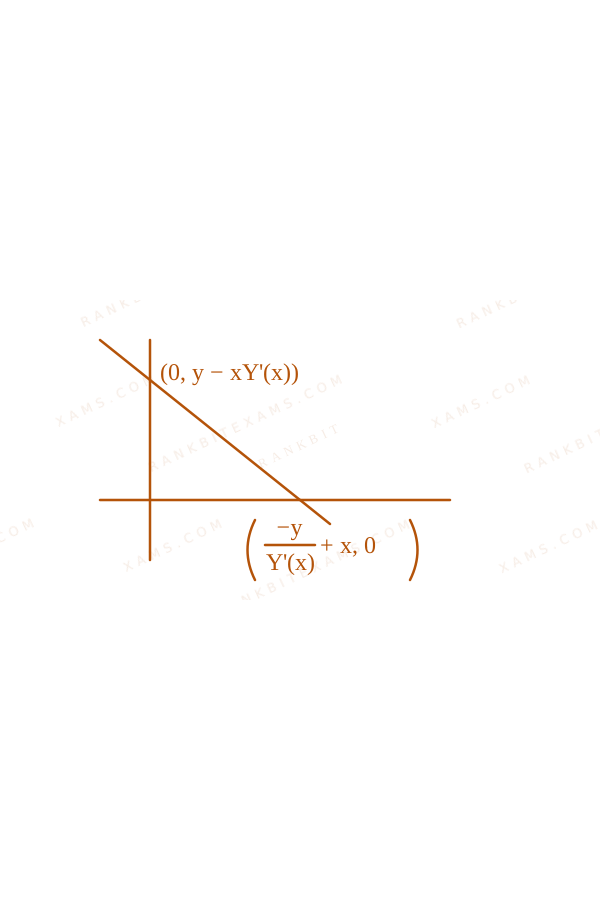
The line Y - y = y'(X - x) intersects the axes to form a triangle. Let's find the intercepts: X-intercept (set Y=0): -y = y'(X - x) ⇒ X = x - (y)/(y') Y-intercept (set X=0): Y - y = y'(-x) ⇒ Y = y - xy'

The area of the triangle bounded by the coordinate axes is:

Area = (1)/(2) ( x - (y)/(y') ) (y - xy') = (-y²)/(2y') + 1

Linear Differential Equation diagram for Q21 - JEE Main 2024 Evening

Step 1: Setting up the Differential Equation

Expand the Area equation:

(1)/(2) [ xy - x²y' - (y²)/(y') + xy ] = (-y²)/(2y') + 1

Multiply by 2:

2xy - x²y' - (y²)/(y') = -(y²)/(y') + 2

Cancel -(y²)/(y') from both sides: 2xy - x²y' = 2

Step 2: Solving the Linear Differential Equation

Rearrange into standard LDE form:

x² (dy)/(dx) - 2xy = -2 (dy)/(dx) - (2)/(x)y = -(2)/(x²)

Find the Integrating Factor (IF):

I.F. = e∫ -(2)/(x) dx = e-2ln x = x⁻² = (1)/(x²)

Multiply the LDE by the IF:

y · (1)/(x²) = ∫ ( -(2)/(x²) ) (1)/(x²) dx + C y x⁻² = -2 ∫ x⁻⁴ dx + C y x⁻² = -2 ( x⁻³-3 ) + C (y)/(x²) = (2)/(3x³) + C y = (2)/(3x) + Cx²
Step 3: Applying Initial Conditions

Given Y(1) = 1 (i.e., when x=1, y=1):

1 = (2)/(3(1)) + C(1)² ⇒ 1 = (2)/(3) + C ⇒ C = (1)/(3)

Thus, the curve is:

y = (2)/(3x) + (x²)/(3)

We need to find 12Y(2):

Y(2) = (2)/(3(2)) + (2²)/(3) = (1)/(3) + (4)/(3) = (5)/(3) 12Y(2) = 12 ( (5)/(3) ) = 4 × 5 = 20
Pattern Recognition

Geometrical word problems forming an Area differential equation almost always reduce to a first-order Linear Differential Equation (LDE) or an Exact differential form once you cleanly substitute the axis intercepts.

Chapter Mix

Class 12 Maths: Differential Equations Class 12 Maths: Application of Derivatives

Reference Study Guides

More Differential Equations Previous-Year Questions — Page 9

Q9 jee_main_2024_30_jan_morning Linear Differential Equations
Let y = y(x) be the solution of the differential equation x dy + 2(1 - x) x + x(2 - x) dx = 0 such that y(0) = 2. Then y(2) is equal to:
  • A. 2
  • B. 21 - (2)
  • C. 2 (2) + 1
  • D. 1

Solution

Related Formula
d(u · v) = u dv + v du
Core Logic

Given the differential equation:

x dy + 2(1 - x) x + (2x - x²) dx = 0

Divide entirely by x (which is 1/ x):

dy + 2(1 - x) x + (2x - x²) x dx = 0

Rearranging it as an exact differential form:

(dy)/(dx) = 2(x - 1) x + (x² - 2x) x
Step 1: Integration using By-Parts

Now integrate both sides:

y(x) = ∫ 2(x - 1) x dx + ∫ (x² - 2x) x dx

Apply integration by parts on the second integral, where u = x² - 2x and dv = x dx:

∫ (x² - 2x) x dx = (x² - 2x)( x) - ∫ (2x - 2) x dx

Substituting this back into y(x):

y(x) = ∫ 2(x - 1) x dx + [ (x² - 2x) x - ∫ 2(x - 1) x dx ] + λ

The integrals cancel out perfectly:

y(x) = (x² - 2x) x + λ
Step 2: Finding Constant and Final Value

Use the initial condition y(0) = 2:

y(0) = 0 + λ ⇒ λ = 2

Thus, the solution is:

y(x) = (x² - 2x) x + 2

To find y(2):

y(2) = (2² - 2(2)) 2 + 2 = (4 - 4) 2 + 2 = 2
Pattern Recognition

When an integrand is a mix of polynomial and trigonometric terms, grouping them to form an exact differential or observing that integration by parts on one term perfectly cancels the other term is a classic structural trick.

Chapter Mix

Class 12 Maths: Differential Equations Class 12 Maths: Integrals

Q27 jee_main_2024_30_jan_morning Linear Differential Equations
Let y = y(x) be the solution of the differential equation (1 - x²) dy = [ xy + (x³ + 2)√(3(1 - x²)) ] dx, -1 < x < 1, y(0) = 0. If y((1)/(2)) = (m)/(n), m and n are co-prime numbers, then m + n is equal to
Numerical Answer. Answer: 97 to 97

Solution

Related Formula

For a linear differential equation (dy)/(dx) + P(x)y = Q(x):

IF = e∫ P(x) dx

Solution: y · IF = ∫ Q(x) · IF dx + C

Core Logic

Rearrange the given differential equation into standard linear form:

(1 - x²) (dy)/(dx) = xy + (x³ + 2)√(3(1 - x²)) (dy)/(dx) - (x)/(1 - x²) y = (x³ + 2)√(3(1 - x²))1 - x² (dy)/(dx) - (x)/(1 - x²) y = √(3)(x³ + 2)√(1 - x²)

Identify P(x) = -(x)/(1 - x²).

Step 1: Finding Integrating Factor (IF)
IF = e∫ -(x)/(1 - x²) dx

Let 1 - x² = t ⇒ -2x dx = dt ⇒ -x dx = (dt)/(2).

IF = e(1)/(2) ∫ (1)/(t) dt = e(1)/(2) ln t = eln √(t) = √(1 - x²)
Step 2: General Solution

The solution is given by:

y √(1 - x²) = ∫ ( √(3)(x³ + 2)√(1 - x²) ) √(1 - x²) dx + C y √(1 - x²) = √(3) ∫ (x³ + 2) dx + C y √(1 - x²) = √(3) ( (x⁴)/(4) + 2x ) + C
Step 3: Finding Constant C

Using y(0) = 0:

0 · 1 = √(3)(0 + 0) + C ⇒ C = 0

So, y(x) = √(3)√(1 - x²) ( (x⁴)/(4) + 2x ).

Step 4: Evaluating required point

Substitute x = 1/2:

y((1)/(2)) = √(3)√(1 - 1/4) ( (1/16)/(4) + 2((1)/(2)) )

Wait, ((1/2)⁴)/(4) = (1/16)/(4) = (1)/(64). Let's recheck the expression:

y((1)/(2)) = √(3)√(3/4) ( (1)/(64) + 1 ) = √(3)√(3)/2 ( (65)/(64) ) = 2 × (65)/(64) = (65)/(32)

Here, m = 65 and n = 32. They are co-prime. Thus, m + n = 65 + 32 = 97.

Pattern Recognition

Whenever roots matching the integration denominator appear on the RHS of a linear differential setup, it is a high-confidence signal that the integrating factor cleanly annihilates the fractional root component during the solution stage.

Chapter Mix

Class 12 Maths: Differential Equations

Q8 jee_main_2024_31_jan_evening Newton's Law of Cooling
The temperature T(t) of a body at time t = 0 is 160° F and it decreases continuously as per the differential equation dTdt = -K(T - 80), where K is positive constant. If T(15) = 120°F, then T(45) is equal to
  • A. 85°F
  • B. 95°F
  • C. 90oF
  • D. 80°F

Solution

Related Formula
∫ (dT)/(T-Tₛ) = -K ∫ dt ln|T-Tₛ| = -Kt + C
Core Logic

Given (dT)/(dt) = -K(T-80). Integrating from t=0 to t:

∫₁₆₀T (dT)/(T-80) = -K ∫₀^t dt [ln|T-80|]₁₆₀^T = -Kt ln((T-80)/(80)) = -Kt T(t) = 80 + 80e-Kt

Given T(15) = 120:

120 = 80 + 80e-15K 40 = 80e-15K e-15K = (1)/(2)

To find T(45):

T(45) = 80 + 80e-45K = 80 + 80(e-15K)³ = 80 + 80((1)/(2))³ = 80 + 80((1)/(8)) = 90
Chapter Mix

Class 12 Maths: Differential Equations

Q29 jee_main_2024_31_jan_evening Linear Differential Equations
Let y = y(x) be the solution of the differential equation ² x dx + ( e2y ² x + x ) dy = 0, 0 < x < (π)/(2), y((π)/(4)) = 0. If y((π)/(6)) = α. Then e8α is equal to
Numerical Answer. Answer: 9 to 9

Solution

Related Formula
Integrating factor for (du)/(dy) + P(y)u = Q(y) is I.F. = e∫ P(y)dy
Core Logic

Given DE: ² x (dx)/(dy) + e2y ² x + x = 0 Substitute t = x (dt)/(dy) = ² x (dx)/(dy). The DE becomes:

(dt)/(dy) + t = -t² e2y

This is a Bernoulli equation in t. Divide by t²:

(1)/(t²)(dt)/(dy) + (1)/(t) = -e2y

Substitute u = (1)/(t) (du)/(dy) = -(1)/(t²)(dt)/(dy).

-(du)/(dy) + u = -e2y (du)/(dy) - u = e2y

This is a linear DE in u with respect to y. P(y) = -1, Q(y) = e2y. Integrating Factor: I.F. = e∫ -1 dy = e-y. Solution:

u e-y = ∫ e2y e-y dy = ∫ e^y dy = e^y + C

Substitute u = (1)/( x):

e-y x = e^y + C

Use given condition y(π/4) = 0:

(e⁰)/( (π/4)) = e⁰ + C 1 = 1 + C C = 0

Therefore, e-y x = e^y x = e-2y. Evaluate at x = π/6, y = α:

(π/6) = e-2α 1√(3) = e-2α e2α = √(3) (e2α)⁴ = (√(3))⁴ = 9

Thus, e8α = 9.

Chapter Mix

Class 12 Maths: Differential Equations

Q9 jee_main_2024_31_jan_morning Homogeneous Differential Equations
The solution curve of the differential equation y(dx)/(dy) = x( ₑ x - ₑ y + 1), x > 0, y > 0 passing through the point (e, 1) is
  • A. | ₑ (y)/(x)| = x
  • B. | ₑ (y)/(x)| = y²
  • C. | ₑ (x)/(y)| = y
  • D. 2| ₑ (x)/(y)| = y + 1

Solution

Core Logic

Given DE: (dx)/(dy) = (x)/(y) (ln((x)/(y)) + 1) Let (x)/(y) = t x = ty. Differentiating w.r.t y:

(dx)/(dy) = t + y(dt)/(dy)
Step 1: Substitution and Integration
t + y(dt)/(dy) = t(ln(t) + 1) = tln t + t y(dt)/(dy) = tln t (dt)/(tln t) = (dy)/(y)

Integrate both sides. Let ln t = p (1)/(t) dt = dp.

∫ (dp)/(p) = ∫ (dy)/(y) ln|p| = ln y + C ln|ln t| = ln y + C ln|ln((x)/(y))| = ln y + C
Step 2: Applying Boundary Conditions

Given curve passes through (e, 1):

ln|ln((e)/(1))| = ln(1) + C C = 0 ln|ln((x)/(y))| = ln y |ln((x)/(y))| = eln y = y
Chapter Mix

Class 12 Maths: Differential Equations

More Differential Equations Questions — jee_main_2024_30_january_evening

Practice all Differential Equations previous-year questions →

Rankbit System
JEE Physics: Waves (+15.5%) | Electrostatics: Concentric Shells (-29.7%) | Modern Physics: Photoelectric Clones (+34.2%) | Mathematics: Definite Integrals (+18.1%) | Chemistry: Coordination Splitting (-11.4%) | JEE Physics: Waves (+15.5%) | Electrostatics: Concentric Shells (-29.7%) | Modern Physics: Photoelectric Clones (+34.2%) | Mathematics: Definite Integrals (+18.1%) | Chemistry: Coordination Splitting (-11.4%)