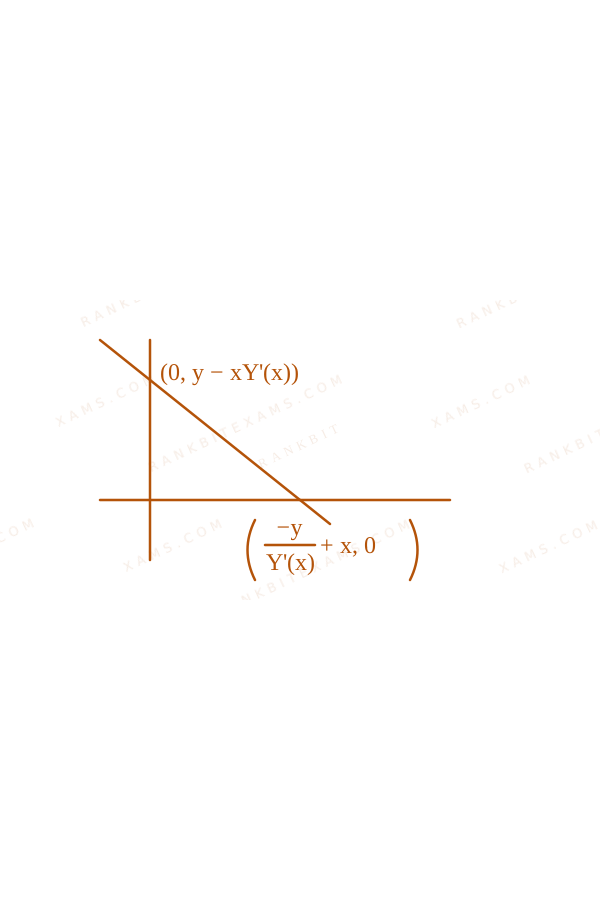
Let Y = Y(X)$Y = Y(X)$ be a curve lying in the first quadrant such that the area enclosed by the line Y - y = Y'(x)(X - x)$Y - y = Y'(x)(X - x)$ and the co-ordinate axes, where (x, y)$(x, y)$ is any point on the curve, is always (-y²)/(2Y'(x)) + 1$\frac{-y^2}{2Y'(x)} + 1$ , Y'(x) ≠ 0$Y'(x) \neq 0$ . If Y(1) = 1$Y(1) = 1$ , then 12Y(2)$12Y(2)$ equals
Numerical Answer Type:
Enter a numerical valueAnswer: 20 to 20+4 marks
Solution & Explanation
Related Formula
Equation of tangent at (x, y): Y - y = (dy)/(dx)(X - x)$$\text{Equation of tangent at } (x, y): Y - y = \frac{dy}{dx}(X - x)$$Area of Right Triangle: (1)/(2) × base × height$$\text{Area of Right Triangle: } \frac{1}{2} \times \text{base} \times \text{height}$$
Core Logic
The line Y - y = y'(X - x)$Y - y = y'(X - x)$ intersects the axes to form a triangle.
Let's find the intercepts:
X-intercept (set Y=0$Y=0$): -y = y'(X - x) ⇒ X = x - (y)/(y')$-y = y'(X - x) \Rightarrow X = x - \frac{y}{y'}$
Y-intercept (set X=0$X=0$): Y - y = y'(-x) ⇒ Y = y - xy'$Y - y = y'(-x) \Rightarrow Y = y - xy'$
The area of the triangle bounded by the coordinate axes is:
Area = (1)/(2) ( x - (y)/(y') ) (y - xy') = (-y²)/(2y') + 1$$\text{Area} = \frac{1}{2} \left( x - \frac{y}{y'} \right) (y - xy') = \frac{-y^2}{2y'} + 1$$
Linear Differential Equation diagram for Q21 - JEE Main 2024 Evening
Geometrical word problems forming an Area differential equation almost always reduce to a first-order Linear Differential Equation (LDE) or an Exact differential form once you cleanly substitute the axis intercepts.
Chapter Mix
Class 12 Maths: Differential Equations
Class 12 Maths: Application of Derivatives
Let f:(0,∞)arrow R$f:(0,\infty)\rightarrow R$ be a function which is differentiable at all points of its domain and satisfies the condition x²f(x)=2xf(x)+3,$x^{2}f^{\prime}(x)=2xf(x)+3,$ with f(1)=4$f(1)=4$ Then 2f(2)$2f(2)$ is equal to:
A.29$29$
B.19$19$
C.39$39$
D.23$23$
Solution
Related Formula
The quotient rule derivative identity is given by:
Recognizing the structure x² f'(x) - 2x f(x)$x^2 f'(x) - 2x f(x)$ as a partial quotient rule is faster than formatting it into standard linear order (dy)/(dx) + P(x)y = Q(x)$\frac{dy}{dx} + P(x)y = Q(x)$ format, though both methods lead to the identical integration parameters safely.
Chapter Mix
Class 12 Mathematics: Differential Equations
Q73jee_main_2025_24_jan_eveningLinear Differential Equations of First Order
Let y=y(x)$y=y(x)$ be the solution of the differential equation
2 x(dy)/(dx)= 2x-4y x, xin(0,(π)/(2))$2\cos x\frac{dy}{dx}=\sin 2x-4y\sin x, x\in\left(0,\frac{\pi}{2}\right)$
If y((π)/(3))=0$y\left(\frac{\pi}{3}\right)=0$ , then y((π)/(4))+y((π)/(4))$y^{\prime}\left(\frac{\pi}{4}\right)+y\left(\frac{\pi}{4}\right)$ is equal to \_\_\_\_.
Numerical Answer.Answer: 1
Solution
Related Formula
Standard first-order linear differential equation structure:
y · ² x = ∫ x · ² x dx = ∫ x x dx = x + C$$y \cdot \sec^2 x = \int \sin x \cdot \sec^2 x dx = \int \sec x \tan x dx = \sec x + C$$y = x + C ² x$$y = \cos x + C\cos^2 x$$
Step 3: Boundary Evaluation
Apply the initialization condition y((π)/(3)) = 0$y\left(\frac{\pi}{3}\right) = 0$:
0 = ((π)/(3)) + C ²((π)/(3)) ⇒ 0 = (1)/(2) + C((1)/(4)) ⇒ C = -2$$0 = \cos\left(\frac{\pi}{3}\right) + C\cos^2\left(\frac{\pi}{3}\right) \Rightarrow 0 = \frac{1}{2} + C\left(\frac{1}{4}\right) \Rightarrow C = -2$$
Thus, the solution is y = x - 2 ² x$y = \cos x - 2\cos^2 x$ .
Find derivative y$y\prime$ :
y = - x + 4 x x = - x + 2 2x$$y\prime = -\sin x + 4\cos x \sin x = -\sin x + 2\sin 2x$$
Step 4: Target Calculation
Evaluate components at x = (π)/(4)$x = \frac{\pi}{4}$ :
Let y = y(x)$y = y(x)$ be the solution of the differential equation ( xy - 5x²√(1 + x²) ) dx + (1 + x²) dy = 0$\left( xy - 5x^2\sqrt{1 + x^2} \right) dx + (1 + x^2) dy = 0$ with initial condition y(0) = 0$y(0) = 0$ . Then y(√(3))$y(\sqrt{3})$ is equal to :
A.5√(3)2$\frac{5\sqrt{3}}{2}$
B.√((14)/(3))$\sqrt{\frac{14}{3}}$
C.2√(2)$2\sqrt{2}$
D.√((15)/(2))$\sqrt{\frac{15}{2}}$
Solution
Related Formula
A linear differential equation of the first order matching (dy)/(dx) + P(x)y = Q(x)$\frac{dy}{dx} + P(x)y = Q(x)$ uses an Integrating Factor written as:
Spotting that multiplying across the differential equation format by √(1+x²)$\sqrt{1+x^2}$ converts the left hand side into a direct product rule derivative matching (d)/(dx)(y√(1+x²))$\frac{d}{dx}(y\sqrt{1+x^2})$ yields a direct integration pathway.
If y=y(x)$y=y(x)$ is the solution of the differential equation, 4-x²(dy)/(dx)=(( ⁻¹((x)/(2)))²-y) ⁻¹((x)/(2))$\sqrt{4-x^{2}}\frac{dy}{dx}=\left(\left(\sin^{-1}\left(\frac{x}{2}\right)\right)^{2}-y\right)\sin^{-1}\left(\frac{x}{2}\right)$-2≤ x≤2$-2\le x\le2$, y(2)=( π²-84)$y(2)=\left(\frac{\pi^{2}-8}{4}\right)$ then y²(0)$y^{2}(0)$ is equal to
Numerical Answer.Answer: 4 to 4
Solution
Related Formula
Standard first-order linear differential equation form:
Recognizing that the coefficient of y$y$ is precisely the derivative of (1)/(2)( ⁻¹(x/2))²$\frac{1}{2}(\sin^{-1}(x/2))^2$ makes computing the linear integrating factor simple.
Let y = y(x)$y = y(x)$ be the solution of the differential equation
x ( ₑ ( x))² dy + ( x - 3y x ₑ ( x)) dx = 0, x in (0, (π)/(2))$$\cos x (\log_e (\cos x))^2 \, dy + (\sin x - 3y \sin x \log_e (\cos x)) \, dx = 0, \quad x \in \left(0, \frac{\pi}{2}\right)$$
If y((π)/(4)) = (-1)/( ₑ 2)$y\left(\frac{\pi}{4}\right) = \frac{-1}{\log_e 2}$, then y((π)/(6))$y\left(\frac{\pi}{6}\right)$ is:
Logarithmic functions nested inside trigonometric terms generally point to substitution structures where ln( x)$\ln(\sec x)$ works cleanly alongside its derivative x dx$\tan x \, dx$.
Chapter Mix
Class 12 Mathematics: Differential Equations
More Differential Equations Questions — jee_main_2024_30_january_evening
Practice past-year questions one chapter at a time. Pick an exam → subject → chapter and get every PYQ for that topic — pulled together from all past papers — with the chapter's key formulas alongside.