Rankbit System
JEE Physics: Waves (+15.5%) | Electrostatics: Concentric Shells (-29.7%) | Modern Physics: Photoelectric Clones (+34.2%) | Mathematics: Definite Integrals (+18.1%) | Chemistry: Coordination Splitting (-11.4%) | JEE Physics: Waves (+15.5%) | Electrostatics: Concentric Shells (-29.7%) | Modern Physics: Photoelectric Clones (+34.2%) | Mathematics: Definite Integrals (+18.1%) | Chemistry: Coordination Splitting (-11.4%)

The correct stability order of carbocations is

Solution & Explanation

### Core Logic The stability of alkyl carbocations is primarily determined by the +I (inductive) effect of alkyl groups and hyperconjugation. 1. (mathrmCH_3)_3mathrmC^+ (tert-butyl carbocation) has 9 alpha-hydrogens, leading to 9 hyperconjugative structures. It is the most stable. 2. (mathrmCH_3)_2mathrmCH^+ (isopropyl carbocation) has 6 alpha-hydrogens. 3. mathrmCH_3-mathrmCH_2^+ (ethyl carbocation) has 3 alpha-hydrogens. 4. mathrmCH_3^+ (methyl carbocation) has 0 alpha-hydrogens and is the least stable. The greater the number of hyperconjugable hydrogens (alpha-hydrogens), the more stable the carbocation. ### Pattern Recognition Stability of alkyl carbocations: 3^circ > 2^circ > 1^circ > textmethyl due to hyperconjugation (+H) and inductive (+I) effects. ### Evaluation Rubric / Model Answer null ### Chapter Mix Class 11 Chemistry: Organic Chemistry Some Basic Principles and Techniques

More Organic Chemistry Some Basic Principles and Techniques Previous-Year Questions — Page 7

Q34 jee_main_2025_04_april_evening Purification of Organic Compounds
Match List-I with List-II -
List-I (Separation of)List-II (Separation Technique)
(A) Aniline from aniline-water mixture(I) Simple distillation
(B) Glycerol from spent-lye in soap industry(II) Fractional distillation
(C) Different fractions of crude oil in petroleum industry(III) Distillation at reduced pressure
(D) Chloroform-Aniline mixture(IV) Steam distillation
Choose the correct answer from the options given below:
  • A. (A)-(IV), (B)-(III), (C)-(II), (D)-(I)
  • B. (A)-(I), (B)-(II), (C)-(III), (D)-(IV)
  • C. (A)-(III), (B)-(IV), (C)-(I), (D)-(II)
  • D. (A)-(II), (B)-(I), (C)-(IV), (D)-(III)

Solution

### Core Logic Evaluating standard NCERT laboratory purification matches: - **(A) Aniline from aniline-water mixture:** Aniline is steam volatile and immiscible with water, so it is separated via **Steam distillation (IV)**. - **(B) Glycerol from spent-lye in soap industry:** Glycerol decomposes at or below its boiling point, hence it is separated via **Distillation at reduced pressure (III)**. - **(C) Different fractions of crude oil:** Separated using their small differences in boiling points via **Fractional distillation (II)**. - **(D) Chloroform-Aniline mixture:** Separated due to a substantial boiling point difference via **Simple distillation (I)**. ### Pattern Recognition Match key words directly: Glycerol/spent-lye always links to reduced pressure (vacuum distillation). Crude oil always couples to fractional columns. Aniline + water implies steam injection. ### Evaluation Rubric / Model Answer null ### Chapter Mix Class 11 Chemistry: Some Basic Principles of Organic Chemistry
Q43 jee_main_2025_04_april_evening Organic Reactions and Mechanisms
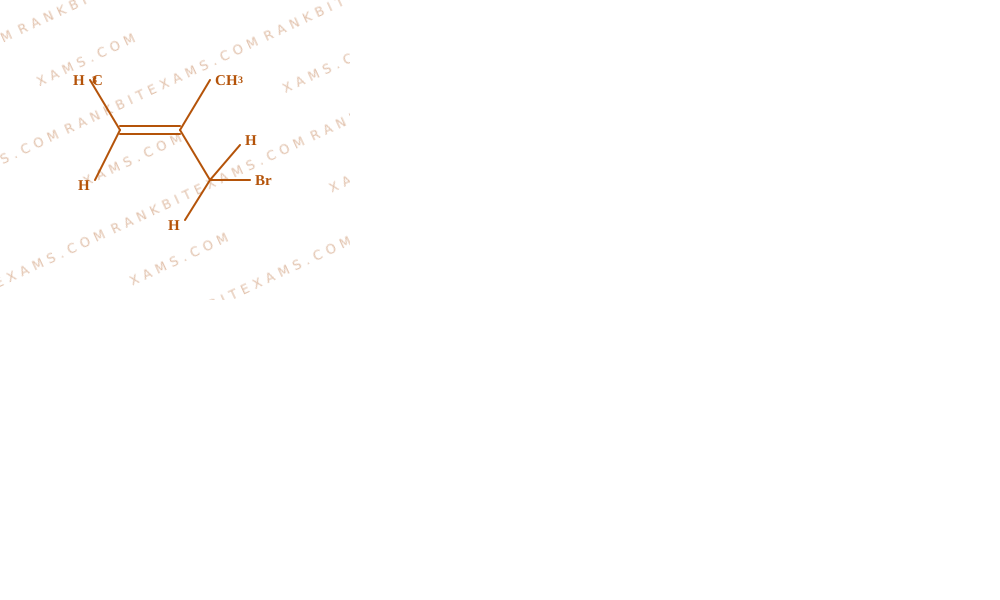
Consider the following molecule (X).
Organic reactant hydrocarbon layout for Q43
The prompt visually depicts a polycyclic unsaturated hydrocarbon system reacting to form compound X.
The structure of X is
Organic reactant hydrocarbon layout for Q43
The prompt visually depicts a polycyclic unsaturated hydrocarbon system reacting to form compound X.
Organic reactant hydrocarbon layout for Q43
The prompt visually depicts a polycyclic unsaturated hydrocarbon system reacting to form compound X.
Organic reactant hydrocarbon layout for Q43
The prompt visually depicts a polycyclic unsaturated hydrocarbon system reacting to form compound X.
Organic reactant hydrocarbon layout for Q43
The prompt visually depicts a polycyclic unsaturated hydrocarbon system reacting to form compound X.
  • A. Structure (1)
  • B. Structure (2)
  • C. Structure (3)
  • D. Structure (4)

Solution

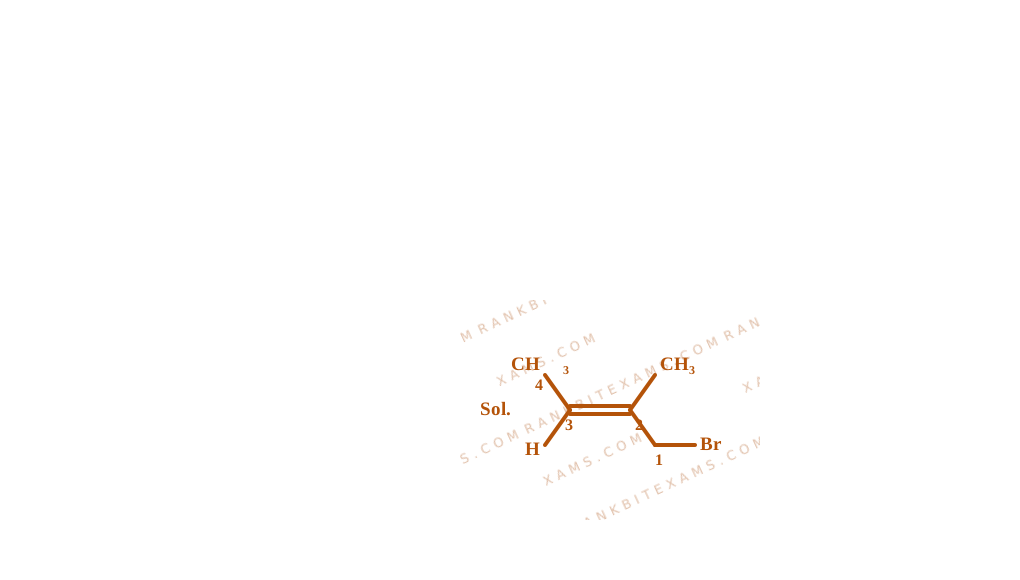
### Core Logic Analyzing the mechanism: 1. Protonation (H^+ attack) on the double bond occurs to generate the most stable intermediate carbocation. 2. The system forms a highly stable **tertiary (3^circ) carbocation** at the bridge junction ring site. 3. Nucleophilic attack by bromide ion (Br^-) captures this bridge junction center selectively, yielding the major brominated structure designated as Structure (2). ### Step 1: Mechanism Breakdown
Carbocation intermediate step illustration for Q43
The prompt visually depicts a polycyclic unsaturated hydrocarbon system reacting to form compound X.
Carbocation intermediate step illustration for Q43
The prompt visually depicts a polycyclic unsaturated hydrocarbon system reacting to form compound X.
Electrophilic addition follows Markovnikov-like stability rules, directing the halide specifically to the bridgehead junction carbocation position. ### Pattern Recognition Whenever adding hydrohalic acids across cyclic non-conjugated dienes or isolated double bonds, always convert the alkene into the most stable, un-strained tertiary carbocation before attaching the nucleophile. ### Evaluation Rubric / Model Answer null ### Chapter Mix Class 11 Chemistry: Some Basic Principles of Organic Chemistry Class 11 Chemistry: Hydrocarbons
Q43 jee_main_2025_04_april_morning Resonance Effect and Dipole Moment
Given below are two statements. Statement I: The dipole moment of overset4CH_3-overset3CH=overset2CH-overset1CH=O is greater than CH_3-CH_2-CH_2-CH=O. Statement II: C_1-C_2 bond length of CH_3-CH=CH-CH=O is greater than C_1-C_2 bond length of CH_3-CH_2-CH_2-CH=O. In the light of the above statements, choose the correct answer from the options given below:
  • A. textStatement I is false but Statement II is true
  • B. textBoth Statement I and Statement II are false
  • C. textStatement I is true but Statement II is false
  • D. textBoth Statement I and Statement II are true

Solution

### Core Logic * **Statement I is true:** In the conjugated system (CH_3-CH=CH-CH=O), extended resonance delocalization occurs, shifting electron density toward the carbonyl oxygen: CH_3-oversetoplusCH-CH=CH-oversetominusO This configuration increases both the partial charge separation q and the dipole distance d, resulting in a significantly larger net dipole moment mu = q times d compared to the non-conjugated saturated aldehyde. * **Statement II is false:** Due to resonance conjugation, the single bond between C_1 and C_2 acquires partial double-bond character. This double-bond character shortens the bond length, making it smaller than the standard single bond found in CH_3-CH_2-CH_2-CH=O. ### Pattern Recognition Conjugation spreads partial charges across a longer carbon chain, expanding the charge separation distance to drive up the overall dipole moment mu. ### Evaluation Rubric / Model Answer null ### Chapter Mix Class 11 Chemistry: Organic Chemistry - Some Basic Principles and Techniques
Q46 jee_main_2025_04_april_morning Quantitative Analysis
In Dumas' method for estimation of nitrogen, 1mathrm~g of an organic compound gave 150mathrm~mL of nitrogen collected at 300mathrm~K temperature and 900mathrm~mmHg pressure. The percentage composition of nitrogen in the compound is _______ % (nearest integer). (Aqueous tension at 300mathrm~K = 15mathrm~mmHg)
Numerical Answer. Answer: 20 to 20

Solution

### Related Formula P_textdry N_2 = P_texttotal - P_textaqueous tension PV = nRT implies n = fracPVRT \% N = fractextMass of NitrogentextMass of Organic Compound times 100 ### Core Logic First, calculate the actual pressure exerted by the dry nitrogen gas: P_N_2 = 900 - 15 = 885mathrm~mmHg = frac885760mathrm~atm Convert volume data to liters: V = 150mathrm~mL = 0.15mathrm~L. Using the ideal gas law to determine the moles of N_2 collected: n = fracleft(frac885760right) times 0.150.0821 times 300 = frac1.1645 times 0.1524.63 approx 0.0071mathrm~moles Calculate the total mass of the liberated nitrogen gas: textMass = n times M_textmolar = 0.0071 times 28 = 0.1988mathrm~g Determine the percentage composition relative to the initial 1mathrm~g sample size: \% N = frac0.19881 times 100 = 19.88\% approx 20\% ### Pattern Recognition Always remember to subtract the aqueous tension value first. Failing to correct for water vapor pressure is the most common pitfall in Dumas' method calculations. ### Evaluation Rubric / Model Answer null ### Chapter Mix Class 11 Chemistry: Organic Chemistry - Some Basic Principles and Techniques
Q27 jee_main_2025_07_april_evening Separation Techniques
Mixture of 1text g each of chlorobenzene, aniline and benzoic acid is dissolved in 50text mL ethyl acetate and placed in a separating funnel, 5text M NaOH (30text mL) was added in the same funnel. The funnel was shaken vigorously and then kept aside. The ethyl acetate layer in the funnel contains:
  • A. textbenzoic acid
  • B. textbenzoic acid and aniline
  • C. textbenzoic acid and chlorobenzene
  • D. textchlorobenzene and aniline

Solution

### Related Formula textPh-COOH + textNaOH ightarrow textPh-COO^-textNa^+ text (Water soluble salt) [cite: 884, 885] ### Core Logic When aqueous textNaOH is added to the mixture: 1. Benzoic acid (textPh-COOH) reacts to form sodium benzoate (textPh-COONa), which is highly water-soluble and moves completely into the aqueous layer. 2. Chlorobenzene (textPh-Cl) and aniline (textPh-NH_2) are organic compounds that do not react with aqueous textNaOH under normal conditions. Therefore, they remain unreacted in the organic layer (ethyl acetate). ### Step 1: Visual Reaction Progress The separation steps can be visualized tracking the structural components:
Separation Techniques diagram for Q27 - JEE Main 2025 Evening
Thus, the ethyl acetate layer strictly contains chlorobenzene and aniline. ### Pattern Recognition Acid-base separation shortcut: Strong bases (textNaOH) pull organic acids into the aqueous phase as salts. Neutral compounds and basic amines stay behind in the organic layer unless a strong acid is added. ### Evaluation Rubric / Model Answer null ### Chapter Mix Class 11 Chemistry: Organic Chemistry - Some Basic Principles and Techniques Class 12 Chemistry: Aldehydes, Ketones and Carboxylic Acids

More Organic Chemistry Some Basic Principles and Techniques Questions — jee_main_2024_30_january_evening

Practice all Organic Chemistry Some Basic Principles and Techniques previous-year questions →

YOUR FIRST PREP STEP STARTS HERE

We Map Every Repeating Question in Competitive Exams.

Say goodbye to generic mock test fatigue. RankBit uses smart analysis to group past exam questions into their foundational Repeating Question Types. Find chapter weightage, track repeating questions, and score higher with targeted practice.

Select Your Target Exam

Choose an exam track below to find formulas per chapter and patterns.

Syncing Exam Intelligence

Mapping formulas and patterns across all tracks…

PATH A — FULL LENGTH PRACTICE

Full Mock Test Hub

Simulate real NTA exam conditions with fully tracked mocks. Time yourself against past papers.

Under Development
PATH B — TARGETED PRACTICE

Topic-wise Practice Hub

Practice past-year questions one chapter at a time. Pick an exam → subject → chapter and get every PYQ for that topic — pulled together from all past papers — with the chapter's key formulas alongside.

Loading Questions... Browse Topics
Latest from the Blog
View all →

Loading articles...