Given below are two statements:
Statement-I: Since fluorine is more electronegative than nitrogen, the net dipole moment of NF₃$NF_3$ is greater than NH₃$NH_3$.
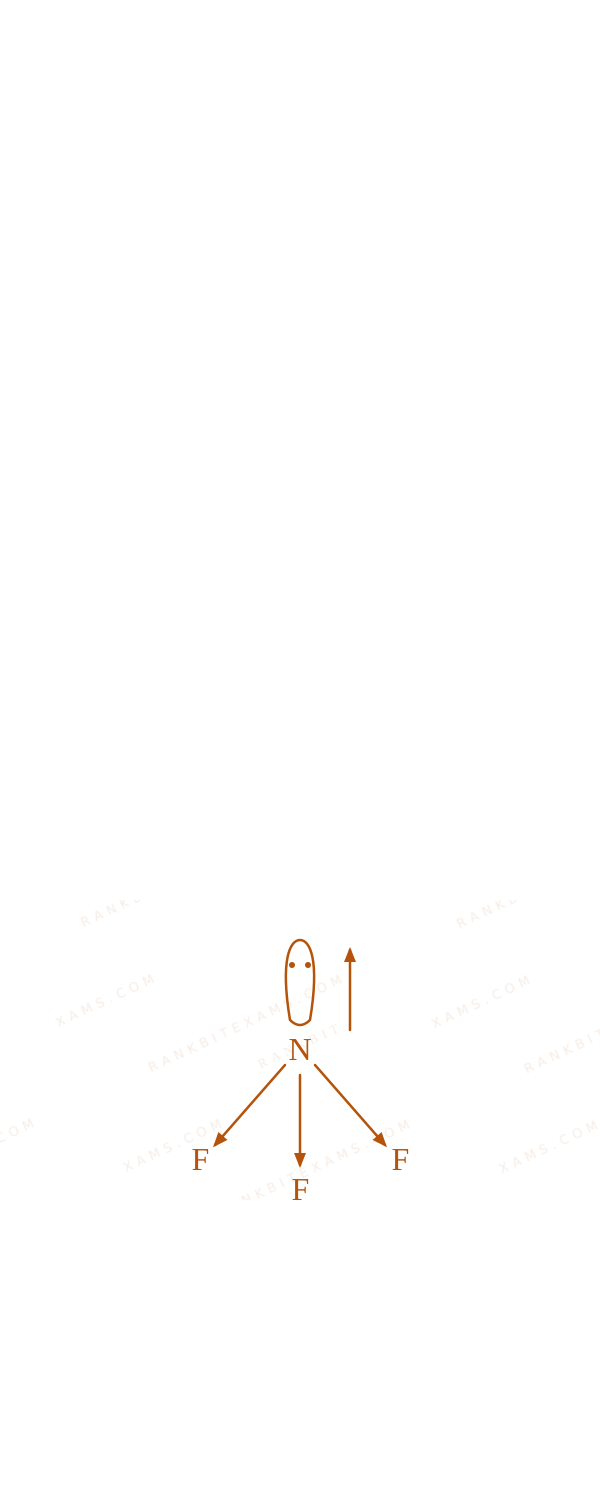
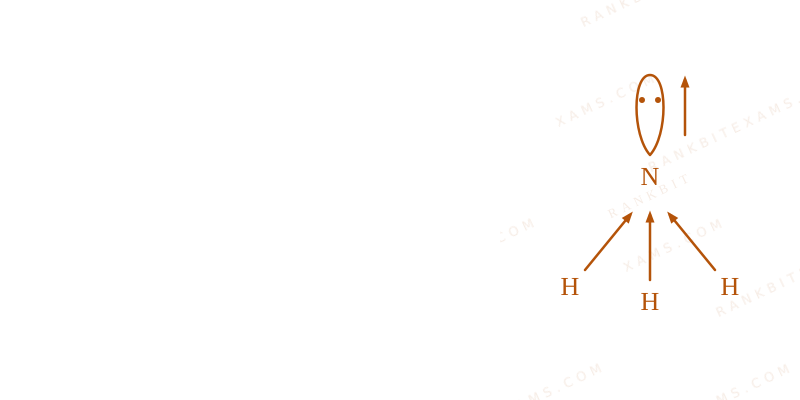
Statement-II: In NH₃$NH_3$, the orbital dipole due to lone pair and the dipole moment of NH bonds are in opposite direction, but in NF₃$NF_3$ the orbital dipole due to lone pair and dipole moments of N-F bonds are in same direction.
In the light of the above statements. Choose the most appropriate from the options given below.
A.Statement I is true but Statement II is false.$\text{Statement I is true but Statement II is false.}$
B.Both Statement I and Statement II are false.$\text{Both Statement I and Statement II are false.}$
C.Both statement I and Statement II is are true.$\text{Both statement I and Statement II is are true.}$
D.Statement I is false but Statement II is are true.$\text{Statement I is false but Statement II is are true.}$
Solution & Explanation
Core Logic
Statement I: The net dipole moment of NH₃$NH_3$ (1.47 D$1.47\, D$) is actually greater than that of NF₃$NF_3$ (0.23 D$0.23\, D$). Therefore, Statement I is false.
Statement II: In NH₃$NH_3$, the N-H$N-H$ bond dipole moments (pointing towards the more electronegative N) reinforce the orbital dipole moment of the lone pair. In NF₃$NF_3$, the N-F$N-F$ bond dipole moments point away from N (towards the more electronegative F), opposing the orbital dipole moment of the lone pair. This partial cancellation in NF₃$NF_3$ makes its net dipole moment lower. Therefore, Statement II is also false, as it reverses the correct orientations.
Dipole moments in NH3 and NF3 diagram for Q75 - JEE Main 2024 Evening
Step 1: Final Conclusion
Since both statements assert the opposite of established facts regarding NH₃$NH_3$ and NF₃$NF_3$, both are false.
Chapter Mix
Class 11 Chemistry: Chemical Bonding and Molecular Structure
More Chemical Bonding and Molecular Structure Previous-Year Questions — Page 9
Q77jee_main_2024_31_jan_morningMolecular Orbital Theory
The linear combination of atomic orbitals to form molecular orbitals takes place only when the combining atomic orbitals
A. have the same energy
B. have the minimum overlap
C. have same symmetry about the molecular axis
D. have different symmetry about the molecular axis
Choose the most appropriate from the options given below:
The combining atomic orbitals must have the same or nearly the same energy.
The combining atomic orbitals must have the same symmetry about the molecular axis.
The combining atomic orbitals must overlap to the maximum extent (not minimum).
Chapter Mix
Class 11 Chemistry: Chemical Bonding and Molecular Structure

Q85jee_main_2024_31_jan_morningHybridization
The number of species from the following in which the central atom uses sp³$sp^3$ hybrid orbitals in its bonding is
NH₃, SO₂, SiO₂, BeCl₂, CO₂, H₂O, CH₄, BF₃$NH_3, SO_2, SiO_2, BeCl_2, CO_2, H_2O, CH_4, BF_3$
Numerical Answer.Answer: 4 to 4
Solution
Core Logic
Analyzing the hybridization of the central atom in each species:
NH₃$NH_3$: 3 bp + 1 lp = 4 electron domains arrow sp³$\rightarrow sp^3$
SO₂$SO_2$: 2 bp + 1 lp = 3 electron domains arrow sp²$\rightarrow sp^2$
SiO₂$SiO_2$: A giant covalent network where each Si is bonded to 4 oxygens tetrahedrally arrow sp³$\rightarrow sp^3$
BeCl₂$BeCl_2$: 2 bp + 0 lp = 2 electron domains arrow sp$\rightarrow sp$
CO₂$CO_2$: 2 bp + 0 lp = 2 electron domains arrow sp$\rightarrow sp$
H₂O$H_2O$: 2 bp + 2 lp = 4 electron domains arrow sp³$\rightarrow sp^3$
CH₄$CH_4$: 4 bp + 0 lp = 4 electron domains arrow sp³$\rightarrow sp^3$
BF₃$BF_3$: 3 bp + 0 lp = 3 electron domains arrow sp²$\rightarrow sp^2$
Total species with sp³$sp^3$ hybridization: NH₃, SiO₂, H₂O, CH₄$NH_3, SiO_2, H_2O, CH_4$. Total count = 4.
Chapter Mix
Class 11 Chemistry: Chemical Bonding and Molecular Structure
Practice past-year questions one chapter at a time. Pick an exam → subject → chapter and get every PYQ for that topic — pulled together from all past papers — with the chapter's key formulas alongside.