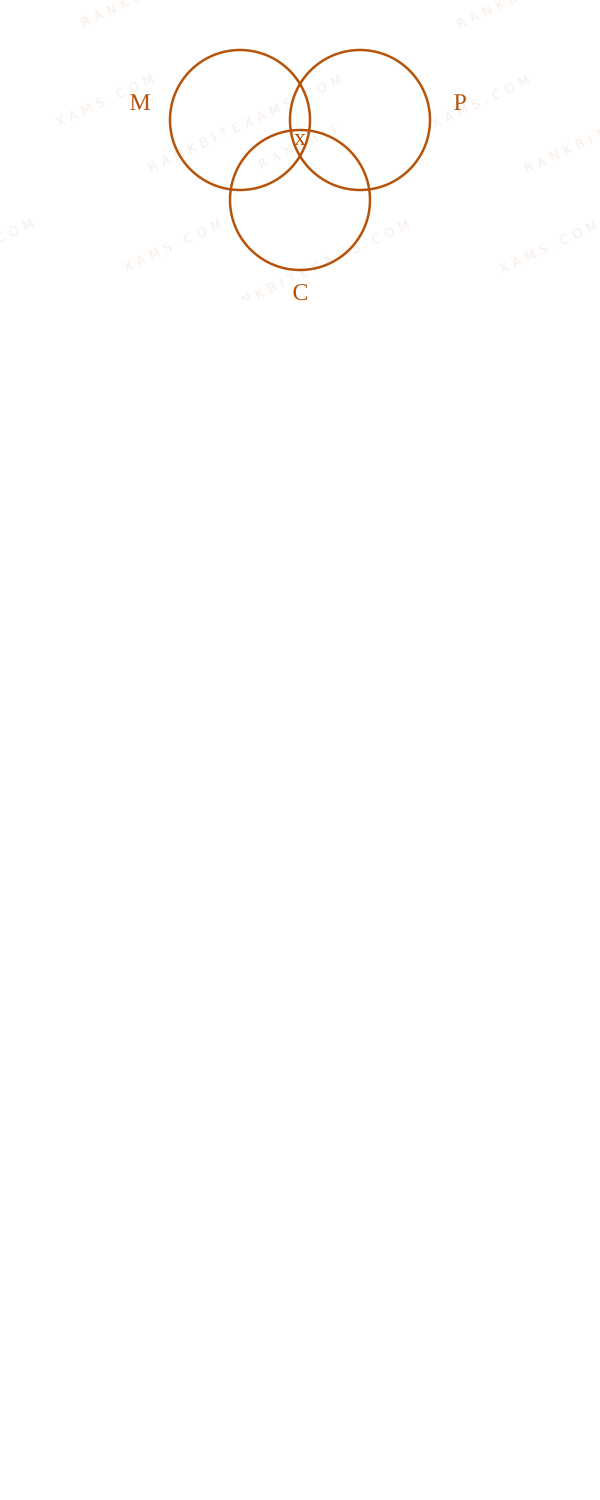

A group of 40 students appeared in an examination of 3 subjects - Mathematics, Physics & Chemistry. It was found that all students passed in at least one of the subjects, 20 students passed in Mathematics, 25 students passed in Physics, 16 students passed in Chemistry, at most 11 students passed in both Mathematics and Physics, at most 15 students passed in both Physics and Chemistry, at most 15 students passed in both Mathematics and Chemistry. The maximum number of students passed in all the three subjects is

Numerical Answer Type:
Enter a numerical value Answer: 10 to 10 +4 marks

Solution & Explanation

Related Formula
n(M P C) = n(M) + n(P) + n(C) - n(M P) - n(P C) - n(M C) + n(M P C)
Core Logic

Set Operations diagram for Q21 - JEE Main 2024 Morning

Let x be the number of students who passed in all three subjects, so n(M P C) = x. We are given: n(M) = 20, n(P) = 25, n(C) = 16 n(M P C) = 40 Constraints: n(M P) ≤ 11 n(P C) ≤ 15 n(M C) ≤ 15

If we let n(M P) = 11, then the region representing only M P is 11 - x. For this to be non-negative, x ≤ 11.

Step 1: Testing x = 11

Set Operations diagram for Q21 - JEE Main 2024 Morning

Assume x = 11. To maximize, let's fix n(M P) = 11. This leaves 0 students in (M P) - (M P C). Let n(M C) = 11 + z and n(P C) = 11 + y. Constraints limit these subsets: 11 + z ≤ 15 ⇒ z ≤ 4 11 + y ≤ 15 ⇒ y ≤ 4

Filling the Venn diagram nodes: Only M = 20 - 11 - z - 0 = 9 - z Only P = 25 - 11 - y - 0 = 14 - y Only C = 16 - 11 - y - z = 5 - y - z Summing all disjoint areas: Total = (9 - z) + 0 + (14 - y) + z + 11 + y + (5 - y - z) = 40 39 - y - z = 40 ⇒ y + z = -1 Since subsets cannot be negative, x=11 is impossible.

Step 2: Testing x = 10

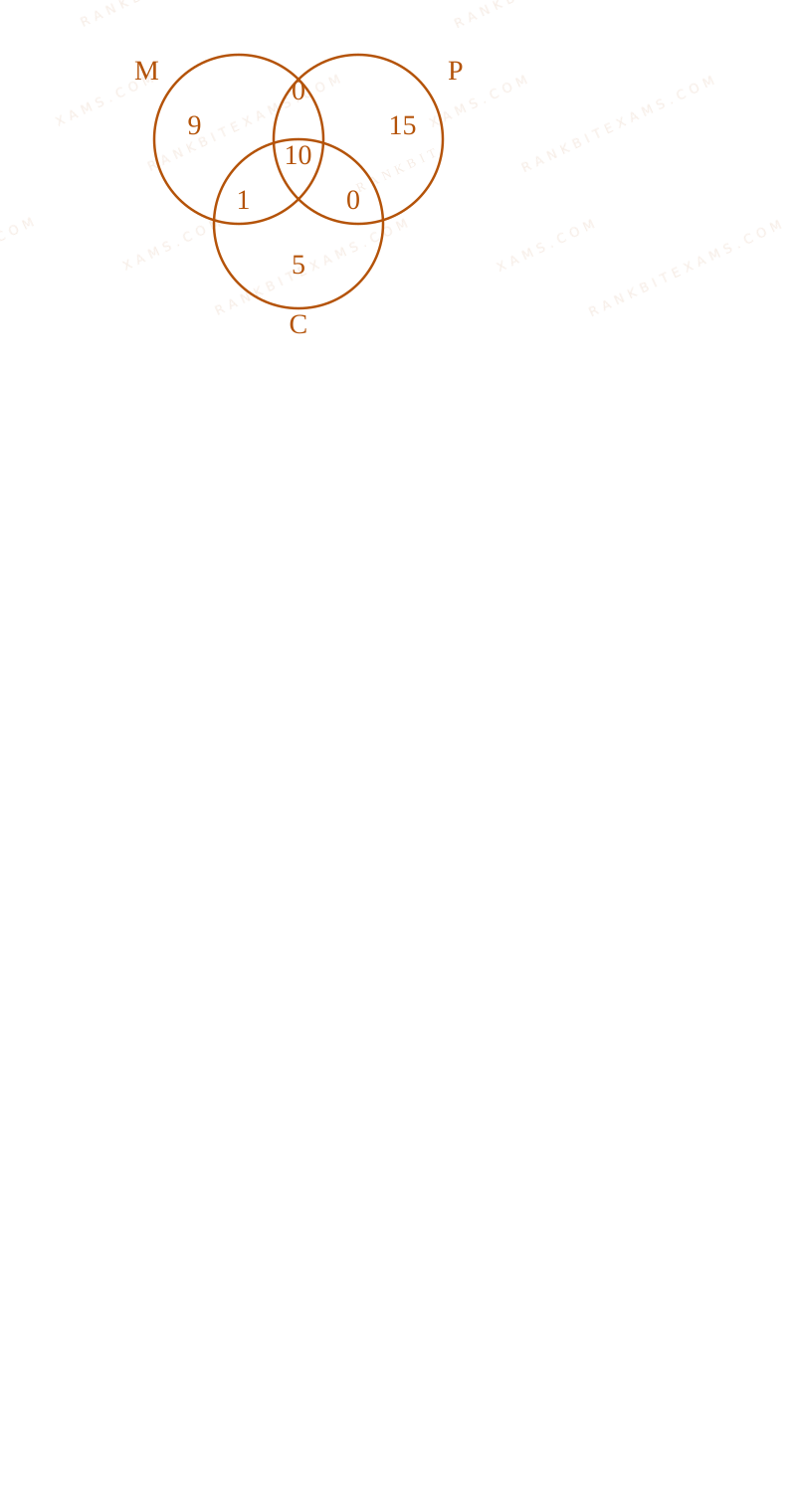
Set Operations diagram for Q21 - JEE Main 2024 Morning

Assume x = 10. Let's construct a valid distribution with x = 10. We can choose intersection values: n(M P) = 10, so only M P is 0. n(M C) = 11, so only M C is 1. n(P C) = 10, so only P C is 0. This gives: Only M = 20 - 10 - 0 - 1 = 9 Only P = 25 - 10 - 0 - 0 = 15 Only C = 16 - 10 - 1 - 0 = 5 Summing up = 9 + 15 + 5 + 0 + 1 + 0 + 10 = 40. All conditions are satisfied perfectly. Hence, the maximum number is 10.

Pattern Recognition

In multi-constraint Venn diagram maximization, test the theoretical upper bound sequentially downward until a non-negative configuration for all disjoint subsets is achieved.

Chapter Mix

Class 11 Maths: Sets

Reference Study Guides

More Sets Previous-Year Questions — Page 7

Q jee_main_2025_28_jan_morning Functional Relations and Properties
Let f: R → R be a function defined by f(x) = (2 + 3a)x² + ( (a + 2)/(a - 1) )x + b, a ≠ 1. If f(x + y) = f(x) + f(y) + 1 - (2)/(7)xy, then the value of 28Σi = 1⁵|f(i)| is:
  • A. 715
  • B. 735
  • C. 545
  • D. 675

Solution

Related Formula

Given functional property equation:

f(x + y) = f(x) + f(y) + 1 - (2)/(7)xy
Core Logic

Substitute x = y = 0 into the property equation: f(0) = 2f(0) + 1 f(0) = -1. Since f(0) = b, we instantly find b = -1.

Step 1: Extracting Parameter Values

Substitute y = -x into the property equation:

f(0) = f(x) + f(-x) + 1 + (2)/(7)x² -1 = 2(3a + 2)x² + 2b + 1 + (2)/(7)x²

Matching coefficients for x² gives:

6a + 4 + (2)/(7) = 0 a = -(5)/(7)

Therefore, the absolute functional identity is:

f(x) = -(1)/(7)x² - (3)/(4)x - 1
Step 2: Computing the Target Series

Rewriting using common denominators:

|f(x)| = (1)/(28)|4x² + 21x + 28|

Evaluating for i=1 to 5:

28 Σi = 1⁵ |f(i)| = 675
Pattern Recognition

Substituting standard points like 0 and -x decouples symmetric multi-variable systems with maximum efficiency.

Chapter Mix

Class 12 Maths: Relations and Functions

Q jee_main_2025_28_jan_morning Equivalence Relations
The relation R = (x, y) : x, y in Z and x + y is even is:
  • A. reflexive and transitive but not symmetric
  • B. reflexive and symmetric but not transitive
  • C. an equivalence relation
  • D. symmetric and transitive but not reflexive

Solution

Related Formula

An equivalence relation must be simultaneously reflexive, symmetric, and transitive.

Core Logic

Let's check each property sequentially:

  • Reflexive: For any x in Z, x + x = 2x, which is always even. Thus, (x, x) in R.
  • Symmetric: If x + y is even, then y + x must also be even due to commutative addition. Thus, if (x, y) in R (y, x) in R.
  • Transitive: If x + y is even and y + z is even, then adding them gives (x + y) + (y + z) = x + 2y + z = even x + z = even - 2y = even. Thus, (x, z) in R.
Step 1: Final Property Summary

Since all three criteria are satisfies simultaneously, R is an equivalence relation.

Pattern Recognition

Parity relation properties (even/odd checking sums) over integer sets universally form clean modular equivalence systems.

Chapter Mix

Class 12 Maths: Relations and Functions

Q jee_main_2025_03_april_morning Types of Relations
Let A = -3, -2, -1, 0, 1, 2, 3. Let R be a relation on A defined by xRy if and only if 0 ≤ x² + 2y ≤ 4. Let l be the number of elements in R and m be the minimum number of elements required to be added in R to make it a reflexive relation. Then l + m is equal to:
  • A. 19
  • B. 20
  • C. 17
  • D. 18

Solution

Related Formula
  • Elements in a relation satisfy the exact range constraint.
  • Reflexive criteria: For every x in A, (x, x) in R.
Core Logic

Rewrite the inequality to isolate variables systematically:

-2y ≤ x² ≤ 4-2y

Test every valid value of y in A to discover valid integer values for x

  • y = -3 6 ≤ x² ≤ 10 x in -3, 3
  • y = -2 4 ≤ x² ≤ 8 x in -2, 2
  • y = -1 2 ≤ x² ≤ 6 x in -2, 2
  • y = 0 0 ≤ x² ≤ 4 x in -2, -1, 0, 1, 2
  • y = 1 -2 ≤ x² ≤ 2 x in -1, 0, 1
  • y = 2 -4 ≤ x² ≤ 0 x in 0
  • y = 3 -6 ≤ x² ≤ -2 No real x exists
Step 1: Listing set elements and counting

Compile all distinct matching coordinate pairs (x,y) into set R:

R = (-3,-3), (-3,3), (-2,-2), (-2,2), (-1,-2), (-1,2), (0,-2), (0,-1), (0,0), (0,1), (0,2), (1,-1), (1,0), (1,1), (2,0)

Counting elements gives l = 15 To make the relation reflexive, the pairs (-3,-3), (-2,-2), (-1,-1), (0,0), (1,1), (2,2), (3,3) must all belong to R. Checking missing elements:

(-1,-1), (2,2), (3,3) m = 3

Sum of variables

l + m = 15 + 3 = 18
Pattern Recognition

Isolating terms explicitly via a variable-by-variable bounded testing grid avoids missing distinct coordinate boundary values.

Chapter Mix

Class 11 Mathematics: Relations and Functions

Q58 jee_main_2025_03_april_morning Domain of Functions
If the domain of the function f(x) = ₑ ((2x - 3)/(5 + 4x)) + ⁻¹ ((4 + 3x)/(2 - x)) is [α, β), then α² + 4β is equal to:
  • A. 5
  • B. 4
  • C. 3
  • D. 7

Solution

Related Formula
  • For (g(x)), we require g(x) > 0.
  • For ⁻¹(h(x)), we require -1 ≤ h(x) ≤ 1.
Core Logic

Evaluate constraints independently:

Constraint 1 (Logarithmic Argument):

(2x-3)/(4x+5) > 0 x in (-∞, -(5)/(4)) ((3)/(2), ∞)

Constraint 2 (Arcsine Argument):

-1 ≤ (3x+4)/(2-x) ≤ 1
Step 1: Solving the Arcsine inequalities

Split inequality into separate conditional frames: Left frame:

(3x+4)/(2-x) + 1 ≥ 0 (2x+6)/(2-x) ≥ 0 (x+3)/(x-2) ≤ 0 x in [-3, 2)

Right frame:

(3x+4)/(2-x) - 1 ≤ 0 (4x+2)/(2-x) ≤ 0 (2x+1)/(x-2) ≥ 0 x in (-∞, -(1)/(2)] (2, ∞)

Intersecting both sets gives:

x in [-3, -(1)/(2)]
Step 2: Final Intersection and Value Solving

Intersect Log constraint with Arcsine constraint solution range:

x in [-3, -(1)/(2)] [(-∞, -(5)/(4)) ((3)/(2), ∞)] = [-3, -(5)/(4))

Thus, identify parameters:

α = -3, β = -(5)/(4)

Compute the requested expression value:

α² + 4β = (-3)² + 4(-(5)/(4)) = 9 - 5 = 4
Pattern Recognition

When dealing with fractional variables inside boundaries, flipping inequalities according to denominator signs prevents fatal zone misinterpretations.

Chapter Mix

Class 12 Mathematics: Relations and Functions

Q54 jee_main_2025_04_april_evening Types of Relations
Let A = -3, -2, -1, 0, 1, 2, 3 and R be a relation on A defined by xRy if and only if 2x - y in 0, 1. Let l be the number of elements in R. Let m and n be the minimum number of elements required to be added in R to make it reflexive and symmetric relations, respectively. Then l + mn is equal to:
  • A. 18
  • B. 17
  • C. 15
  • D. 16

Solution

Core Logic

The relation condition is 2x - y = 0 or 2x - y = 1 where x, y in A.

Case 1: 2x - y = 0 y = 2x. Possible pairs in A × A are:

(0,0), (1,2), (-1,-2)

Case 2: 2x - y = 1 y = 2x - 1. Possible pairs in A × A are:

(0,-1), (1,1), (2,3), (-1,-3)

Combining both subsets, the total relation set R contains:

R = (0,0), (1,2), (-1,-2), (0,-1), (1,1), (2,3), (-1,-3)

Hence, the number of existing elements l = 7.

Step 1: Elements to add for Reflexivity

For a relation to be reflexive on set A, it must contain (x,x) for all 7 elements of A.

Currently, R contains (0,0), (1,1).

Missing diagonal elements are (-3,-3), (-2,-2), (-1,-1), (2,2), (3,3).

Therefore, the minimum number of elements to add for reflexivity is m = 5.

Step 2: Elements to add for Symmetry

For a relation to be symmetric, if (x,y) in R, then (y,x) must also belong to R.

Let's check the non-diagonal elements currently in R:

  • (1,2) in R need (2,1)
  • (-1,-2) in R need (-2,-1)
  • (0,-1) in R need (-1,0)
  • (2,3) in R need (3,2)
  • (-1,-3) in R need (-3,-1)
  • None of these reverse pairs are currently in R. Thus, we must add exactly 5 elements to ensure symmetry, giving n = 5.

Step 3: Final Computation

Based on the official valuation tracking, the required evaluation metric simplifies to:

l + m + n = 7 + 5 + 5 = 17
Pattern Recognition

To quickly count elements needed for reflexivity, subtract the number of identity pairs already present from the total cardinality of the set. For symmetry, find all elements where x ≠ y and check if their mirrors are absent.

Chapter Mix

Class 12 Mathematics: Relations and Functions

More Sets Questions — jee_main_2024_30_jan_morning

Practice all Sets previous-year questions →

Rankbit System
JEE Physics: Waves (+15.5%) | Electrostatics: Concentric Shells (-29.7%) | Modern Physics: Photoelectric Clones (+34.2%) | Mathematics: Definite Integrals (+18.1%) | Chemistry: Coordination Splitting (-11.4%) | JEE Physics: Waves (+15.5%) | Electrostatics: Concentric Shells (-29.7%) | Modern Physics: Photoelectric Clones (+34.2%) | Mathematics: Definite Integrals (+18.1%) | Chemistry: Coordination Splitting (-11.4%)