
A group of 40 students appeared in an examination of 3 subjects - Mathematics, Physics & Chemistry. It was found that all students passed in at least one of the subjects, 20 students passed in Mathematics, 25 students passed in Physics, 16 students passed in Chemistry, at most 11 students passed in both Mathematics and Physics, at most 15 students passed in both Physics and Chemistry, at most 15 students passed in both Mathematics and Chemistry. The maximum number of students passed in all the three subjects is

Numerical Answer Type:
Enter a numerical value Answer: 10 to 10 +4 marks

Solution & Explanation

Related Formula
n(M P C) = n(M) + n(P) + n(C) - n(M P) - n(P C) - n(M C) + n(M P C)
Core Logic

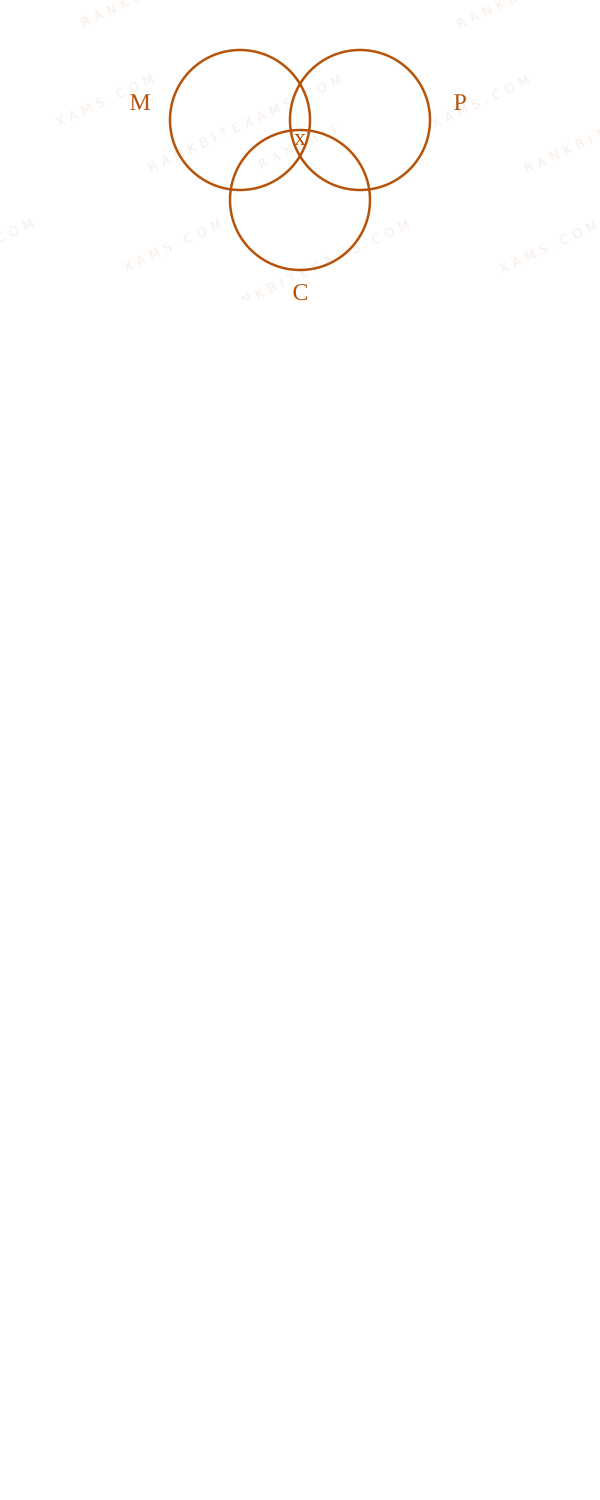
Set Operations diagram for Q21 - JEE Main 2024 Morning

Let x be the number of students who passed in all three subjects, so n(M P C) = x. We are given: n(M) = 20, n(P) = 25, n(C) = 16 n(M P C) = 40 Constraints: n(M P) ≤ 11 n(P C) ≤ 15 n(M C) ≤ 15

If we let n(M P) = 11, then the region representing only M P is 11 - x. For this to be non-negative, x ≤ 11.

Step 1: Testing x = 11

Set Operations diagram for Q21 - JEE Main 2024 Morning

Assume x = 11. To maximize, let's fix n(M P) = 11. This leaves 0 students in (M P) - (M P C). Let n(M C) = 11 + z and n(P C) = 11 + y. Constraints limit these subsets: 11 + z ≤ 15 ⇒ z ≤ 4 11 + y ≤ 15 ⇒ y ≤ 4

Filling the Venn diagram nodes: Only M = 20 - 11 - z - 0 = 9 - z Only P = 25 - 11 - y - 0 = 14 - y Only C = 16 - 11 - y - z = 5 - y - z Summing all disjoint areas: Total = (9 - z) + 0 + (14 - y) + z + 11 + y + (5 - y - z) = 40 39 - y - z = 40 ⇒ y + z = -1 Since subsets cannot be negative, x=11 is impossible.

Step 2: Testing x = 10

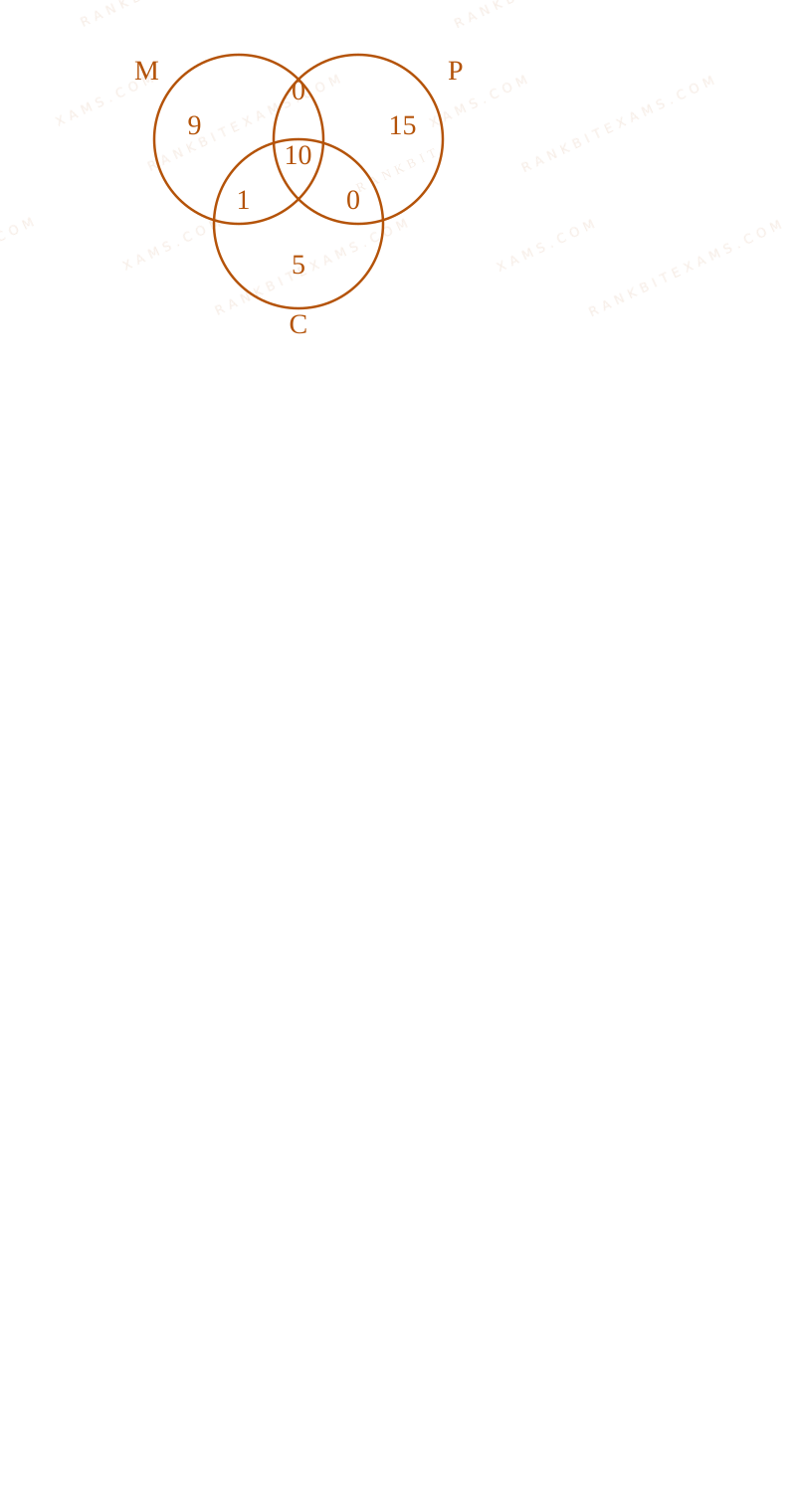
Set Operations diagram for Q21 - JEE Main 2024 Morning

Assume x = 10. Let's construct a valid distribution with x = 10. We can choose intersection values: n(M P) = 10, so only M P is 0. n(M C) = 11, so only M C is 1. n(P C) = 10, so only P C is 0. This gives: Only M = 20 - 10 - 0 - 1 = 9 Only P = 25 - 10 - 0 - 0 = 15 Only C = 16 - 10 - 1 - 0 = 5 Summing up = 9 + 15 + 5 + 0 + 1 + 0 + 10 = 40. All conditions are satisfied perfectly. Hence, the maximum number is 10.

Pattern Recognition

In multi-constraint Venn diagram maximization, test the theoretical upper bound sequentially downward until a non-negative configuration for all disjoint subsets is achieved.

Chapter Mix

Class 11 Maths: Sets

Reference Study Guides

More Sets Previous-Year Questions — Page 5

Q62 jee_main_2025_02_april_evening Domain of a Function
If the domain of the function f(x) = 1√(10 + 3x - x²) + 1√(x + |x|) is (a, b), then (1 + a)² + b² is equal to:
  • A. 26
  • B. 29
  • C. 25
  • D. 30

Solution

Related Formula
For 1√(g(x)) to be defined, we require: g(x) > 0
Core Logic

We find the domains of the two constituent terms separately and then find their intersection.

Step 1: Find the domain of the first term

For the first term to be defined:

10 + 3x - x² > 0 x² - 3x - 10 < 0 (x - 5)(x + 2) < 0 x in (-2, 5) --- (1)
Step 2: Find the domain of the second term

For the second term to be defined:

x + |x| > 0

  • If x ≥ 0: x + x = 2x > 0 x > 0.
  • If x < 0: x - x = 0 0.
  • Thus, the domain of the second term is:

x in (0, ∞) --- (2)
Step 3: Find intersection and calculate the final expression

Intersecting domains (1) and (2):

x in (-2, 5) (0, ∞) x in (0, 5)

Comparing this with (a, b) gives a = 0 and b = 5.

Now calculate the value:

(1 + a)² + b² = (1 + 0)² + 5² = 1 + 25 = 26
Pattern Recognition

Modulus domain constraint: The function x + |x| is non-zero only for positive values of x. This is a standard math trick that collapses complex domains down to x > 0 instantly.

Chapter Mix

Class 11 Mathematics: Relations and Functions

Q jee_main_2025_02_april_morning Types of Relations
Let A be the set of all functions f Z → Z and R be a relation on A such that R = (f, g): f(0) = g(1) and f(1) = g(0). Then R is:
  • A. Symmetric and transitive but not reflexive
  • B. Symmetric but neither reflexive nor transitive
  • C. Reflexive but neither symmetric nor transitive
  • D. Transitive but neither reflexive nor symmetric

Solution

Related Formula

Definition of properties of binary relations:

  • Reflexive: (f, f) in R f(0) = f(1)
  • Symmetric: (f, g) in R (g, f) in R
  • Transitive: (f, g) in R and (g, h) in R (f, h) in R
Core Logic

Evaluate reflexivity, symmetry, and transitivity sequentially by plugging standard arbitrary function values into the condition definition.

Step 1: Reflexivity Audit

For (f,f) in R, we require f(0) = f(1) and f(1) = f(0). This holds true only for functions whose values at 0 and 1 are identical. Since it does not hold true for all possible functions mapping Z → Z (e.g., f(x)=x), R is not reflexive.

Step 2: Symmetry Audit

Assume (f,g) in R f(0) = g(1) and f(1) = g(0). To check if (g,f) in R, check its matching constraints: g(0) = f(1) and g(1) = f(0). Both statements are perfectly identical to our assumption. Therefore, R is symmetric.

Step 3: Transitivity Audit

Assume (f,g) in R f(0) = g(1), f(1) = g(0). Assume (g,h) in R g(0) = h(1), g(1) = h(0). For (f,h) in R, we need f(0) = h(1) and f(1) = h(0). From assumptions: f(0) = g(1) = h(0) and f(1) = g(0) = h(1). This means f(0) = h(0) and f(1) = h(1), which does not necessarily satisfy f(0)=h(1). Hence, R is not transitive.

Pattern Recognition

The relation swaps indices 0 and 1. Swapping twice returns you to the original position, which visually justifies why symmetry holds trivially, while transitivity creates a cyclic dependency that fails standard property constraints.

Chapter Mix

Class 12 Mathematics: Relations and Functions

Q jee_main_2025_03_april_evening Domain of Functions
If the domain of the function f(x) = ₇(1 - ₄(x² - 9x + 18)) is (α, β) (γ, δ), then the sum α + β + γ + δ is equal to
  • A. 18
  • B. 16
  • C. 15
  • D. 17

Solution

Related Formula

For a logarithmic term b(g(x)) to be defined:

  • g(x) > 0
  • b > 0, b ≠ 1
Core Logic

Let's set defining inequalities sequentially:

  • Inside the outer logarithm:
1 - ₄(x² - 9x + 18) > 0 ₄(x² - 9x + 18) < 1

Since base is 4 > 1:

x² - 9x + 18 < 4 x² - 9x + 14 < 0 (x-2)(x-7) < 0 x in (2, 7) --- (1)
Step 1: Finding bounds for inner logarithmic term
  • Inside the inner logarithm:
x² - 9x + 18 > 0 (x-3)(x-6) > 0 x in (-∞, 3) (6, ∞) --- (2)
Step 2: Intersection of regions

Taking the intersection of (1) and (2):

x in (2, 3) (6, 7)

This gives:

α = 2, β = 3, γ = 6, δ = 7

Calculating the sum:

α + β + γ + δ = 2 + 3 + 6 + 7 = 18
Pattern Recognition

Logarithmic domains must check arguments from the innermost level to the outermost level. Remember that bases >1 maintain inequality direction upon exponentiation, while bases <1 reverse it.

Chapter Mix

Class 11 Mathematics: Relations and Functions

Q56 jee_main_2025_03_april_evening Types of Relations
Let A = -2, -1, 0, 1, 2, 3. Let R be a relation on A defined by xRy if and only if y = x, 1. Let l be the number of elements in R. Let m and n be the minimum number of elements required to be added in R to make it reflexive and symmetric relations, respectively. Then l + m + n is equal to
  • A. 12
  • B. 11
  • C. 13
  • D. 14

Solution

Related Formula

A relation R on set A is:

  • Reflexive: If (x, x) in R for all x in A.
  • Symmetric: If (x, y) in R (y, x) in R.
Core Logic

Let's find the explicit set R using y = x, 1:

  • x = -2 y = 1 (-2, 1) in R
  • x = -1 y = 1 (-1, 1) in R
  • x = 0 y = 1 (0, 1) in R
  • x = 1 y = 1 (1, 1) in R
  • x = 2 y = 2 (2, 2) in R
  • x = 3 y = 3 (3, 3) in R
R = (-2, 1), (-1, 1), (0, 1), (1, 1), (2, 2), (3, 3)

Thus, l = 6 elements.

Step 1: Making the Relation Reflexive

For R to be reflexive, it must contain all elements (x, x) where x in A = -2, -1, 0, 1, 2, 3. Currently, R has (1,1), (2,2), (3,3). Missing elements: (-2, -2), (-1, -1), (0, 0).

Thus, minimum number of elements to add: m = 3

Step 2: Making the Relation Symmetric

For R to be symmetric, if (x, y) in R and x ≠ y, then (y, x) must also be in R.

  • (-2, 1) in R need (1, -2)
  • (-1, 1) in R need (1, -1)
  • (0, 1) in R need (1, 0)
  • Missing elements to form symmetric pairs: (1, -2), (1, -1), (1, 0).

    Thus, minimum number of elements to add: n = 3

    Calculating total:

l + m + n = 6 + 3 + 3 = 12
Pattern Recognition

To quickly solve counting tasks of elements in relations: Write down the pairs explicitly since the set size is small (|A|=6). Count the elements already satisfying standard relations, then subtract from |A| to find missing diagonal terms for reflexivity.

Chapter Mix

Class 12 Mathematics: Relations and Functions

Q60 jee_main_2025_03_april_evening Functional Equations
Let f be a function such that f(x) + 3f((24)/(x)) = 4x, x ≠ 0. Then f(3) + f(8) is equal to
  • A. 11
  • B. 10
  • C. 12
  • D. 13

Solution

Related Formula

A functional equation relates the values of a function at different arguments. We can find values by substituting symmetric inputs that map to each other (e.g., x and (24)/(x)).

Core Logic

Given:

f(x) + 3f((24)/(x)) = 4x --- (1)
Step 1: Substitution of values

Substitute x = 3:

f(3) + 3f(8) = 12 --- (2)

Substitute x = 8:

f(8) + 3f(3) = 32 --- (3)
Step 2: Linear combination of equations

Add equations (2) and (3) directly:

(f(3) + 3f(8)) + (f(8) + 3f(3)) = 12 + 32 4(f(3) + f(8)) = 44 f(3) + f(8) = 11
Pattern Recognition

Instead of solving for the general function f(x) (which is also easy by substitution: replace x → 24/x), look at the symmetric nature of the target expression f(3) + f(8). Direct addition of symmetric systems avoids resolving the individual values and saves time.

Chapter Mix

Class 11 Mathematics: Relations and Functions

More Sets Questions — jee_main_2024_30_jan_morning

Practice all Sets previous-year questions →

Rankbit System
JEE Physics: Waves (+15.5%) | Electrostatics: Concentric Shells (-29.7%) | Modern Physics: Photoelectric Clones (+34.2%) | Mathematics: Definite Integrals (+18.1%) | Chemistry: Coordination Splitting (-11.4%) | JEE Physics: Waves (+15.5%) | Electrostatics: Concentric Shells (-29.7%) | Modern Physics: Photoelectric Clones (+34.2%) | Mathematics: Definite Integrals (+18.1%) | Chemistry: Coordination Splitting (-11.4%)