A group of 40 students appeared in an examination of 3 subjects - Mathematics, Physics & Chemistry. It was found that all students passed in at least one of the subjects, 20 students passed in Mathematics, 25 students passed in Physics, 16 students passed in Chemistry, at most 11 students passed in both Mathematics and Physics, at most 15 students passed in both Physics and Chemistry, at most 15 students passed in both Mathematics and Chemistry. The maximum number of students passed in all the three subjects is

Numerical Answer Type:
Enter a numerical value Answer: 10 to 10 +4 marks

Solution & Explanation

Related Formula
n(M P C) = n(M) + n(P) + n(C) - n(M P) - n(P C) - n(M C) + n(M P C)
Core Logic

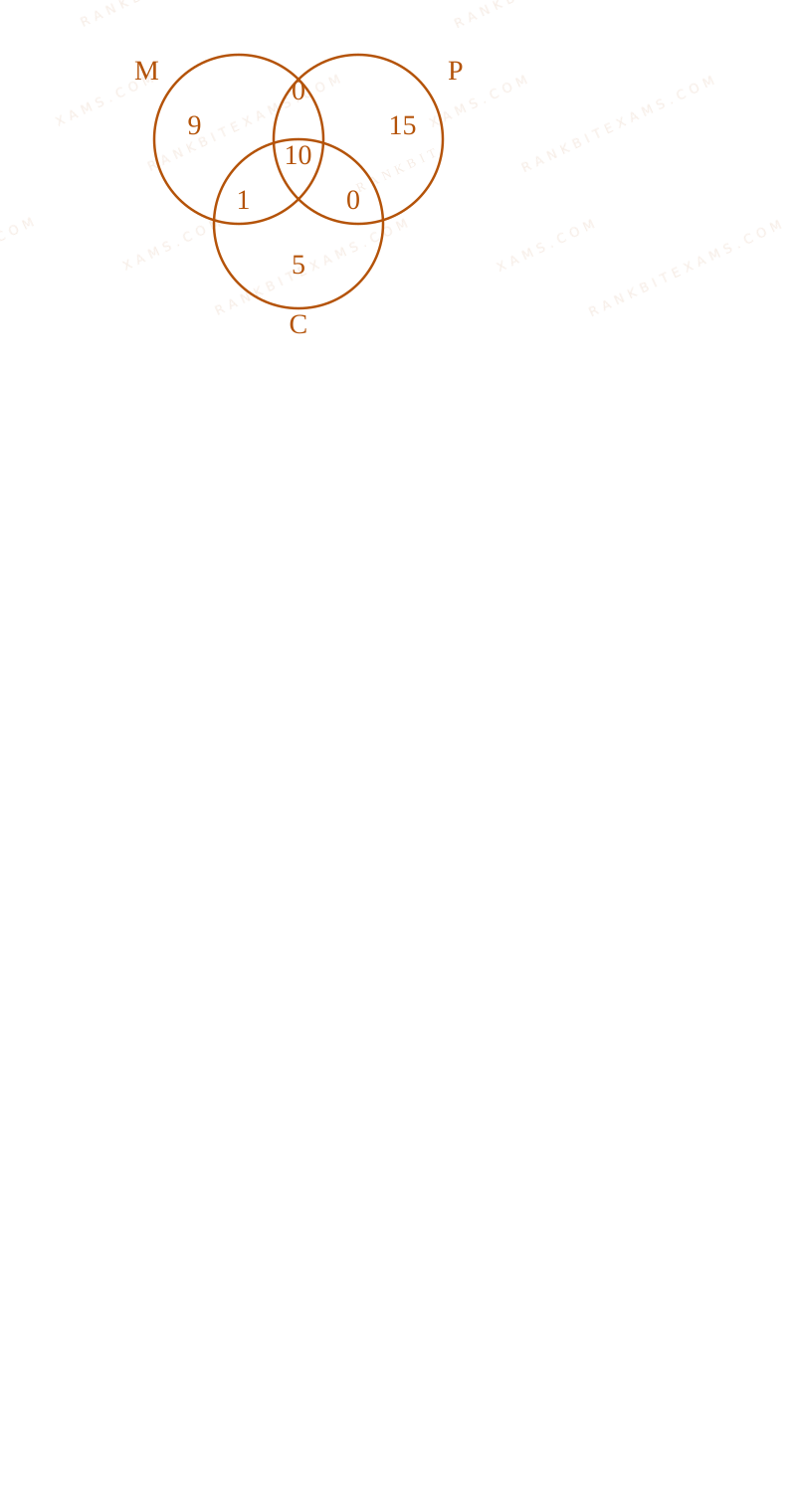
Set Operations diagram for Q21 - JEE Main 2024 Morning

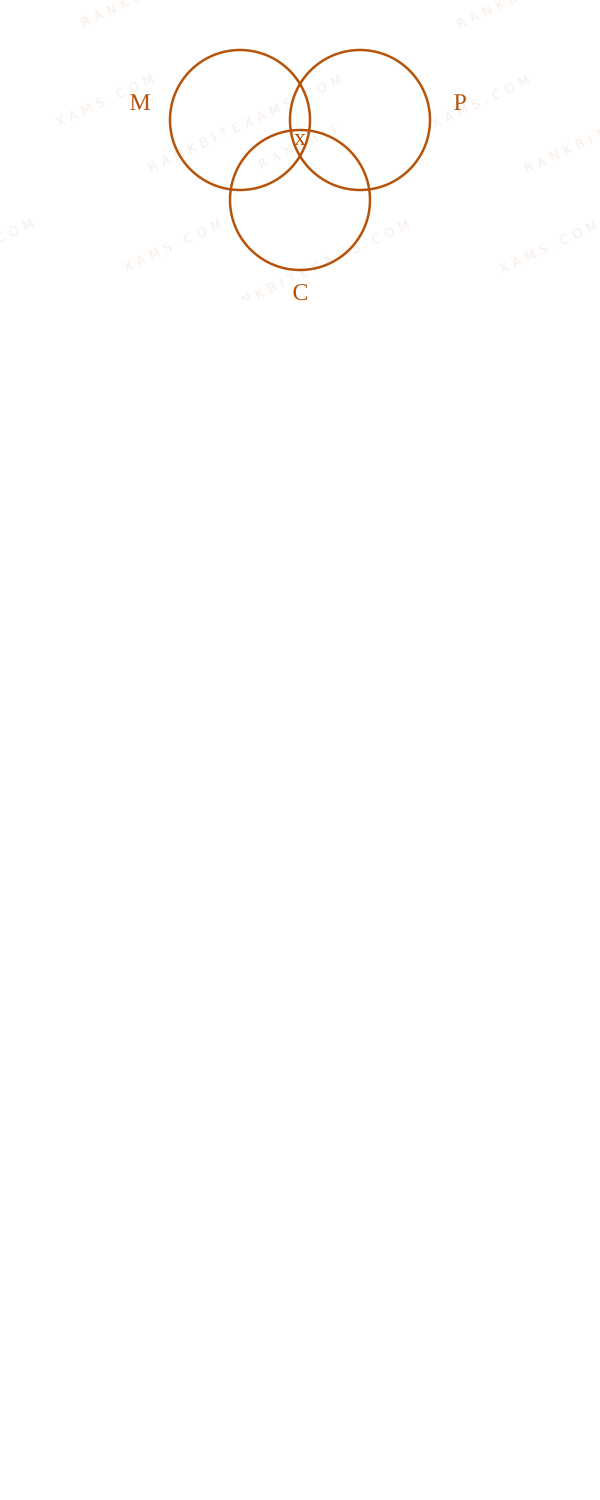
Let x be the number of students who passed in all three subjects, so n(M P C) = x. We are given: n(M) = 20, n(P) = 25, n(C) = 16 n(M P C) = 40 Constraints: n(M P) ≤ 11 n(P C) ≤ 15 n(M C) ≤ 15

If we let n(M P) = 11, then the region representing only M P is 11 - x. For this to be non-negative, x ≤ 11.

Step 1: Testing x = 11

Set Operations diagram for Q21 - JEE Main 2024 Morning

Assume x = 11. To maximize, let's fix n(M P) = 11. This leaves 0 students in (M P) - (M P C). Let n(M C) = 11 + z and n(P C) = 11 + y. Constraints limit these subsets: 11 + z ≤ 15 ⇒ z ≤ 4 11 + y ≤ 15 ⇒ y ≤ 4

Filling the Venn diagram nodes: Only M = 20 - 11 - z - 0 = 9 - z Only P = 25 - 11 - y - 0 = 14 - y Only C = 16 - 11 - y - z = 5 - y - z Summing all disjoint areas: Total = (9 - z) + 0 + (14 - y) + z + 11 + y + (5 - y - z) = 40 39 - y - z = 40 ⇒ y + z = -1 Since subsets cannot be negative, x=11 is impossible.

Step 2: Testing x = 10

Set Operations diagram for Q21 - JEE Main 2024 Morning

Assume x = 10. Let's construct a valid distribution with x = 10. We can choose intersection values: n(M P) = 10, so only M P is 0. n(M C) = 11, so only M C is 1. n(P C) = 10, so only P C is 0. This gives: Only M = 20 - 10 - 0 - 1 = 9 Only P = 25 - 10 - 0 - 0 = 15 Only C = 16 - 10 - 1 - 0 = 5 Summing up = 9 + 15 + 5 + 0 + 1 + 0 + 10 = 40. All conditions are satisfied perfectly. Hence, the maximum number is 10.

Pattern Recognition

In multi-constraint Venn diagram maximization, test the theoretical upper bound sequentially downward until a non-negative configuration for all disjoint subsets is achieved.

Chapter Mix

Class 11 Maths: Sets

Reference Study Guides

More Sets Previous-Year Questions — Page 2

Q14 jee_main_2026_22_january_morning Domain of a Function
If the domain of the function f(x) = ⁻¹((5 - x)/(3 + 2x)) + (1)/( (10 - x)) is (- ∞, α] [β, γ) - δ, then 6(α + β + γ + δ) is equal to
  • A. 70
  • B. 66
  • C. 67
  • D. 68

Solution

Related Formula
Domain of ⁻¹(y) is -1 ≤ y ≤ 1 Domain of (1)/( (z)) is z > 0, z ≠ 1
Core Logic

For f(x) to be defined, two main conditions must hold:

  • -1 ≤ (5 - x)/(2x + 3) ≤ 1
  • 10 - x > 0 and 10 - x ≠ 1
Step 1: Solving the Logarithmic Domain

10 - x > 0 x < 10 10 - x ≠ 1 x ≠ 9

Step 2: Solving the Inverse Sine Domain

-1 ≤ (5 - x)/(2x + 3) ≤ 1 This is equivalent to |(5 - x)/(2x + 3)| ≤ 1, which means:

(5 - x)² ≤ (2x + 3)² (assuming x ≠ -1.5) (5 - x)² - (2x + 3)² ≤ 0

Factor as difference of squares:

(5 - x - (2x + 3))(5 - x + 2x + 3) ≤ 0 (2 - 3x)(x + 8) ≤ 0

Multiply by -1 and flip the inequality:

(3x - 2)(x + 8) ≥ 0

So, x in (-∞, -8] [(2)/(3), ∞).

Step 3: Intersection of Domains

Intersecting with x < 10 and x ≠ 9:

Domain = (-∞, -8] [(2)/(3), 10) - 9

Comparing with the given form (-∞, α] [β, γ) - δ, we have: α = -8, β = (2)/(3), γ = 10, δ = 9.

Step 4: Final Value Calculation

Evaluate 6(α + β + γ + δ):

6(-8 + (2)/(3) + 10 + 9) = 6(11 + (2)/(3)) = 6((35)/(3)) = 70
Pattern Recognition

Instead of solving two separate rational inequalities for ≤ 1 and ≥ -1, converting the absolute value fraction into a difference of squares quickly bypasses sign analysis pitfalls, delivering the required critical points effortlessly.

Chapter Mix

Class 11 Maths: Sets, Relations and Functions Class 12 Maths: Inverse Trigonometric Functions

Q3 jee_main_2026_22_january_evening Number of Elements in Relation
The number of elements in the relation R = (x,y) : 4x² + y² < 52, x, y in Z is
  • A. 77
  • B. 89
  • C. 67
  • D. 86

Solution

Related Formula

Count integer pairs (x, y) satisfying 4x² + y² < 52.

Core Logic

Systematically test possible integer values of x:

  • For x = 0: y² < 52 y in 0, ± 1, , ± 7 (15 values)
  • For x = ± 1: y² < 48 y in 0, ± 1, , ± 6 (2 × 13 = 26 values)
  • For x = ± 2: y² < 36 y in 0, ± 1, , ± 5 (2 × 11 = 22 values)
  • For x = ± 3: y² < 16 y in 0, ± 1, ± 2, ± 3 (2 × 7 = 14 values)
Step 1: Total Sum

Total elements = 15 + 26 + 22 + 14 = 77.

Pattern Recognition

Bound x first since its coefficient is larger, then sum valid values of y symmetrically.

Chapter Mix

Class 11 Maths: Sets and Relations

Q14 jee_main_2026_22_january_evening Domain of Composite Function
Let the domain of the function f(x) = ₃ ₅ (7 - ₂ (x² - 10x + 85)) + ⁻¹ (|(3x-7)/(17-x)|) be (α, β]. Then α + β is equal to:
  • A. 10
  • B. 12
  • C. 9
  • D. 8

Solution

Related Formula

For logarithmic domain: argument must be strictly positive. For inverse sine domain: argument must lie in [-1, 1].

Core Logic

Domain interval intersection for Q14 - JEE Main 2026 Evening

Let λ = x² - 10x + 85.

  • Logarithmic conditions:
  • λ > 0
  • 7 - ₂ λ > 0 λ < 2⁷
  • ₅ (7 - ₂ λ) > 0 7 - ₂ λ > 1 ₂ λ < 6 λ < 64
  • Combining: 0 < x² - 10x + 85 < 64 x² - 10x + 21 < 0 x in (3, 7).

Step 1: Inverse Sine Domain
|(3x-7)/(17-x)| ≤ 1 -1 ≤ (3x-7)/(17-x) ≤ 1 x in [-5, 6]
Step 2: Intersection of Domains

Intersection of x in (3, 7) and x in [-5, 6] is (3, 6]. Here α = 3, β = 6 α + β = 9.

Pattern Recognition

Unpack nested logarithms sequentially from outside in to determine tight bounds on inner quadratic.

Chapter Mix

Class 11 Maths: Functions and Graphs

Q18 jee_main_2026_22_january_evening Greatest Integer Function Properties
Let f(x) = [x]² - [x+3] - 3, x in R where [·] is the greatest integer function. Then:
  • A. f(x) > 0 only for x in [4,∞)
  • B. f(x) < 0 only for x in [-1,3)
  • C. ∫₀² f(x) dx = -6
  • D. f(x) = 0 for finitely many values of x.

Solution

Related Formula

Property of greatest integer function: [x+k] = [x] + k for integer k.

Core Logic

Simplify f(x):

f(x) = [x]² - ([x] + 3) - 3 = [x]² - [x] - 6 = ([x] + 2)([x] - 3)
  • f(x) < 0 -2 < [x] < 3 [x] in -1, 0, 1, 2 x in [-1, 3).
Step 1: Check Other Options
  • f(x) > 0 [x] < -2 or [x] > 3 x in (-∞, -2) [4, ∞) (Option 1 incorrect).
  • ∫₀² f(x) dx = ∫₀¹ (-6) dx + ∫₁² (-6) dx = -12 (Option 3 incorrect).
  • f(x) = 0 [x] = 3 or [x] = -2, which has infinitely many solutions (Option 4 incorrect).
Pattern Recognition

Factorize expression in terms of [x] to easily check intervals for positive/negative values.

Chapter Mix

Class 11 Maths: Functions and Graphs

Q6 jee_main_2026_23_january_morning Equivalence Relations
Let A = -2, -1, 0, 1, 2, 3, 4. Let R be a relation on A defined by xRy if and only if 2x + y ≤ 2. Let l be the number of elements in R. Let m and n be the minimum number of elements required to be added in R to make it reflexive and symmetric relations respectively. Then l + m + n is equal to:
  • A. 32
  • B. 34
  • C. 33
  • D. 35

Solution

Related Formula
Reflexive: (a,a) in R a in A Symmetric: (a,b) in R ⇒ (b,a) in R
Core Logic

Evaluate 2x + y ≤ 2 for all elements in A = -2, -1, 0, 1, 2, 3, 4 to find pairs (x,y) in R. For x = -2: y ≤ 6 ⇒ y in -2, -1, 0, 1, 2, 3, 4 (7 pairs) For x = -1: y ≤ 4 ⇒ y in -2, -1, 0, 1, 2, 3, 4 (7 pairs) For x = 0: y ≤ 2 ⇒ y in -2, -1, 0, 1, 2 (5 pairs) For x = 1: y ≤ 0 ⇒ y in -2, -1, 0 (3 pairs) For x = 2: y ≤ -2 ⇒ y in -2 (1 pair) For x = 3: y ≤ -4 ⇒ None For x = 4: y ≤ -6 ⇒ None

Total elements in R, l = 7 + 7 + 5 + 3 + 1 = 23.

Step 1: Calculate Minimum Additions for Reflexivity (m)

For R to be reflexive, we need (x,x) in R for all x in A. Let's check which are missing: 2(x) + x = 3x ≤ 2. This holds for x = -2, -1, 0. It fails for x = 1, 2, 3, 4. Thus, we need to add 4 elements: (1,1), (2,2), (3,3), (4,4). So, m = 4.

Step 2: Calculate Minimum Additions for Symmetry (n)

For R to be symmetric, if (x,y) in R, we must have (y,x) in R. Let's check elements where 2x+y ≤ 2 but 2y+x > 2. We list pairs where (x,y) in R but (y,x) R: For x = -2: ( -2, 3 ) and ( -2, 4 ) are in R. Inverse (3, -2) has 2(3)+(-2) = 4 > 2 (not in R). Add 2 elements. For x = -1: (-1, 2), (-1, 3), (-1, 4) are in R. Inverses: (2, -1) has 2(2)-1=3>2; (3, -1) has 2(3)-1=5>2; (4, -1) has 2(4)-1=7>2. Add 3 elements. For x = 0: (0, 2) is in R. Inverse (2, 0) has 2(2)+0=4>2. Add 1 element. Total pairs to add to make it symmetric, n = 2 + 3 + 1 = 6. (The pairs to add are (3,-2), (4,-2), (2,-1), (3,-1), (4,-1), (2,0)).

Step 3: Final Sum
l + m + n = 23 + 4 + 6 = 33
Pattern Recognition

Counting discrete relations systematically over a small finite set avoids oversight. Breaking it down by individual x constraints builds an exhaustive map.

Chapter Mix

Class 12 Maths: Relations and Functions
More Sets Questions — jee_main_2024_30_jan_morning

Practice all Sets previous-year questions →

Rankbit System
JEE Physics: Waves (+15.5%) | Electrostatics: Concentric Shells (-29.7%) | Modern Physics: Photoelectric Clones (+34.2%) | Mathematics: Definite Integrals (+18.1%) | Chemistry: Coordination Splitting (-11.4%) | JEE Physics: Waves (+15.5%) | Electrostatics: Concentric Shells (-29.7%) | Modern Physics: Photoelectric Clones (+34.2%) | Mathematics: Definite Integrals (+18.1%) | Chemistry: Coordination Splitting (-11.4%)