
A group of 40 students appeared in an examination of 3 subjects - Mathematics, Physics & Chemistry. It was found that all students passed in at least one of the subjects, 20 students passed in Mathematics, 25 students passed in Physics, 16 students passed in Chemistry, at most 11 students passed in both Mathematics and Physics, at most 15 students passed in both Physics and Chemistry, at most 15 students passed in both Mathematics and Chemistry. The maximum number of students passed in all the three subjects is

Numerical Answer Type:
Enter a numerical value Answer: 10 to 10 +4 marks

Solution & Explanation

Related Formula
n(M P C) = n(M) + n(P) + n(C) - n(M P) - n(P C) - n(M C) + n(M P C)
Core Logic

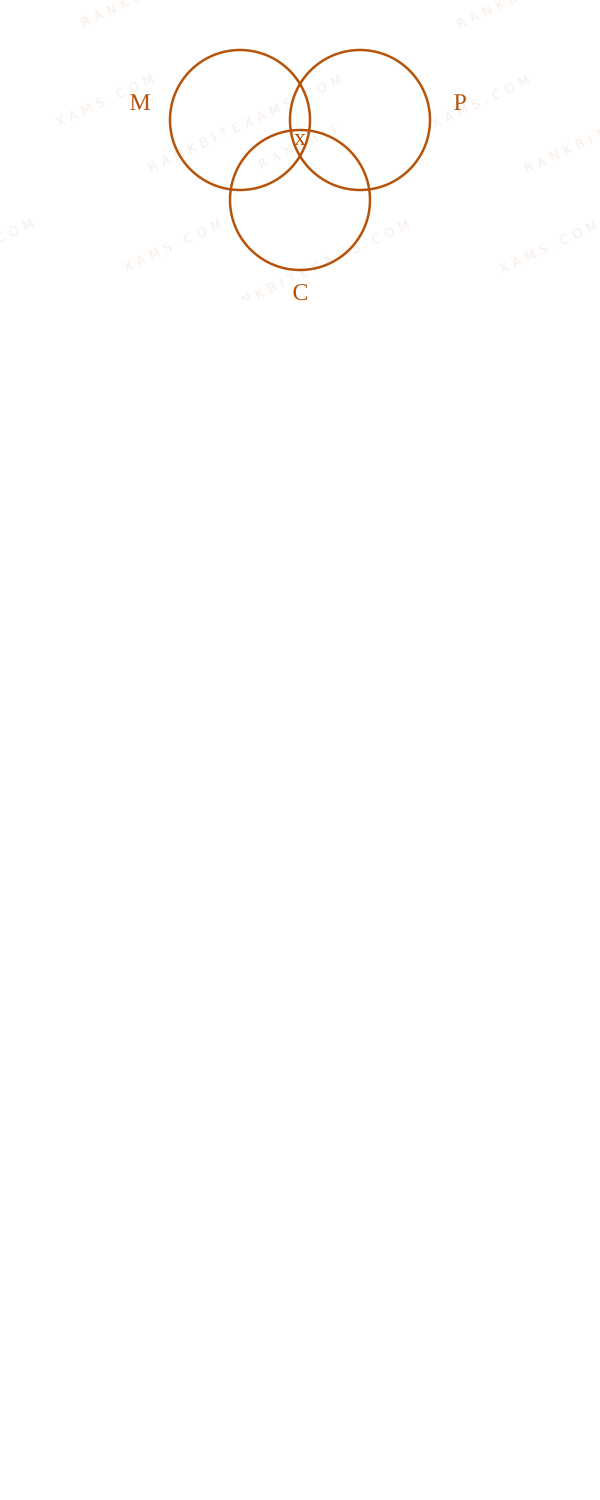
Set Operations diagram for Q21 - JEE Main 2024 Morning

Let x be the number of students who passed in all three subjects, so n(M P C) = x. We are given: n(M) = 20, n(P) = 25, n(C) = 16 n(M P C) = 40 Constraints: n(M P) ≤ 11 n(P C) ≤ 15 n(M C) ≤ 15

If we let n(M P) = 11, then the region representing only M P is 11 - x. For this to be non-negative, x ≤ 11.

Step 1: Testing x = 11

Set Operations diagram for Q21 - JEE Main 2024 Morning

Assume x = 11. To maximize, let's fix n(M P) = 11. This leaves 0 students in (M P) - (M P C). Let n(M C) = 11 + z and n(P C) = 11 + y. Constraints limit these subsets: 11 + z ≤ 15 ⇒ z ≤ 4 11 + y ≤ 15 ⇒ y ≤ 4

Filling the Venn diagram nodes: Only M = 20 - 11 - z - 0 = 9 - z Only P = 25 - 11 - y - 0 = 14 - y Only C = 16 - 11 - y - z = 5 - y - z Summing all disjoint areas: Total = (9 - z) + 0 + (14 - y) + z + 11 + y + (5 - y - z) = 40 39 - y - z = 40 ⇒ y + z = -1 Since subsets cannot be negative, x=11 is impossible.

Step 2: Testing x = 10

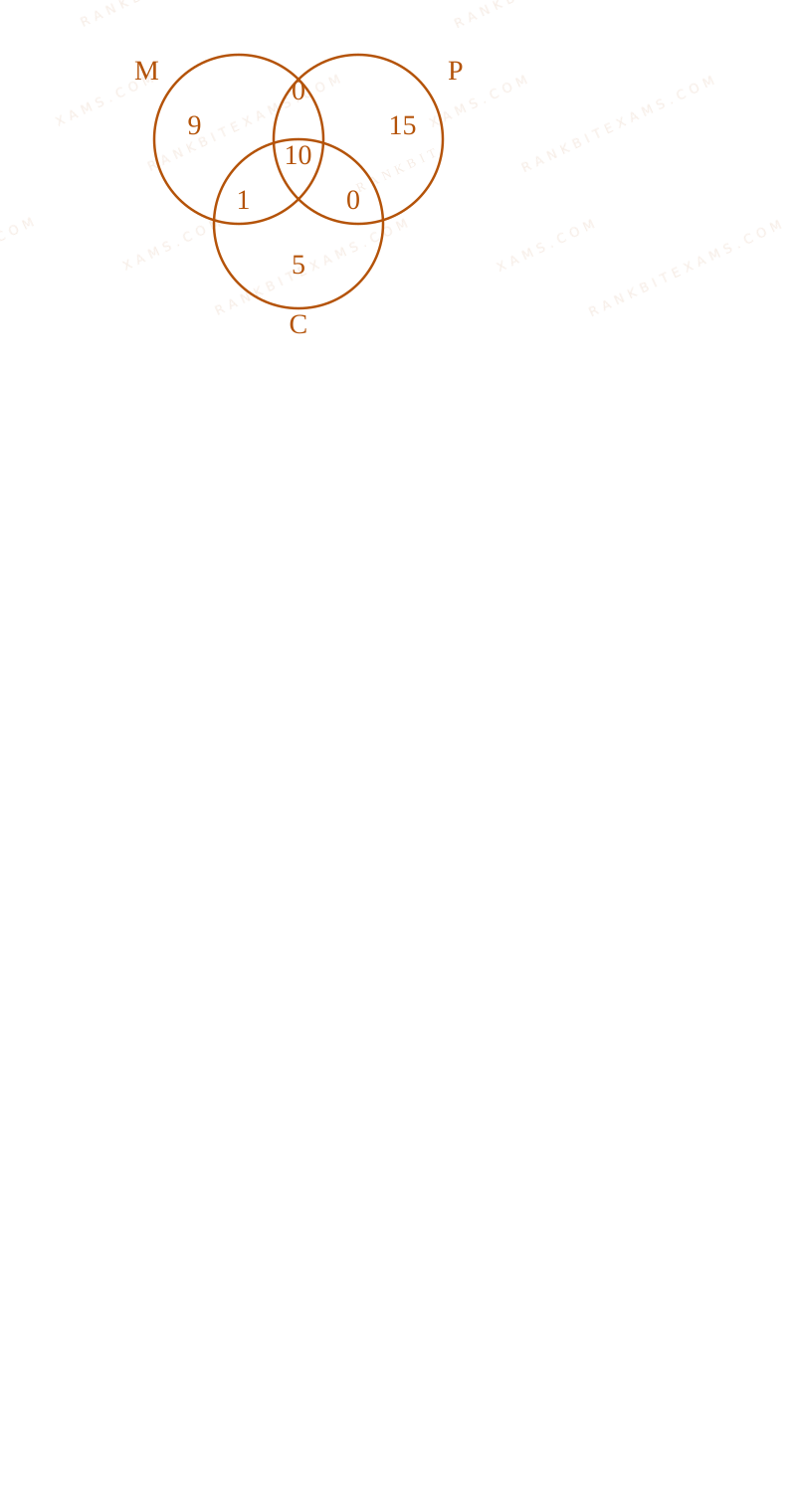
Set Operations diagram for Q21 - JEE Main 2024 Morning

Assume x = 10. Let's construct a valid distribution with x = 10. We can choose intersection values: n(M P) = 10, so only M P is 0. n(M C) = 11, so only M C is 1. n(P C) = 10, so only P C is 0. This gives: Only M = 20 - 10 - 0 - 1 = 9 Only P = 25 - 10 - 0 - 0 = 15 Only C = 16 - 10 - 1 - 0 = 5 Summing up = 9 + 15 + 5 + 0 + 1 + 0 + 10 = 40. All conditions are satisfied perfectly. Hence, the maximum number is 10.

Pattern Recognition

In multi-constraint Venn diagram maximization, test the theoretical upper bound sequentially downward until a non-negative configuration for all disjoint subsets is achieved.

Chapter Mix

Class 11 Maths: Sets

Reference Study Guides

More Sets Previous-Year Questions — Page 10

Q53 jee_main_2025_24_jan_morning Functional Relations and Equations
Let f: R - 0 → R be a function such that f(x) - 6f((1)/(x)) = (35)/(3x) - (5)/(2) If x → 0 ( (1)/(α x) + f(x) ) = β for some α, β in R, then α + 2β is equal to :
  • A. 3
  • B. 5
  • C. 4
  • D. 6

Solution

Related Formula

For functional equations with inversion, substituting x → (1)/(x) establishes a solvable system of algebraic equations to isolate f(x) directly.

Core Logic

The given equation is:

f(x) - 6f((1)/(x)) = (35)/(3x) - (5)/(2) (1)

Substitute x → (1)/(x) in equation (1):

f((1)/(x)) - 6f(x) = (35x)/(3) - (5)/(2) (2)
Step 1: Eliminate f(1/x)

Multiply equation (2) by 6 and add it to equation (1):

[ f(x) - 6f((1)/(x)) ] + 6 [ f((1)/(x)) - 6f(x) ] = ( (35)/(3x) - (5)/(2) ) + 6 ( (35x)/(3) - (5)/(2) ) f(x) - 36f(x) = (35)/(3x) - (5)/(2) + 70x - 15 -35f(x) = 70x + (35)/(3x) - (35)/(2)

Divide across by -35:

f(x) = -2x - (1)/(3x) + (1)/(2)
Step 2: Evaluate the Limit

We are given that the following limit evaluates to a finite constant β:

x → 0 ( (1)/(α x) + f(x) ) = β x → 0 ( (1)/(α x) - 2x - (1)/(3x) + (1)/(2) ) = β x → 0 ( [ (1)/(α) - (1)/(3) ] (1)/(x) - 2x + (1)/(2) ) = β

For the limit to be a finite value, the coefficient of (1)/(x) must vanish completely:

(1)/(α) - (1)/(3) = 0 α = 3

When α = 3, the limit simplifies directly to the constant term:

β = x → 0 ( -2x + (1)/(2) ) = (1)/(2)
Step 3: Calculate Final Value

Substitute the determined parameters α and β:

α + 2β = 3 + 2((1)/(2)) = 3 + 1 = 4
Pattern Recognition

In limit problems involving fractional components where x → 0, any term like (1)/(x) or higher negative powers must have a net coefficient of zero to guarantee existence of a finite limit value.

Chapter Mix

Class 11 Mathematics: Functions Class 11 Mathematics: Limits and Derivatives

Q64 jee_main_2025_28_jan_evening Range and Onto Functions
Let f:[0,3]arrow A be defined by f(x)=2x³-15x²+36x+7 and g:[0,∞)arrow B be defined by g(x)= x²⁰²⁵x²⁰²⁵+1. If both the functions are onto and S=xin Z:xin A or xin B, then n(S) is equal to:
  • A. 30
  • B. 36
  • C. 29
  • D. 31

Solution

Related Formula

For a function to be onto, its Codomain must equal its Range.

Core Logic

First, find range A for f(x) = 2x³ - 15x² + 36x + 7 over [0, 3]. Differentiating f(x):

f'(x) = 6x² - 30x + 36 = 6(x² - 5x + 6) = 6(x-2)(x-3)

Critical points are x=2 and x=3. Evaluate f(x) at boundary and critical points:

  • f(0) = 7
  • f(2) = 2(8) - 15(4) + 36(2) + 7 = 16 - 60 + 72 + 7 = 35
  • f(3) = 2(27) - 15(9) + 36(3) + 7 = 54 - 135 + 108 + 7 = 34
  • Thus, Range A = [7, 35].

Step 1: Find Range B for g(x)

Now look at g(x) = x²⁰²⁵x²⁰²⁵+1 = 1 - 1x²⁰²⁵+1 over [0, ∞).

  • At x = 0, g(0) = 0.
  • As x → ∞, g(x) → 1.
  • Since g(x) is continuous and monotonically strictly increasing, Range B = [0, 1).

Step 2: Find the Integer Count of Union Set S

S = x in Z : x in A or x in B = Z (A B)

A B = [0, 1) [7, 35]

The integers in this set are:

  • From [0, 1): x = 0
  • From [7, 35]: x = 7, 8, 9, , 35
  • Total number of integers n(S):

n(S) = 1 + (35 - 7 + 1) = 1 + 29 = 30
Pattern Recognition

The condition 'or' means union. Be careful not to include integers between 1 and 6 since they are not present in either continuous range segment.

Chapter Mix

Class 12 Mathematics: Functions Class 12 Mathematics: Application of Derivatives

Q65 jee_main_2025_28_jan_evening Domain of Inverse Trigonometric Functions
Let [x] denote the greatest integer less than or equal to x. Then domain of f(x)= ⁻¹(2[x]+1) is:
  • A. (-∞,-1] [0,∞)
  • B. (-∞,∞)
  • C. (-∞,-1] [1,∞)
  • D. (-∞,∞)-0

Solution

Related Formula

The domain of ⁻¹(y) is given by |y| ≥ 1, which means:

y ≤ -1 or y ≥ 1
Core Logic

For f(x) = ⁻¹(2[x]+1) to be defined:

2[x] + 1 ≤ -1 or 2[x] + 1 ≥ 1
Step 1: Solve individual inequalities

Case 1:

2[x] + 1 ≤ -1 2[x] ≤ -2 [x] ≤ -1

This holds true for all x < 0, i.e., x in (-∞, 0).

Case 2:

2[x] + 1 ≥ 1 2[x] ≥ 0 [x] ≥ 0

This holds true for all x ≥ 0, i.e., x in [0, ∞).

Step 2: Take Union of the Solutions
Domain = (-∞, 0) [0, ∞) = (-∞, ∞)
Pattern Recognition

Since [x] covers all integer values and 2[x]+1 forms all odd integer values, the expression inside ⁻¹ is always a non-zero integer. Non-zero integers always have absolute value ≥ 1. Hence, it is valid for all real numbers.

Chapter Mix

Class 11 Mathematics: Functions Class 12 Mathematics: Inverse Trigonometric Functions

Q70 jee_main_2025_28_jan_evening Functional Equations
Let f:R-0arrow(-∞,1] be a polynomial of degree 2, satisfying f(x)f((1)/(x))=f(x)+f((1)/(x)). If f(K)=-2K then the sum of squares of all possible values of K is:
  • A. 1
  • B. 6
  • C. 7
  • D. 9

Solution

Related Formula

Standard result for functional equation of a polynomial satisfying f(x)f(1/x) = f(x) + f(1/x):

f(x) = 1 ± xⁿ
Core Logic

Given that f(x) is a polynomial of degree 2, the identity implies:

f(x) = 1 + x² or f(x) = 1 - x²

We are given the range is bounded above: (-∞, 1].

  • For 1 + x², the range is [1, ∞).
  • For 1 - x², the range is (-∞, 1].
  • Therefore, the correct functional form is f(x) = 1 - x².

Step 1: Solve for K

Given condition: f(K) = -2K

1 - K² = -2K K² - 2K - 1 = 0

Let the roots of this equation be K₁ and K₂. From quadratic properties (Vieta's formulas): K₁ + K₂ = 2

K₁ · K₂ = -1
Step 2: Calculate Sum of Squares

We need the sum of squares of the values of K:

K₁² + K₂² = (K₁ + K₂)² - 2K₁K₂ K₁² + K₂² = (2)² - 2(-1) = 4 + 2 = 6
Pattern Recognition

The functional equation f(x)f(1/x)=f(x)+f(1/x) uniquely forces polynomials to be 1 ± xⁿ. Remembering this shortcut saves valuable time required to derive the template from general coefficients.

Chapter Mix

Class 11 Mathematics: Complex Numbers and Quadratic Equations Class 12 Mathematics: Functions

Q61 jee_main_2025_29_jan_morning Types of Relations
Define a relation R on the interval [0,(π)/(2)) by x R y if and only if ²x - ²y = 1 . Then R is:
  • A. an equivalence relation
  • B. both reflexive and transitive but not symmetric
  • C. both reflexive and symmetric but not transitive
  • D. reflexive but neither symmetric nor transitive

Solution

Related Formula
² θ - ² θ = 1
Core Logic

To show R is an equivalence relation, verify reflexive, symmetric, and transitive properties sequentially.

Step 1: Reflexive Property

For any x in [0, π/2):

² x - ² x = 1 xRx (Reflexive)
Step 2: Symmetric Property

If xRy ² x - ² y = 1. Using identities: (1 + ² x) - ( ² y - 1) = 1 ² y - ² x = 1 yRx (Symmetric)

Step 3: Transitive Property

If

Step 3: Transitive Property

If $xRyandyRz \implies \sec^2 x - \tan^2 y = 1and ² y - ² z = 1. Adding both equations:

² x - ² y + ² y - ² z = 2² x + ( ² y - ² y) - ² z = 2 ² x + 1 - ² z = 2² x - ² z = 1 xRz (Transitive)

Hence,

Hence, $Ris an equivalence relation.

Pattern Recognition

Converting the relation constraint to

Pattern Recognition

Converting the relation constraint to $\sec^2 x - 1 = \tan^2 y \implies \tan^2 x = \tan^2 y$ makes the equivalence property obvious by basic equality comparison rules.

Chapter Mix

Class 12 Mathematics: Relations and Functions

More Sets Questions — jee_main_2024_30_jan_morning

Practice all Sets previous-year questions →

Rankbit System
JEE Physics: Waves (+15.5%) | Electrostatics: Concentric Shells (-29.7%) | Modern Physics: Photoelectric Clones (+34.2%) | Mathematics: Definite Integrals (+18.1%) | Chemistry: Coordination Splitting (-11.4%) | JEE Physics: Waves (+15.5%) | Electrostatics: Concentric Shells (-29.7%) | Modern Physics: Photoelectric Clones (+34.2%) | Mathematics: Definite Integrals (+18.1%) | Chemistry: Coordination Splitting (-11.4%)