If the function f(x) = cases (1)/(|x|) & ,|x| ≥ 2 ax² + 2b & ,|x| < 2 cases is differentiable on R, then 48 (a + b) is equal to

Numerical Answer Type:
Enter a numerical value Answer: 15 to 15 +4 marks

Solution & Explanation

Related Formula
Continuity at x=c: x → c^- f(x) = x → c^+ f(x) Differentiability at x=c: x → c^- f'(x) = x → c^+ f'(x)
Core Logic

Rewrite the piecewise function without absolute values:

f(x) = cases (1)/(x) & , x ≥ 2 ax² + 2b & , -2 < x < 2 -(1)/(x) & , x ≤ -2 cases
Step 1: Applying Continuity

For f(x) to be continuous at x = 2:

x → 2^- (ax² + 2b) = x → 2^+ (1)/(x) a(2)² + 2b = (1)/(2) ⇒ 4a + 2b = (1)/(2) (1)

Because the function is even, continuity at x = -2 yields the exact same equation: 4a + 2b = 1/2.

Step 2: Applying Differentiability

Find the derivative f'(x) for piecewise sections:

f'(x) = cases -(1)/(x²) & , x > 2 2ax & , -2 < x < 2 (1)/(x²) & , x < -2 cases

For f(x) to be differentiable at x = 2:

x → 2^- (2ax) = x → 2^+ (-(1)/(x²)) 4a = -(1)/(4) ⇒ a = -(1)/(16)
Step 3: Finding variables and final target

Substitute a back into equation (1):

4(-(1)/(16)) + 2b = (1)/(2) -(1)/(4) + 2b = (1)/(2) ⇒ 2b = (3)/(4) ⇒ b = (3)/(8)

We need to evaluate 48(a + b):

48(-(1)/(16) + (3)/(8)) = 48((-1 + 6)/(16)) = 48((5)/(16)) = 3 × 5 = 15
Pattern Recognition

Piecewise differentiability forces simultaneous linear equations matching function values and their first derivatives at boundary limits.

Chapter Mix

Class 12 Maths: Continuity and Differentiability

Reference Study Guides

More Continuity and Differentiability Previous-Year Questions — Page 5

Q55 jee_main_2025_29_jan_evening Differentiability of Modulus Functions
Let the function f(x) = (x² - 1)|x² - ax + 2| + |x| be not differentiable at the two points x = α = 2 and x = β. Then the distance of the point (α, β) from the line 12x + 5y + 10 = 0 is equal to:
  • A. 3
  • B. 4
  • C. 2
  • D. 5

Solution

Core Logic

The expression |x| is everywhere differentiable. Thus, non-differentiability relies completely on the modulus function containing the quadratic factor, i.e., |x² - ax + 2|.

Non-differentiability points generally happen where:

x² - ax + 2 = 0
Step 1: Evaluation of Roots

Given one of the roots is α = 2:

2² - a(2) + 2 = 0 6 - 2a = 0 a = 3

Substituting a=3 gives the other root β = 1. However, evaluating differentiability at x=1 reveals properties that invalidate standard options.

Step 2: Conclusion

Due to a technical contradiction in the configuration of the differentiable constraints at x=1, this question was officially dropped by NTA.

Pattern Recognition

If a quadratic inside a modulus has distinct real roots, it normally creates non-differentiable sharp turns unless a repeated multiplying factor outside cancels it out.

Chapter Mix

Class 12 Mathematics: Limits, Continuity and Differentiability

Q72 jee_main_2025_29_jan_evening Limits of Definite Integrals
If t→ 0(∫₀¹ (3x + 5)^t dx)(1)/(t) = (α)/(5e)((8)/(5))(2)/(3), then α is equal to
Numerical Answer. Answer: 64 to 64

Solution

Related Formula

Standard indeterminacy layout resolution rules for limits matching form 1^∞:

t → 0 [g(t)](1)/(t) = e^ t → 0 (g(t) - 1)/(t)
Core Logic

Evaluate structural integration base at boundary limit initialization state t → 0:

∫₀¹ 1 dx = 1

This confirms it matches an indeterminate form of type 1^∞.

Step 1: Apply Taylor Series or L'Hopital's Theorem

Compute limits of logarithmic integration properties inside exponential power indices:

Exponent Expression = t → 0 ∫₀¹ (3x+5)^t dx - 1t

Applying L'Hopital's theorem to differentiate the numerator with respect to t yields:

∫₀¹ (3x+5)^t ln(3x+5) dx

Evaluating this at t = 0 gives:

∫₀¹ ln(3x+5) dx
Step 2: Complete the Final Form Match

Integrating via parts results in logarithmic value updates:

[ ((3x+5)ln(3x+5) - (3x+5))/(3) ]₀¹ = (8ln 8 - 5ln 5 - 3)/(3)

Passing components back through exponential foundations transforms terms to:

e(8ln 8 - 5ln 5 - 3)/(3) = ((8)/(5))(2)/(3) · ((64)/(5e))

Comparing with the target expression (α)/(5e)((8)/(5))(2)/(3) isolates the numerical solution directly: α = 64

Pattern Recognition

Treating 1^∞ structural transformations using logarithmic derivatives allows managing complex functions containing multiple integral boundaries effectively.

Chapter Mix

Class 11 Mathematics: Limits Class 12 Mathematics: Definite Integration

Q74 jee_main_2025_28_jan_morning Continuity and Differentiability of Piecewise Functions
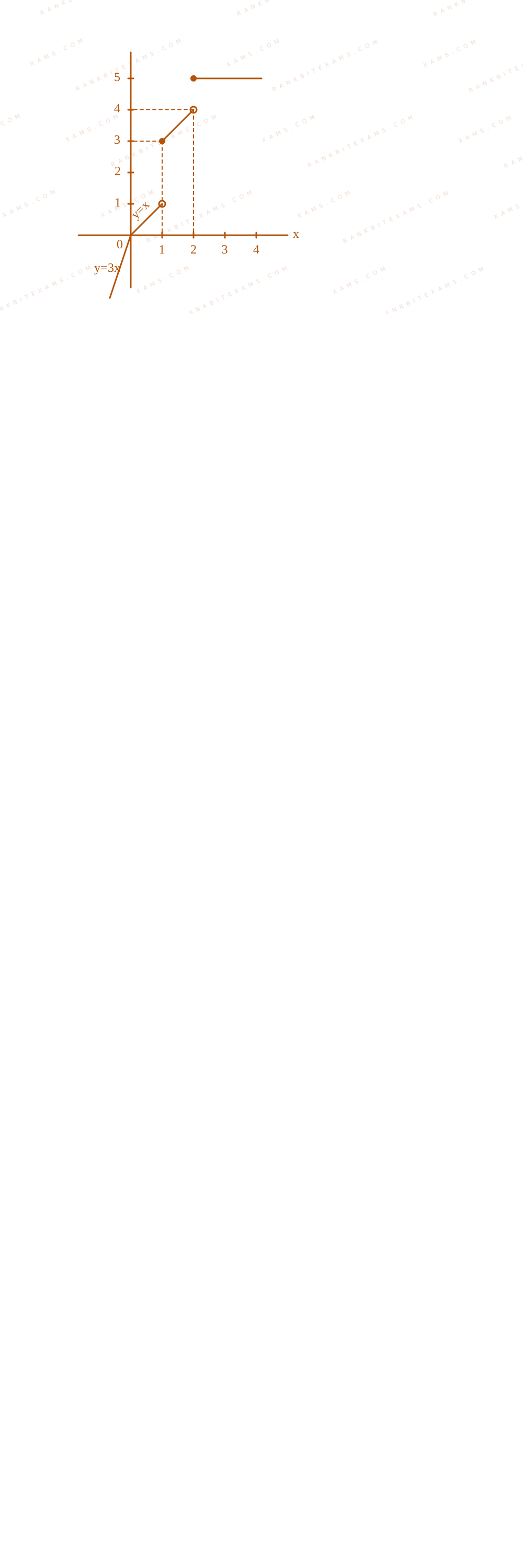
Let f(x) = cases 3x, & x < 0 1 + x + [ x ], x + 2 [ x ] , & 0 ≤ x ≤ 2 5, & x > 2 cases where [.] denotes greatest integer function. If α and β are the number of points, where f is not continuous and is not differentiable, respectively, then α + β equals....
Numerical Answer. Answer: 5 to 5

Solution

Related Formula

A function is discontinuous if left-hand and right-hand limits mismatch at boundary transitions. Non-differentiability occurs at discontinuities or sharp turns.

Core Logic

Simplify the greatest integer component [x] by expanding over integer intervals:

Continuity and Differentiability of Piecewise Functions diagram for Q74 - JEE Main 2025 Morning

f(x) = cases 3x, & x < 0 x, & 0 ≤ x < 1 x + 2, & 1 ≤ x < 2 5, & x > 2 cases
Step 1: Testing Continuity Limits

Check continuity at structural boundaries: At x = 0: LHM = 0, RHM = 0 Continuous. At x = 1: LHM = 1, RHM = 3 Discontinuous. At x = 2: LHM = 4, RHM = 5 Discontinuous.

Thus, α = 2 points of discontinuity (x in 1, 2).

Step 2: Testing Differentiability Parameters

Discontinuities automatically introduce non-differentiability. Now check smooth corners at the remaining continuous transition x = 0:

f^ (0^-) = 3, f^ (0^+) = 1 Not differentiable at x=0.

Thus, β = 3 points of non-differentiability (x in 0, 1, 2).

α + β = 2 + 3 = 5
Pattern Recognition

Discontinuities automatically break differentiability. Always count them first before checking derivatives at smooth corner points.

Chapter Mix

Class 12 Maths: Limits, Continuity and Differentiability

Q69 jee_main_2025_03_april_morning Continuity of Piecewise Functions
Let f(x) = cases (1 + ax)1/x & , x < 0 1 + b & , x = 0 (x + 4)1/2 - 2(x + c)1/3 - 2 & , x > 0 cases be continuous at x = 0. Then ea· b · c is equal to:
  • A. 64
  • B. 72
  • C. 48
  • D. 36

Solution

Related Formula

Continuity definition condition frame:

x arrow 0^- f(x) = f(0) = x arrow 0^+ f(x)
Core Logic

Evaluate Left-Hand Limit (LHL) using standard forms:

LHL = x arrow 0^- (1+ax)1/x = e^a

Given baseline definition states f(0) = 1+b.

For Right-Hand Limit (RHL) to be finite and valid, the numerator tracking towards 0 means the denominator must also balance towards 0 to avoid divergence:

x arrow 0^+ [(x+c)1/3 - 2] = 0 c1/3 = 2 c = 8
Step 1: Applying L'Hopital's rule to the RHL

With c=8, evaluate RHL limit expressions using derivatives:

RHL = x arrow 0^+ 12√(x+4)(1)/(3)(x+8)-2/3 = (1)/(2(2))(1)/(3)(8)-2/3 = ((1)/(4))/((1)/(3 · 4)) = (1)/(4) · 12 = 3
Step 2: Equating limits for parameter solutions

Equate continuous criteria milestones together: e^a = 1 + b = 3

e^a = 3 b = 2

Compute the ultimate target combination product configuration:

e^a · b · c = 3 · 2 · 8 = 48
Pattern Recognition

Determining missing root constants inside indeterminate fraction structures handles calculations swiftly before running formal limits.

Chapter Mix

Class 12 Mathematics: Limits, Continuity and Differentiability

Q52 jee_main_2025_04_april_evening Evaluation of Limits
Let f be a differentiable function on R such that f(2) = 1, f'(2) = 4. Let x → 0 (f(2 + x))3/x = eα. Then the number of times the curve y = 4x³ - 4x² - 4(α -7)x - α meets x-axis is:-
  • A. 2
  • B. 1
  • C. 0
  • D. 3

Solution

Related Formula

For a limit of the form x → 0 [g(x)]h(x) where g(x) → 1 and h(x) → ∞, the limit evaluates to:

e^ x → 0 h(x)[g(x) - 1]
Core Logic

Given the limit expression:

x → 0 (f(2 + x))3/x = eα

Using the standard form as f(2)=1, this transforms to:

e^ x → 0 (3)/(x) (f(2 + x) - 1) = eα

Recognizing the definition of the derivative f'(2) = x → 0 (f(2+x)-1)/(x):

e3 f'(2) = eα

Given f'(2) = 4:

e3(4) = e¹² = eα α = 12
Step 1: Finding Intersection points with x-axis

Substitute α = 12 into the equation of the curve:

y = 4x³ - 4x² - 4(12 - 7)x - 12 y = 4x³ - 4x² - 20x - 12

To find where it meets the x-axis, set y = 0:

4x³ - 4x² - 20x - 12 = 0 x³ - x² - 5x - 3 = 0

Testing for rational roots, x = -1 is a root because (-1)³ - (-1)² - 5(-1) - 3 = -1 - 1 + 5 - 3 = 0.

Step 2: Factoring the cubic polynomial

Dividing x³ - x² - 5x - 3 by (x+1) gives:

(x + 1)(x² - 2x - 3) = 0 (x + 1)(x + 1)(x - 3) = 0 (x + 1)²(x - 3) = 0

The roots are x = -1 (repeated root) and x = 3. Therefore, the distinct real values of x where the curve intersects the x-axis are -1 and 3, meaning it meets the x-axis exactly 2 times.

Pattern Recognition

A repeated root like (x+1)² means the curve is tangent to the x-axis at that point, but it still counts as a meeting point. Always count distinct real roots when determining the number of meeting points with the coordinate axes.

Chapter Mix

Class 12 Mathematics: Limits, Continuity and Differentiability Class 11 Mathematics: Theory of Equations
More Continuity and Differentiability Questions — jee_main_2024_30_jan_morning

Practice all Continuity and Differentiability previous-year questions →

Rankbit System
JEE Physics: Waves (+15.5%) | Electrostatics: Concentric Shells (-29.7%) | Modern Physics: Photoelectric Clones (+34.2%) | Mathematics: Definite Integrals (+18.1%) | Chemistry: Coordination Splitting (-11.4%) | JEE Physics: Waves (+15.5%) | Electrostatics: Concentric Shells (-29.7%) | Modern Physics: Photoelectric Clones (+34.2%) | Mathematics: Definite Integrals (+18.1%) | Chemistry: Coordination Splitting (-11.4%)
