Choose the correct Statements from the following:
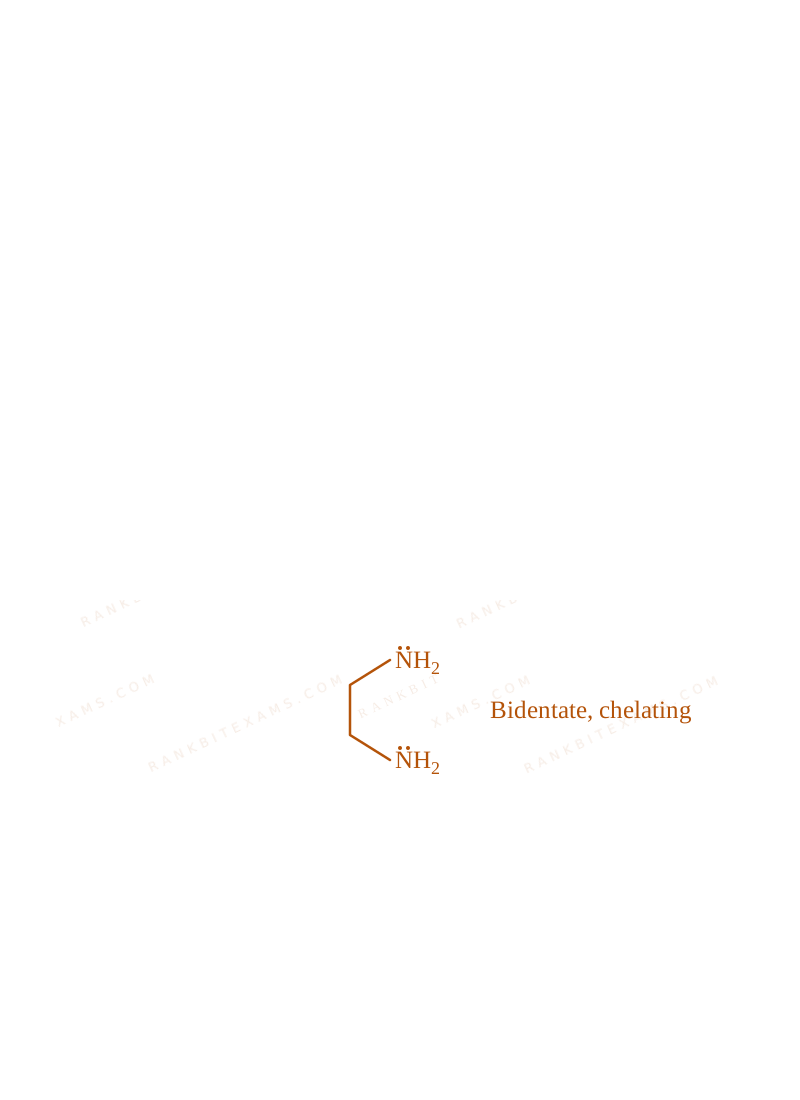
(A) Ethane-1 2-diamine is a chelating ligand.
(B) Metallic aluminium is produced by electrolysis of aluminium oxide in presence of cryolite.
(C) Cyanide ion is used as ligand for leaching of silver.
(D) Phosphine act as a ligand in Wilkinson catalyst.
(E) The stability constants of Ca²⁺$Ca^{2+}$ and Mg²⁺$Mg^{2+}$ are similar with EDTA complexes.
Choose the correct answer from the options given below:
A.(B), (C), (E) only$\text{(B), (C), (E) only}$
B.(C), (D), (E) only$\text{(C), (D), (E) only}$
C.(A), (B), (C) only$\text{(A), (B), (C) only}$
D.(A), (D), (E) only$\text{(A), (D), (E) only}$
Solution & Explanation
Core Logic
(A) Ethane-1,2-diamine (en) is a bidentate ligand. Because it coordinates through two nitrogen atoms to the same metal ion, it forms a ring, making it a chelating ligand. (True)
Ligands and Coordination Number solution diagram for Q80 - JEE Main 2024 Morning
(B) In the Hall-Heroult process, metallic aluminium is produced by the electrolysis of molten alumina (Al₂O₃$Al_2O_3$). Cryolite (Na₃AlF₆$Na_3AlF_6$) is added to lower the melting point and increase conductivity. (True)
(C) In the extraction of silver (MacArthur-Forrest cyanide process), Ag$Ag$ ore is leached with a dilute solution of NaCN$NaCN$ or KCN$KCN$ in the presence of air to form the soluble complex [Ag(CN)₂]^-$[Ag(CN)_2]^-$. Thus, cyanide acts as a ligand. (True)
(D) Wilkinson's catalyst is [RhCl(PPh₃)₃]$[RhCl(PPh_3)_3]$. The ligand is triphenylphosphine (PPh₃$PPh_3$), not phosphine (PH₃$PH_3$). (False)
(E) The stability constant of the Ca²⁺$Ca^{2+}$-EDTA complex is significantly higher than that of the Mg²⁺$Mg^{2+}$-EDTA complex, which is why EDTA is used to estimate hardness sequentially. They are not similar. (False)
Step 1: Conclusion
Only statements (A), (B), and (C) are correct.
Chapter Mix
Class 12 Chemistry: Coordination Compounds
Class 12 Chemistry: General Principles and Processes of Isolation of Elements
More Coordination Compounds Previous-Year Questions — Page 10
Q33jee_main_2025_24_jan_eveningQualitative Analysis of Cations
Find the compound 'A' from the following reaction sequences.
A aqua-regia B (1) KNO2 | NH4OH, (2) AcOH yellow ppt$$\mathrm{A} \xrightarrow{\text{aqua-regia}} \mathrm{B} \xrightarrow{\text{(1) } \mathrm{KNO}{2} | \mathrm{NH}{4}\mathrm{OH}, \text{ (2) } \mathrm{AcOH}} \text{yellow ppt}$$
A. \text{ZnS}
B. \text{CoS}
C. \text{MnS}
D. \text{NiS}
Solution
Core Logic
This pathway corresponds to the standard confirmatory test for cobalt (Co²⁺$\mathrm{Co}^{2+}$) ions in qualitative inorganic analysis:
CoS$\mathrm{CoS}$ dissolves in aqua regia to yield cobalt chloride (CoCl₂$\mathrm{CoCl}_2$):
CoS + aqua regia arrow CoCl₂$$\mathrm{CoS} + \text{aqua regia} \rightarrow \mathrm{CoCl}_{2}$$
Treating this solution with potassium nitrite (KNO₂$\mathrm{KNO}_{2}$) in the presence of acetic acid (AcOH$\mathrm{AcOH}$) oxidizes Co²⁺$\mathrm{Co}^{2+}$ to Co³⁺$\mathrm{Co}^{3+}$, precipitating potassium cobaltinitrite as a characteristic yellow solid:
A yellow precipitate formed specifically upon adding KNO₂$\mathrm{KNO}_2$ and acetic acid is a definitive signature of potassium cobaltinitrite, K₃[Co(NO₂)₆]$\mathrm{K}_3[\mathrm{Co}(\mathrm{NO}_2)_6]$. This confirms the starting sulfide was CoS$\mathrm{CoS}$.
Chapter Mix
Class 12 Chemistry: Coordination Compounds
Class 11 Chemistry: Qualitative Analysis

Q37jee_main_2025_24_jan_eveningSpectrochemical Series and Colour
When Ethane-1, 2-diamine is added progressively to an aqueous solution of Nickel (II) chloride, the sequence of colour change observed will be:
A. \text{Pale Blue } \rightarrow \text{ Blue } \rightarrow \text{ Green } \rightarrow \text{ Violet}
B. \text{Pale Blue } \rightarrow \text{ Blue } \rightarrow \text{ Violet } \rightarrow \text{ Green}
C. \text{Green } \rightarrow \text{ Pale Blue } \rightarrow \text{ Blue } \rightarrow \text{ Violet}
D. \text{Violet } \rightarrow \text{ Blue } \rightarrow \text{ Pale Blue } \rightarrow \text{ Green}
Solution
Core Logic
An aqueous nickel (II) chloride solution contains the green hexaquarickel(II) complex, [Ni(H₂O)₆]²⁺$[\mathrm{Ni}(\mathrm{H}_{2}\mathrm{O})_{6}]^{2+}$. Ethane-1,2-diamine ('en') is a bidentate ligand that binds more strongly than water, shifting the crystal field splitting parameter (Δₒ$\Delta_o$) to higher energies as it replaces water molecules:
This progressive ligand replacement shifts the absorption spectrum, changing the solution's visible color from Green arrow$\rightarrow$ Pale Blue arrow$\rightarrow$ Blue arrow$\rightarrow$ Violet.
Pattern Recognition
Replacing weak-field ligands (like H₂O$\mathrm{H}_2\mathrm{O}$) with stronger bidentate chelating ligands (like 'en') increases crystal field splitting. For Ni²⁺$\mathrm{Ni}^{2+}$, this ligand substitution always follows the specific chromatic progression: Green arrow$\rightarrow$ Pale Blue arrow$\rightarrow$ Blue arrow$\rightarrow$ Violet.
Chapter Mix
Class 12 Chemistry: Coordination Compounds
Q38jee_main_2025_24_jan_eveningCrystal Field Theory
The conditions and consequence that favours the t2g³ eg¹$t_{2g}^{3} e_{g}^{1}$ configuration in a metal complex are:
A. \text{weak field ligand, high spin complex}
B. \text{strong field ligand, high spin complex}
C. \text{strong field ligand, low spin complex}
D. \text{weak field ligand, low spin complex}
Solution
Core Logic
Consider an octahedral coordination environment for a d⁴$d^4$ transition metal ion configuration:
Weak Field Ligand (WFL):
The crystal field splitting energy is smaller than the pairing energy (Δₒ < P$\Delta_o < P$). Consequently, electrons prefer to occupy the higher-energy eg$e_g$ orbitals rather than pair up in the lower-energy t2g$t_{2g}$ orbitals. This leads to a high spin complex with the configuration:
t2g³ eg¹$$t_{2g}^{3} e_{g}^{1}$$
Strong Field Ligand (SFL):
The splitting energy is larger than the pairing energy (Δₒ > P$\Delta_o > P$). Electrons pair up in the t2g$t_{2g}$ orbitals before occupying the eg$e_g$ subshell, resulting in a low spin complex with the configuration:
t2g⁴ eg⁰$$t_{2g}^{4} e_{g}^{0}$$
Pattern Recognition
An electron occupying an eg$e_g$ orbital before the t2g$t_{2g}$ orbitals are fully paired requires a weak-field ligand. This configuration maximizes the number of unpaired electrons, which is the defining characteristic of a high-spin complex.
Chapter Mix
Class 12 Chemistry: Coordination Compounds
Q28jee_main_2025_24_jan_morningWerner's Theory of Coordination Compounds
One mole of the octahedral complex compound Co(NH₃)₅Cl₃$Co(NH_{3})_{5}Cl_{3}$ gives 3 moles of ions on dissolution in water. One mole of the same complex reacts with excess of AgNO₃$AgNO_{3}$ solution to yield two moles of AgCl(s)$AgCl_{(s)}$. The structure of the complex is:
Moles of AgCl precipitated = Moles of ionizable Cl⁻ ions outside the coordination sphere$$\text{Moles of } AgCl \text{ precipitated} = \text{Moles of ionizable } Cl^{-} \text{ ions outside the coordination sphere}$$
Core Logic
Since 1 mole of the complex yields 2 moles of AgCl(s)$AgCl_{(s)}$, there must be exactly 2 chloride ions outside the coordination sphere to undergo precipitation:
Coordination Number 6 corresponds to either d²sp³$d^2sp^3$ or sp³d²$sp^3d^2$ configuration templates.
Coordination Number 4 corresponds to either sp³$sp^3$ or dsp²$dsp^2$ configuration templates.
Core Logic
Analyzing metal orbital dynamics under varying ligand fields:
(A) [CoF₆]³⁻$[CoF_6]^{3-}$: Co³⁺$Co^{3+}$ (3d⁶$3d^6$) with a weak field ligand (F^-$F^-$) arrow$\rightarrow$ no pairing occurs arrow$\rightarrow$ utilizes outer orbitals arrow$\rightarrow$sp³d²$sp^3d^2$.
(B) [NiCl₄]²⁻$[NiCl_4]^{2-}$: Ni²⁺$Ni^{2+}$ (3d⁸$3d^8$) with a weak field ligand (Cl^-$Cl^-$) arrow$\rightarrow$ no pairing occurs arrow$\rightarrow$ tetrahedral profile arrow$\rightarrow$sp³$sp^3$.
(C) [Co(NH₃)₆]³⁺$[Co(NH_3)_6]^{3+}$: Co³⁺$Co^{3+}$ (3d⁶$3d^6$) with a strong field ligand (NH₃$NH_3$) arrow$\rightarrow$ electrons pair up arrow$\rightarrow$ inner orbital configuration arrow$\rightarrow$d²sp³$d^2sp^3$.
(D) [Ni(CN)₄]²⁻$[Ni(CN)_4]^{2-}$: Ni²⁺$Ni^{2+}$ (3d⁸$3d^8$) with a strong field ligand (CN^-$CN^-$) arrow$\rightarrow$ forced pairing opens a 3d$3d$ slot arrow$\rightarrow$ square planar geometry arrow$\rightarrow$dsp²$dsp^2$.
Practice past-year questions one chapter at a time. Pick an exam → subject → chapter and get every PYQ for that topic — pulled together from all past papers — with the chapter's key formulas alongside.