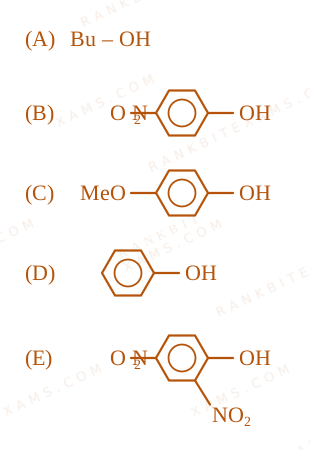
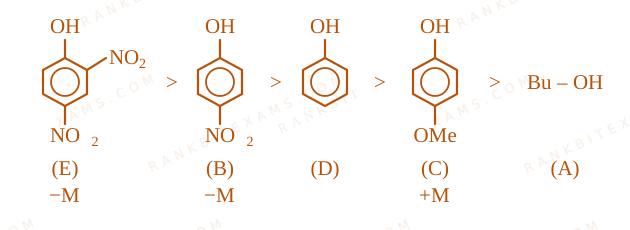
Aliphatic alcohols (Bu-OH$\text{Bu-OH}$) are least acidic due to +I$+I$ effects. Among phenols, electron-donating groups like -OMe$-\text{OMe}$ (+M$+M$ effect) reduce acidity relative to plain phenol, while electron-withdrawing groups (-NO₂$-\text{NO}_2$, -M$-M$ and -I$-I$ effects) significantly enhance stability of the conjugate phenoxide base. Two -NO₂$-\text{NO}_2$ groups heighten acidity maximally.
Structures of molecules P, Q, R, S assigned letters A through E.
+M$+M$ groups lower acidity; -M$-M$ groups raise it. Alcohols are always less acidic than resonant phenols.
Chapter Mix
Class 12 Chemistry: Alcohols, Phenols and Ethers
Q71jee_main_2024_27_jan_morningAcidity of Phenols and Lucas Test
Given below are two statements:
Statement (I): p-nitrophenol is more acidic than m-nitrophenol and o-nitrophenol.
Statement (II) : Ethanol will give immediate turbidity with Lucas reagent.
In the light of the above statements, choose the correct answer from the options given below :
A. Statement I is true but Statement II is false
B. Both Statement I and Statement II are true
C. Both Statement I and Statement II are false
D. Statement I is false but Statement II is true
Solution
Core Logic
Statement I is correct: At the para-position, the -NO₂$-\text{NO}_2$ group exerts both powerful -I$-I$ and -M$-M$ effects, maximizing electron withdrawal from the phenoxide ion. Intramolecular hydrogen bonding reduces the acidity of o-nitrophenol.
Statement II is incorrect: Lucas reagent (conc. HCl + anhydrous ZnCl₂$\text{conc. HCl} + \text{anhydrous ZnCl}_2$) reacts instantly with tertiary alcohols to give immediate turbidity. Primary alcohols like ethanol do not show turbidity at room temperature without prolonged heating.
Pattern Recognition
Para-nitrophenol acidity maximization vs Lucas test thresholds (3° > 2° > 1°$3^{\circ} > 2^{\circ} > 1^{\circ}$). Primary alcohols react very slowly.
Chapter Mix
Class 12 Chemistry: Alcohols, Phenols and Ethers
Qjee_main_2024_29_jan_morningCleavage of C-O Bond in Ethers
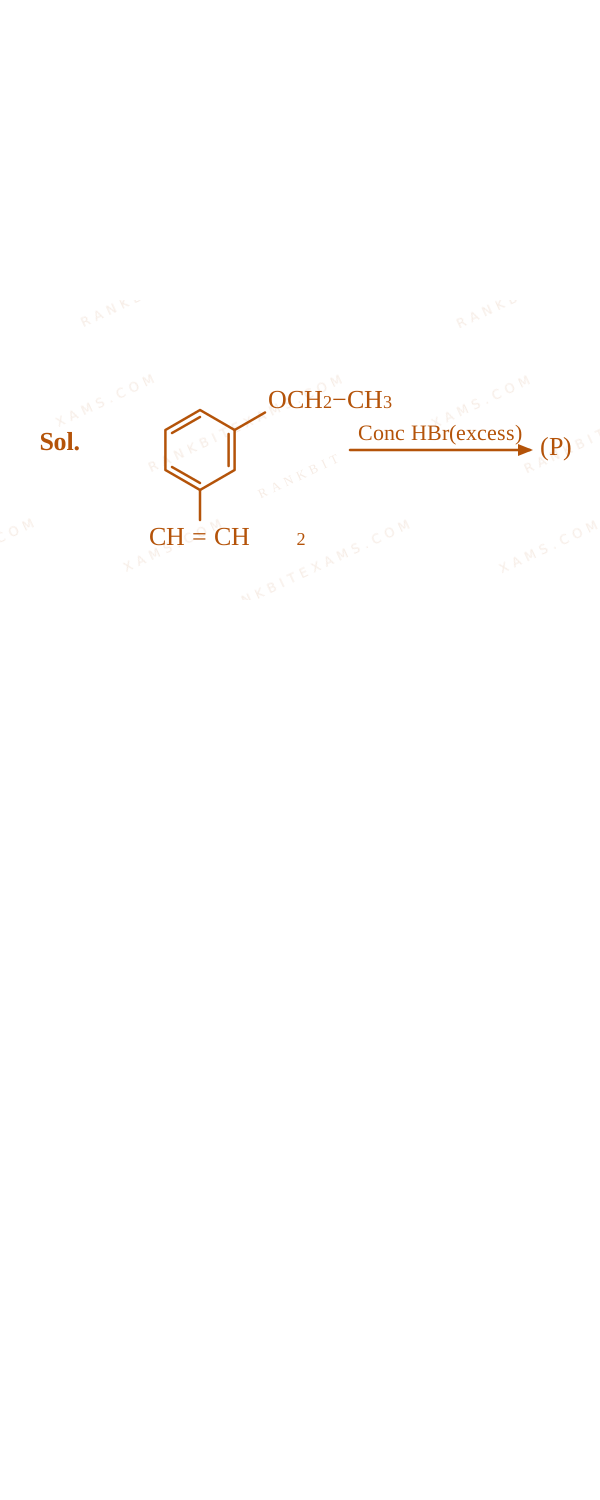
The major product(P) in the following reaction is
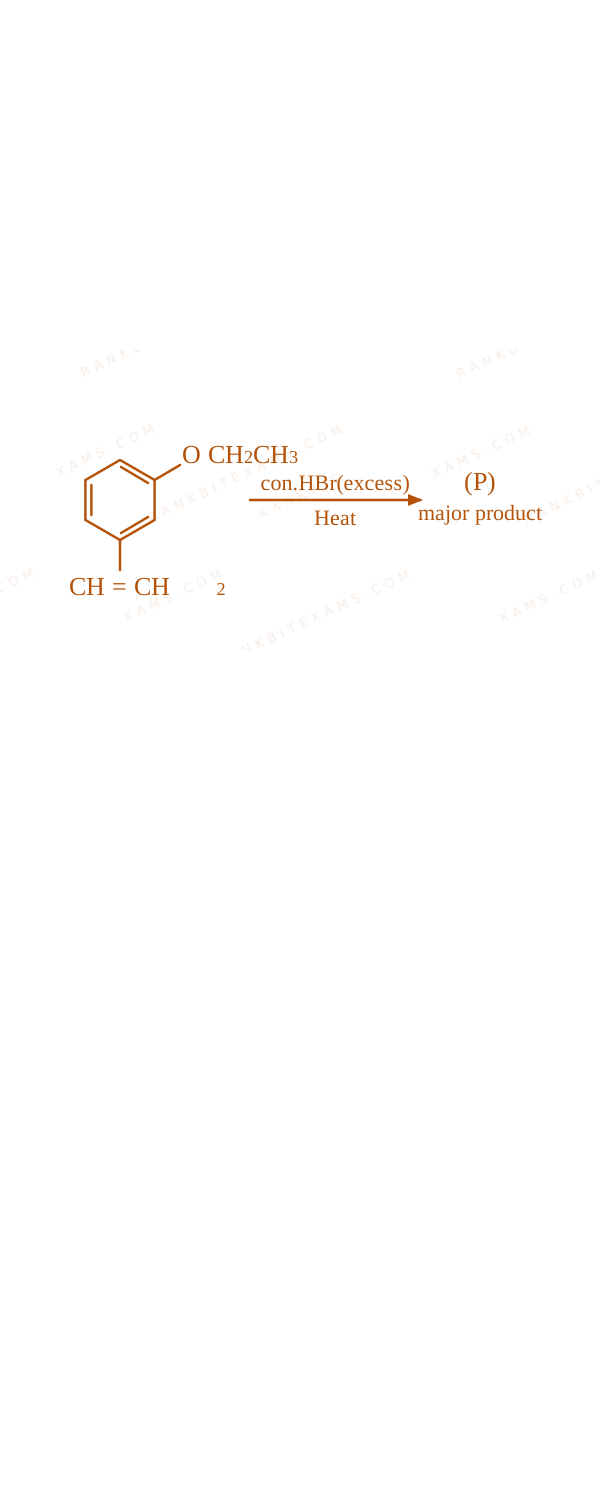
Reaction showing an aromatic ether with a vinyl group reacting with excess HBr.
A. ""
B. ""
C. ""
D. ""
Solution
Core Logic
The substrate has two reactive functional groups towards HBr$HBr$ (in excess):
An aromatic ether (anisole-type) linkage: -O-CH₂-CH₃$-O-CH_2-CH_3$
An isolated alkene (vinyl) group attached to the aromatic ring: -CH=CH₂$-CH=CH_2$
Reaction 1: Ether Cleavage
The ether linkage reacts with HBr$HBr$. Protonation of the ether oxygen occurs first, forming an oxonium ion. The Br^-$Br^-$ ion then attacks the less hindered (and sp³$sp^3$ hybridized) alkyl group (SN2$S_N2$ mechanism), specifically the ethyl group. The C(aryl)-O$C(\text{aryl})-O$ bond is much stronger due to partial double bond character from resonance, so it does NOT break.
This yields a phenol group on the ring and ethyl bromide (CH₃-CH₂-Br$CH_3-CH_2-Br$).
Reaction 2: Electrophilic Addition to Alkene
The vinyl group (-CH=CH₂$-CH=CH_2$) undergoes electrophilic addition with HBr$HBr$. Protonation yields the more stable secondary benzylic carbocation (Markovnikov's rule). The Br^-$Br^-$ then attacks this carbocation to form a 1$1$-bromoethyl group attached to the ring.
Step 1: Detailed Mechanism
Reaction showing an aromatic ether with a vinyl group reacting with excess HBr.
Final product: The ring retains an -OH$-OH$ group (phenol) at the original ether position, and the vinyl group is converted into a -CH(Br)-CH₃$-CH(Br)-CH_3$ group.
Pattern Recognition
Excess HBr$HBr$ with an aryl-alkyl ether always cleaves the alkyl C-O$C-O$ bond to give phenol + alkyl bromide. Never break the aryl C-O$C-O$ bond.
Chapter Mix
Class 12 Chemistry: Alcohols Phenols and Ethers
Class 11 Chemistry: Hydrocarbons
Qjee_main_2024_30_january_eveningReactions of Phenols
Salicylaldehyde is synthesized from phenol, when reacted with
A.
B.CO₂ , NaOH$\text{CO}_2 \text{, NaOH}$
C.CCl₄ , NaOH$\text{CCl}_4 \text{, NaOH}$
D.HCCl₃ , NaOH$\text{HCCl}_3 \text{, NaOH}$
Solution
Core Logic
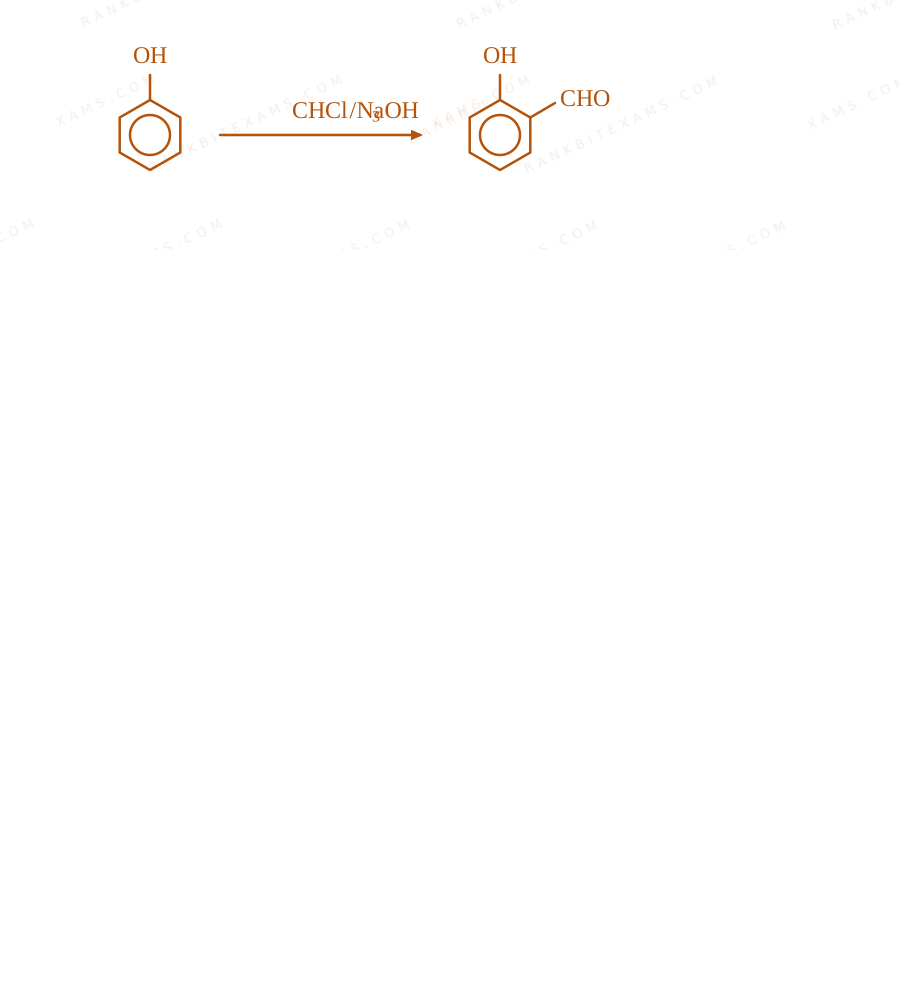
Salicylaldehyde is synthesized from phenol via the Reimer-Tiemann reaction.
In this reaction, phenol is treated with chloroform (CHCl₃$CHCl_3$ or HCCl₃$HCCl_3$) and aqueous sodium hydroxide (NaOH$NaOH$) to introduce an aldehyde group (-CHO$-CHO$) at the ortho position of the benzene ring.
Reimer Tiemann reaction mechanism diagram for Q62 - JEE Main 2024 Evening
Practice past-year questions one chapter at a time. Pick an exam → subject → chapter and get every PYQ for that topic — pulled together from all past papers — with the chapter's key formulas alongside.