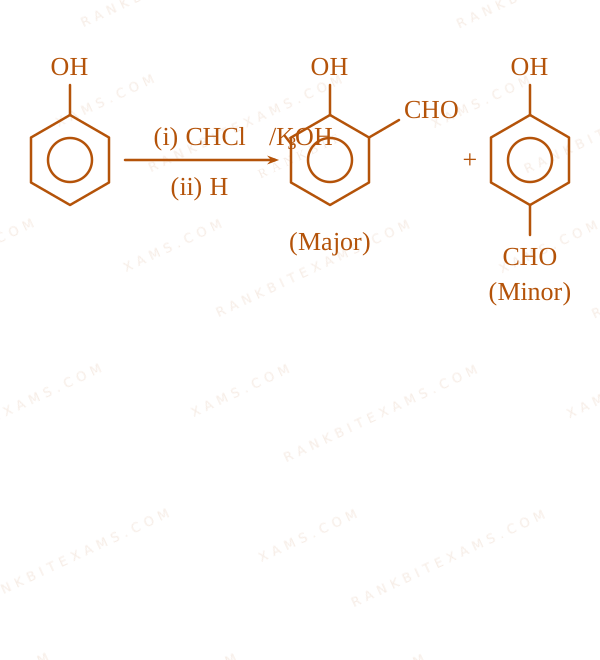
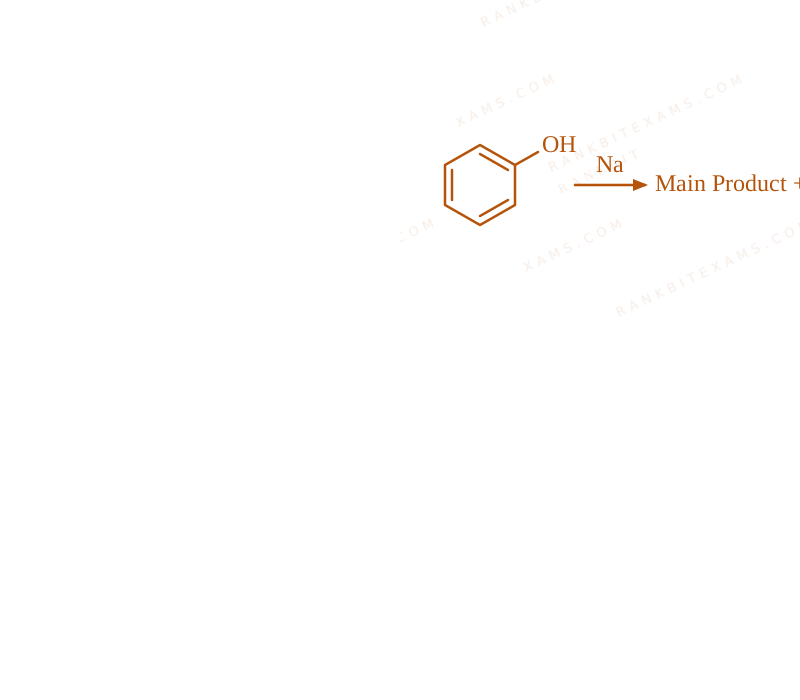
Phenol treated with chloroform in presence of sodium hydroxide, which further hydrolysed in presence of an acid results
A. Salicylic acid
B. Benzene-1,2-diol
C. Benzene-1, 3-diol
D. 2-Hydroxybenzaldehyde
Solution
### Related Formula
textPhenol + textCHCl_3 + textNaOH xrightarrowtextH^+ text2-Hydroxybenzaldehyde (Salicylaldehyde)$$\text{Phenol} + \text{CHCl}_3 + \text{NaOH} \xrightarrow{\text{H}^+} \text{2-Hydroxybenzaldehyde (Salicylaldehyde)}$$
### Core Logic
This chemical sequences details the well-known Reimer-Tiemann reaction mechanism. The treatment of phenol with alkaline chloroform generates a dichlorocarbene intermediate (:textCCl_2$:\text{CCl}_2$), which acts as an electrophile and specifically attacks the ortho position of the phenoxide ring system.
Subsequent basic hydrolysis converts the functional intermediate to an aldehyde block, providing 2-hydroxybenzaldehyde as the major final product.
### Step 1: Visual Pathway Validation
The step-by-step schematic transforms structural blocks through standard intermediates:
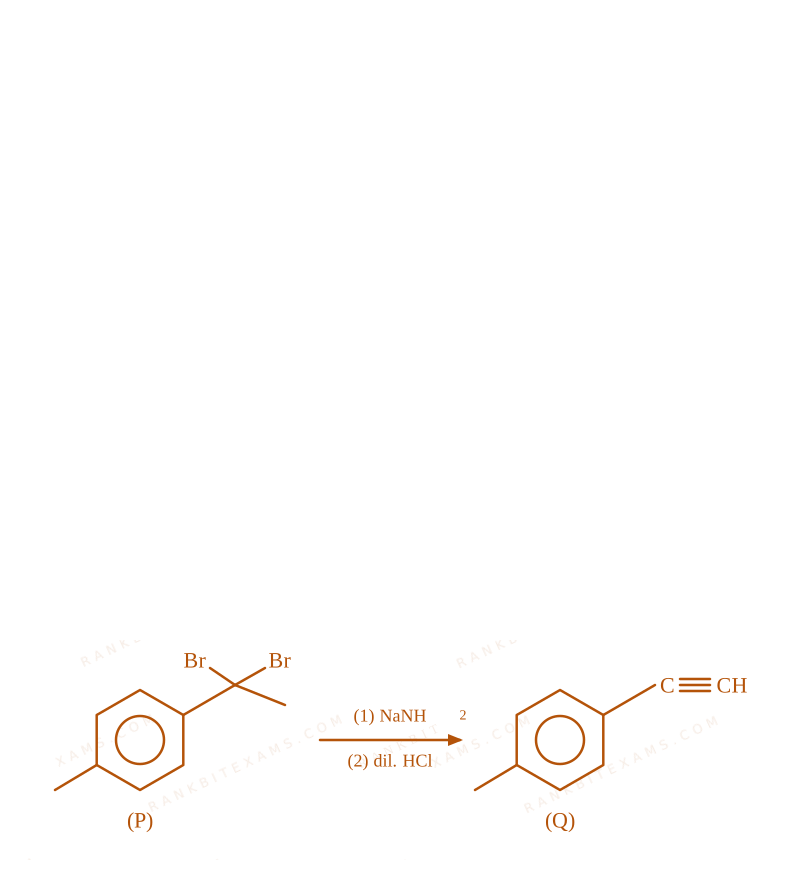
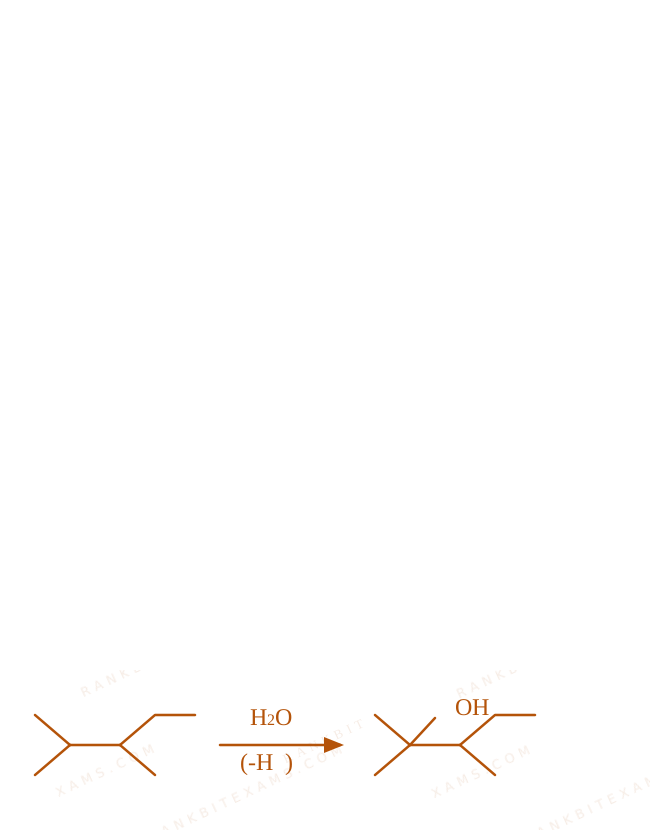
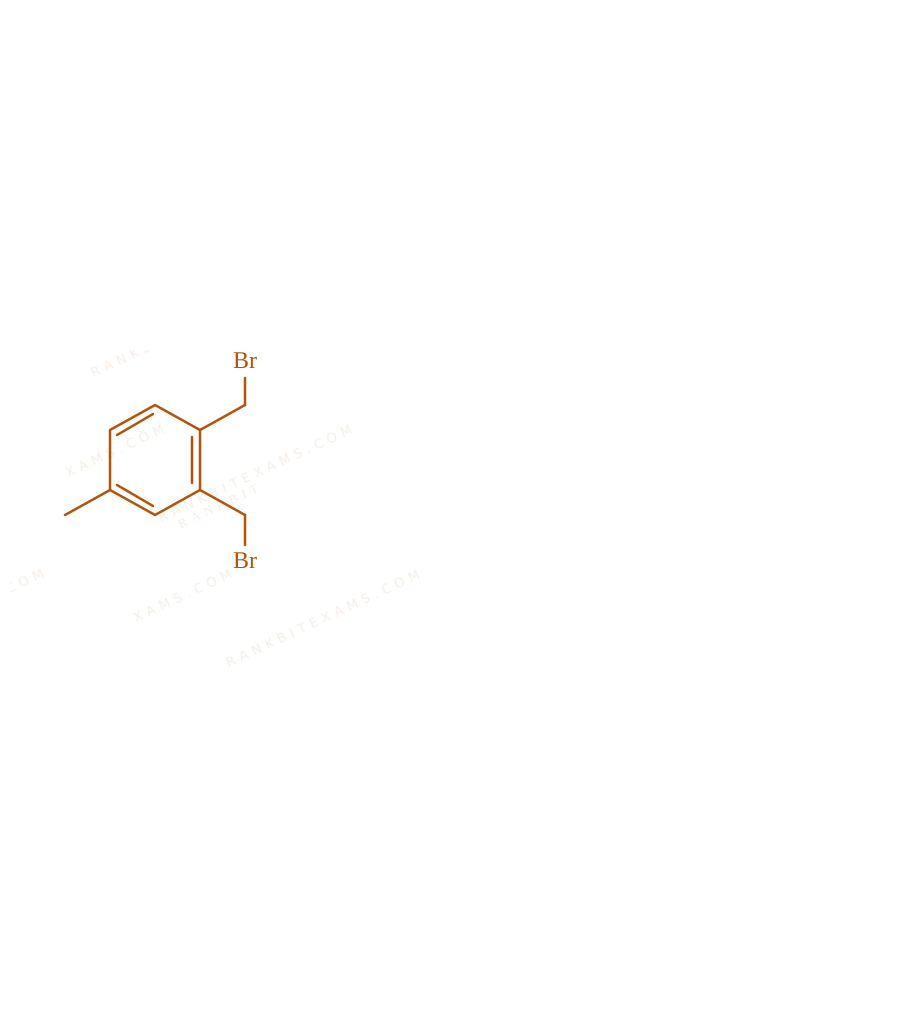
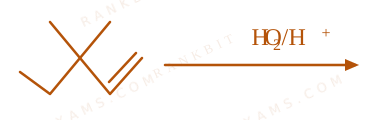
Reimer-Tiemann Reaction solution diagram for Q68 - JEE Main 2024 Evening
### Pattern Recognition
Chloroform + Base + Phenol yields formylation at the ortho site, producing salicylaldehyde (2-hydroxybenzaldehyde).
### Evaluation Rubric / Model Answer
null
### Chapter Mix
Class 12 Chemistry: Organic Compounds Containing Oxygen
Q72jee_main_2024_29_january_eveningSelective Reduction and Aldol Condensation
Identify the reagents used for the following conversion
The diagram displays a complex organic multi-step conversion starting from an ester-aldehyde block to a bicyclic system.
A. A = textLiAlH_4$\text{LiAlH}_4$, B = textNaOH_text(aq)$\text{NaOH}_{\text{(aq)}}$, C = textNH_2 - textNH_2 / textKOH$\text{NH}_2 - \text{NH}_2 / \text{KOH}$, ethylene glycol
B. A = textLiAlH_4$\text{LiAlH}_4$, B = textNaOH_text(alc)$\text{NaOH}_{\text{(alc)}}$, C = textZn/HCl$\text{Zn/HCl}$
C. A = textDIBAL-H$\text{DIBAL-H}$, B = textNaOH_text(aq)$\text{NaOH}_{\text{(aq)}}$, C = textNH_2 - textNH_2 / textKOH$\text{NH}_2 - \text{NH}_2 / \text{KOH}$, ethylene glycol
D. A = textDIBAL-H$\text{DIBAL-H}$, B = textNaOH_text(alc)$\text{NaOH}_{\text{(alc)}}$, C = textZn/HCl$\text{Zn/HCl}$
Solution
### Related Formula
textEster xrightarrowtextDIBAL-H textAldehyde$$\text{Ester} \xrightarrow{\text{DIBAL-H}} \text{Aldehyde}$$
### Core Logic
Breaking down the multistep pathway:
* **Step A**: The ester group is selectively reduced to an aldehyde using textDIBAL-H$\text{DIBAL-H}$ at low temperature without affecting other domains.
* **Step B**: An intramolecular Aldol condensation occurs in the presence of base (textNaOH$\text{NaOH}$) to generate the bicyclic alpha,beta$\alpha,\beta$-unsaturated carbonyl framework.
* **Step C**: Clemmensen reduction (using amalgamated zinc and hydrochloric acid, textZn(Hg)/HCl$\text{Zn(Hg)/HCl}$) reduces the ketone group to a hydrocarbon block.
### Step 1: Verification
The step-by-step mechanism proceeds precisely as illustrated below:
The diagram displays a complex organic multi-step conversion starting from an ester-aldehyde block to a bicyclic system.
### Pattern Recognition
DIBAL-H stops cleanly at the aldehyde phase from an ester precursor, preparing the molecule perfectly for subsequent aldol ring closures.
### Evaluation Rubric / Model Answer
null
### Chapter Mix
Class 12 Chemistry: Organic Compounds Containing Oxygen
More Organic Compounds Containing Oxygen Questions — jee_main_2024_29_january_evening
We Map Every Repeating Question in Competitive Exams.
Say goodbye to generic mock test fatigue. RankBit uses smart analysis to group past exam questions into their foundational Repeating Question Types. Find chapter weightage, track repeating questions, and score higher with targeted practice.
Select Your Target Exam
Choose an exam track below to find formulas per chapter and patterns.
Syncing Exam Intelligence
Mapping formulas and patterns across all tracks…
PATH A — FULL LENGTH PRACTICE
Full Mock Test Hub
Simulate real NTA exam conditions with fully tracked mocks. Time yourself against past papers.
Practice past-year questions one chapter at a time. Pick an exam → subject → chapter and get every PYQ for that topic — pulled together from all past papers — with the chapter's key formulas alongside.