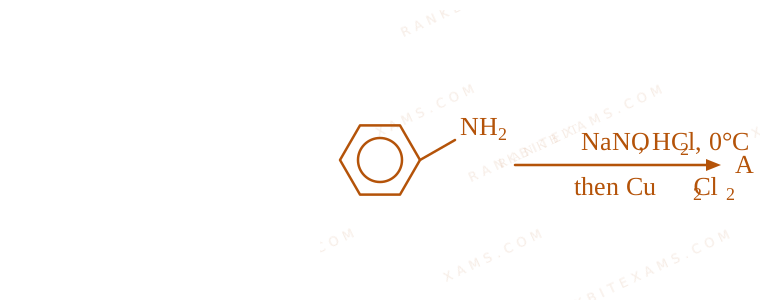
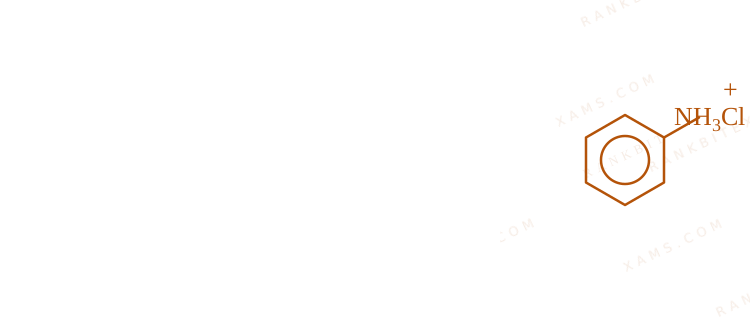
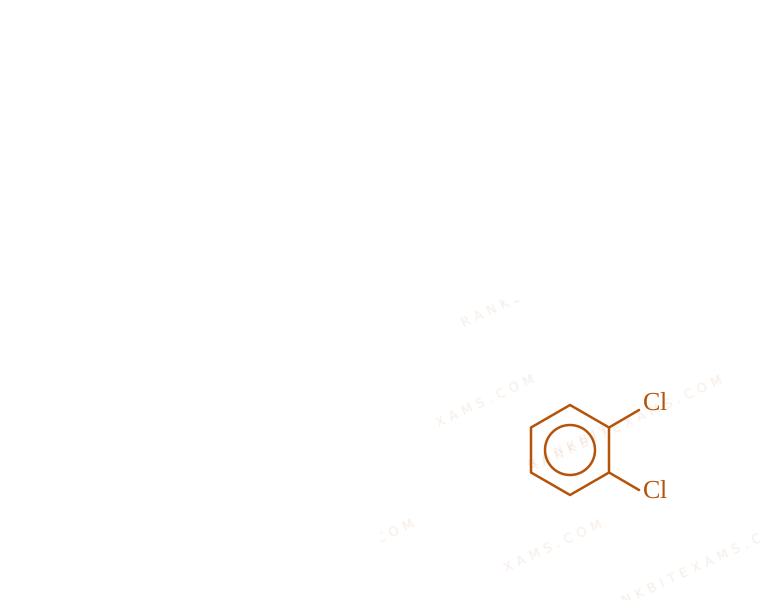
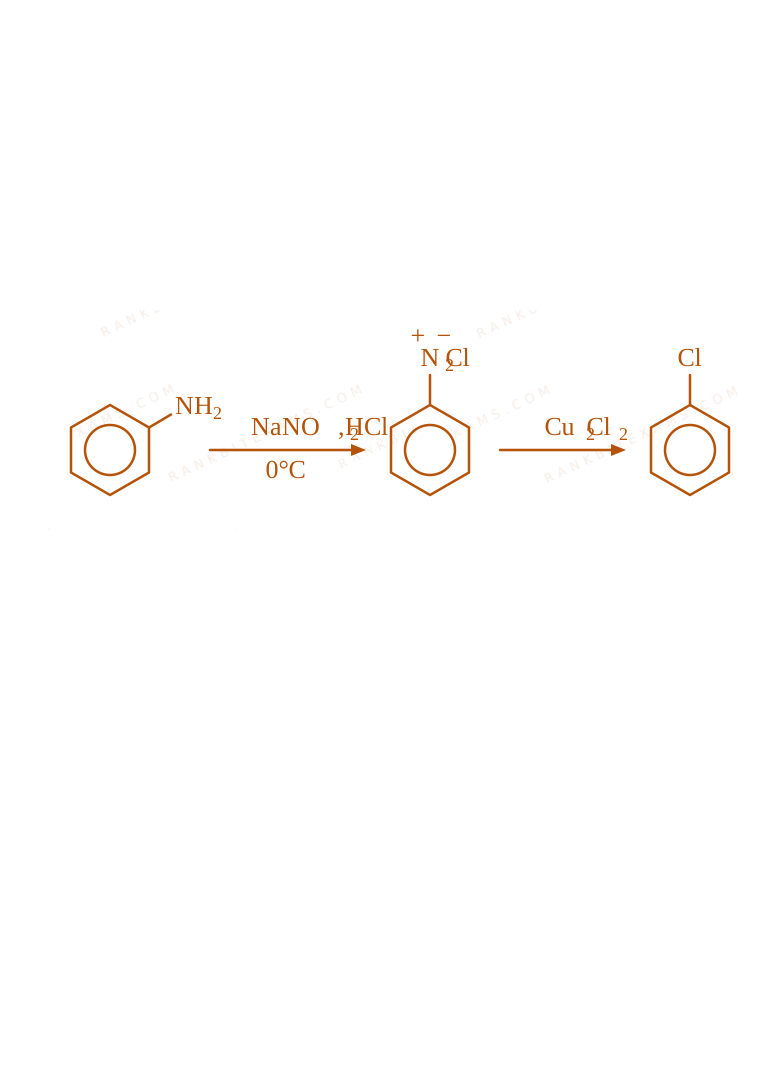
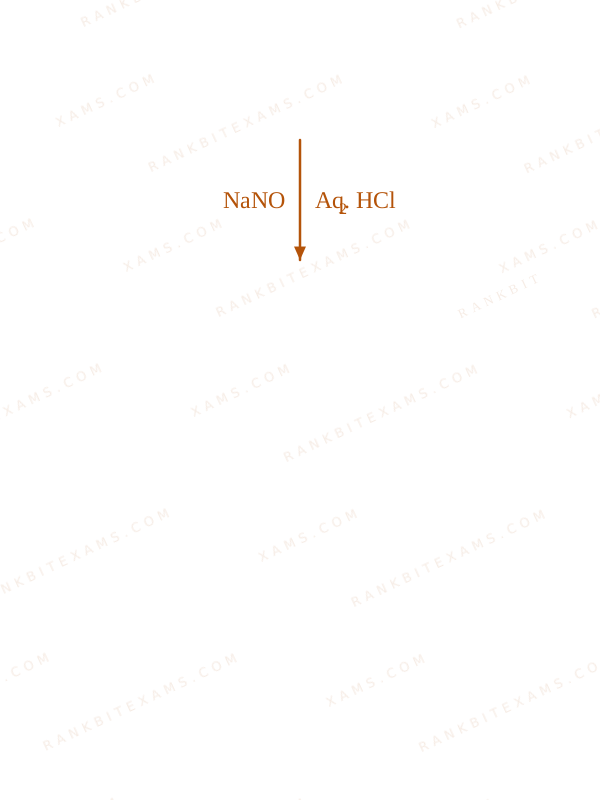
Diazotization Step: Aniline reacts with nitrous acid generated in situ (NaNO₂ + HCl$\text{NaNO}_2 + \text{HCl}$) at low temperature (0-5^$0-5^\circ\text{C}$) to form benzene diazonium chloride intermediate.
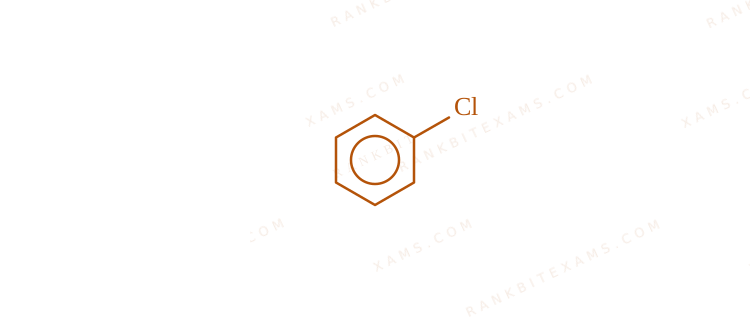
Sandmeyer Replacement Step: Treating the diazonium salt with cuprous chloride (Cu₂Cl₂$\text{Cu}_2\text{Cl}_2$) results in replacement of the diazo group by a chlorine atom.
Step 1: Visual Verification
Tracing structural shifts through intermediates validates the final outcome:
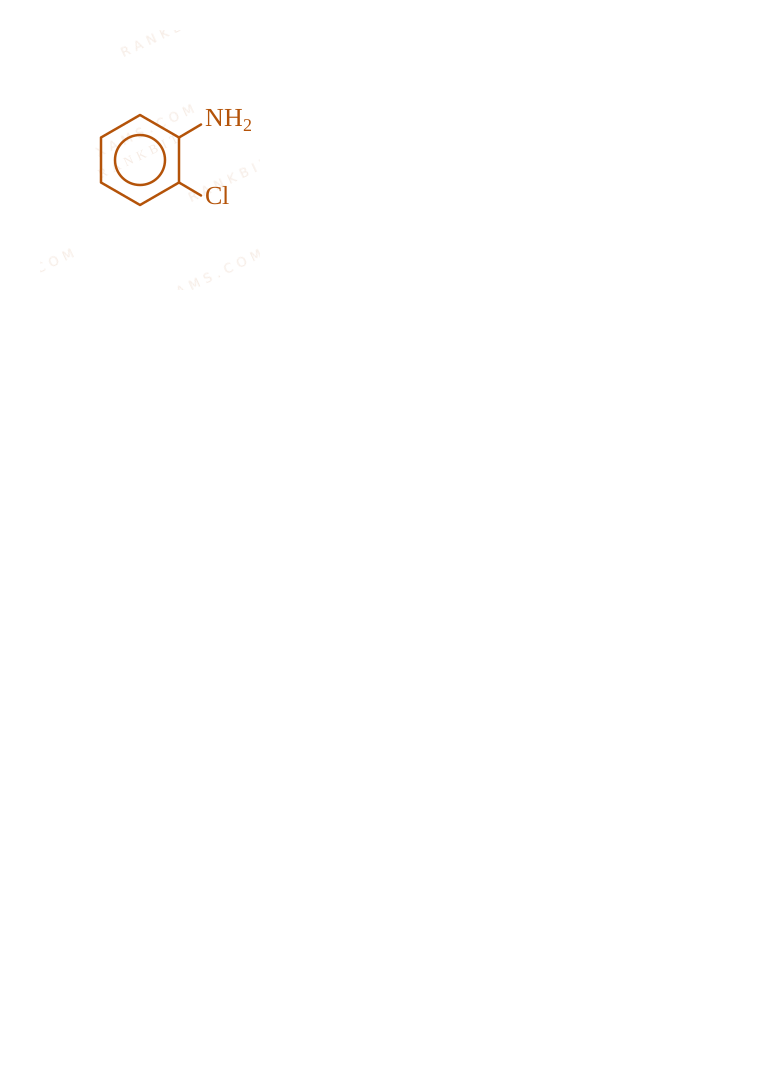
The diagram details aniline undergoing diazotization with sodium nitrite and hydrochloric acid, followed by treatment with cuprous chloride.
Pattern Recognition
Aniline arrow$\rightarrow$ Diazonium salt arrow$\rightarrow$ Chlorobenzene via standard Sandmeyer synthesis protocols.
Chapter Mix
Class 12 Chemistry: Organic Compounds Containing Nitrogen
More Organic Compounds Containing Nitrogen Previous-Year Questions
Q60jee_main_2026_21_jan_morningPreparation of Amines
An organic compound (P) on treatment with aqueous ammonia under hot condition forms compound (Q) which on heating with Br₂$Br_{2}$ and KOH forms compound (R) having molecular formula C₉H₇N$C_{9}H_{7}N$. Names of P, Q and R respectively are.
The reaction of an amide with Br₂$Br_2$ and KOH is Hoffmann bromamide degradation. It steps down the carbon chain by one carbonyl carbon to form a primary amine.
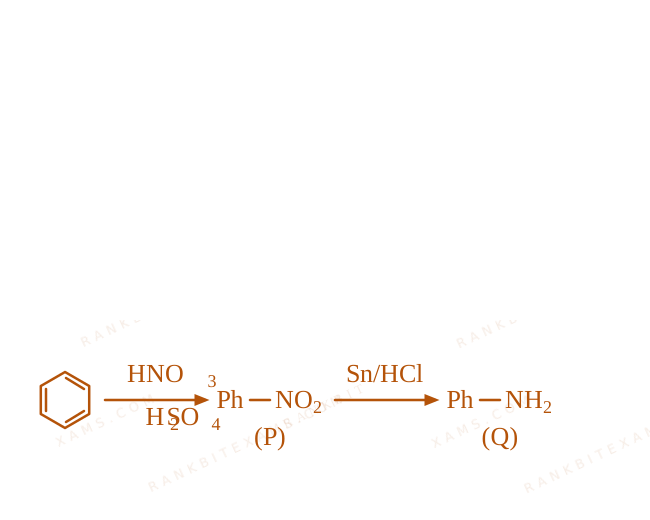
Let's analyze the options and molecular formula. The question says (R) has molecular formula C₉H₇N$C_9H_7N$. Wait, looking at the standard solutions for this type of problem, aniline is C₆H₇N$C_6H_7N$. The PDF says C₉H₇N$C_9H_7N$ which is likely a typo in the original paper for C₆H₇N$C_6H_7N$, since option (1) gives Aniline (C₆H₇N$C_6H_7N$). Let's assume the standard sequence:
Electrophilic Substitution Reactions diagram for Q74 - JEE Main 2026 Morning
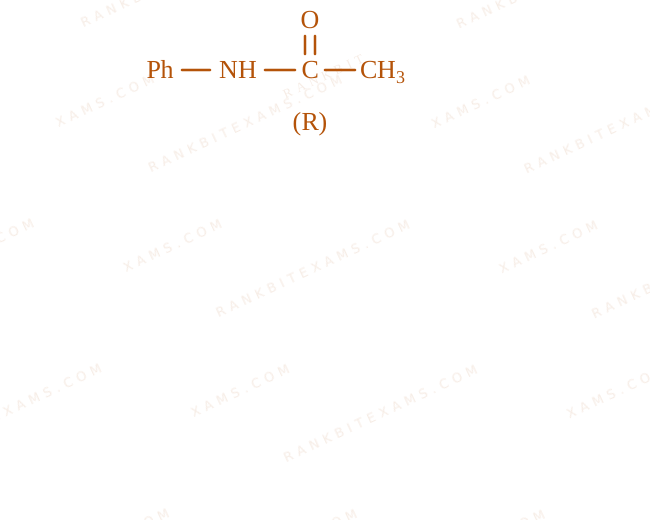
Step 3: Acetylation of aniline with acetic anhydride gives acetanilide (R). This protects the amino group to prevent oxidation and polysubstitution in the next step.
Qjee_main_2026_21_jan_eveningChemical Reactions of Amines and Halogenation
Consider the above sequence of reactions.
(1) Br₂ / FeBr₃ / Δ$\text{Br}_2 / \text{FeBr}_3 / \Delta$
(2) Sn / HCl / Δ$\text{Sn} / \text{HCl} / \Delta$
(3) pH neutralisation arrow Major Product (P)$\text{pH neutralisation} \rightarrow \text{Major Product (P)}$
(4) Br₂ / H₂O$\text{Br}_2 / \text{H}_2\text{O}$
(5) NaNO₂ / HBr, 0-5°C$\text{NaNO}_2 / \text{HBr}, 0-5^{\circ}\text{C}$
(6) CuBr / NaBr$\text{CuBr} / \text{NaBr}$
The number of bromine atom(s) in the final product (P) will be:
Reaction sequence diagram showing starting material and reagents for synthesis of product P.
A.(1) 1$(1) \ 1$
B.(2) 6$(2) \ 6$
C.(3) 5$(3) \ 5$
D.(4) 3$(4) \ 3$
Solution
Core Logic
Tracing the steps through nitration/bromination, reduction to amine via Sn/HCl$\text{Sn/HCl}$, subsequent extensive bromination with Br₂/H₂O$\text{Br}_2/\text{H}_2\text{O}$, diazotization, and Sandmeyer bromination (CuBr/NaBr$\text{CuBr/NaBr}$), we get substitution at multiple positions leading to 5 bromine atoms in the final product structure.
Step 1: Final Calculation
Number of Br atoms in major product (P) = 5.
Pattern Recognition
Sees: Multi-step aromatic conversion involving halogenation and diazotization.
Trap: Counting substituent groups incorrectly after Sandmeyer reaction.
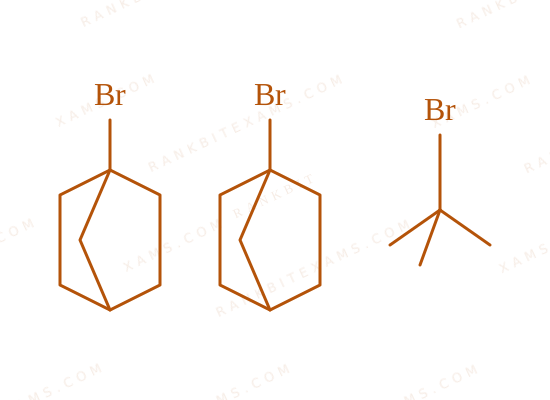
'A' is a neutral organic compound (M. F : C₈H₉ON$C_{8}H_{9}ON$). On treatment with aqueous Br₂/HO(-)$Br_{2}/HO^{(-)}$, 'A' forms a compound 'B' which is soluble in dilute acid. 'B' on treatment with aqueous NaNO₂/HCl(0-5°C)$NaNO_{2}/HCl(0-5^{\circ}C)$ produces a compound 'C' which on treatment with CuCN/NaCN produces 'D' Hydrolysis of 'D' produces 'E' which is also obtainable from the hydrolysis of 'A'. 'E' on treatment with acidified KMnO₄$KMnO_{4}$ produces 'F'. 'F' contains two different types of hydrogen atoms. The structure of 'A' is
A.Structure 1$\text{Structure 1}$
B.Structure 2$\text{Structure 2}$
C.Structure 3$\text{Structure 3}$
D.Structure 4$\text{Structure 4}$
Solution
Core Logic
Let's trace the sequence:
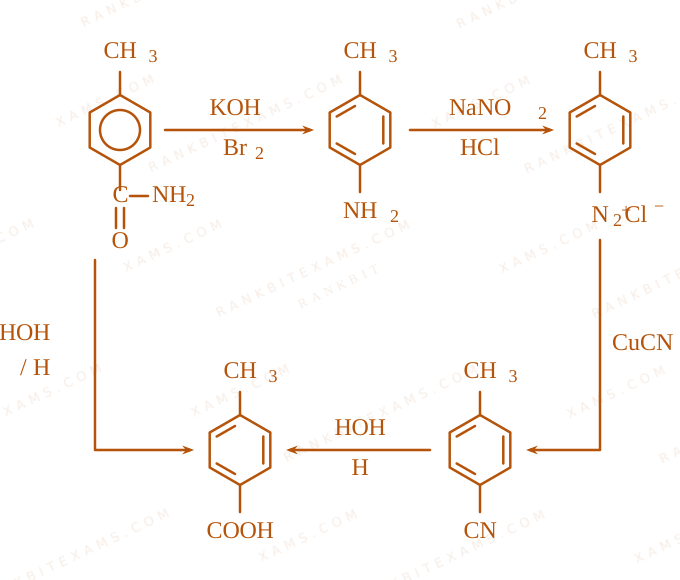
A (C₈H₉ON$C_8H_9ON$) is neutral and reacts with Br₂/OH^-$Br_2/OH^-$ (Hofmann Bromamide Degradation). This means A is a primary amide.
Product B is soluble in dilute acid, meaning it is a primary amine (Ar-NH₂$Ar-NH_2$ or alkyl amine).
B reacts with NaNO₂/HCl$NaNO_2/HCl$ at 0-5°C$0-5^{\circ}C$ to form C. Since C undergoes Sandmeyer with CuCN to form D, B must be an aromatic primary amine, and C is a diazonium salt.
D is an aryl cyanide (Ar-CN$Ar-CN$). Hydrolysis of D yields E (Ar-COOH$Ar-COOH$).
Crucially, E is also obtainable from the direct hydrolysis of A. This confirms A is an aryl amide of the form Ar-CONH₂$Ar-CONH_2$.
Sequence of reactions for identifying Compound A
Let's analyze the formula C₈H₉ON$C_8H_9ON$. The amide group is -CONH₂$-CONH_2$. Removing -CONH₂$-CONH_2$ leaves C₇H₇$C_7H_7$. A benzene ring with one methyl group is a tolyl group. So A is a methylbenzamide (CH₃-C₆H₄-CONH₂$CH_3-C_6H_4-CONH_2$).
E is methylbenzoic acid (CH₃-C₆H₄-COOH$CH_3-C_6H_4-COOH$).
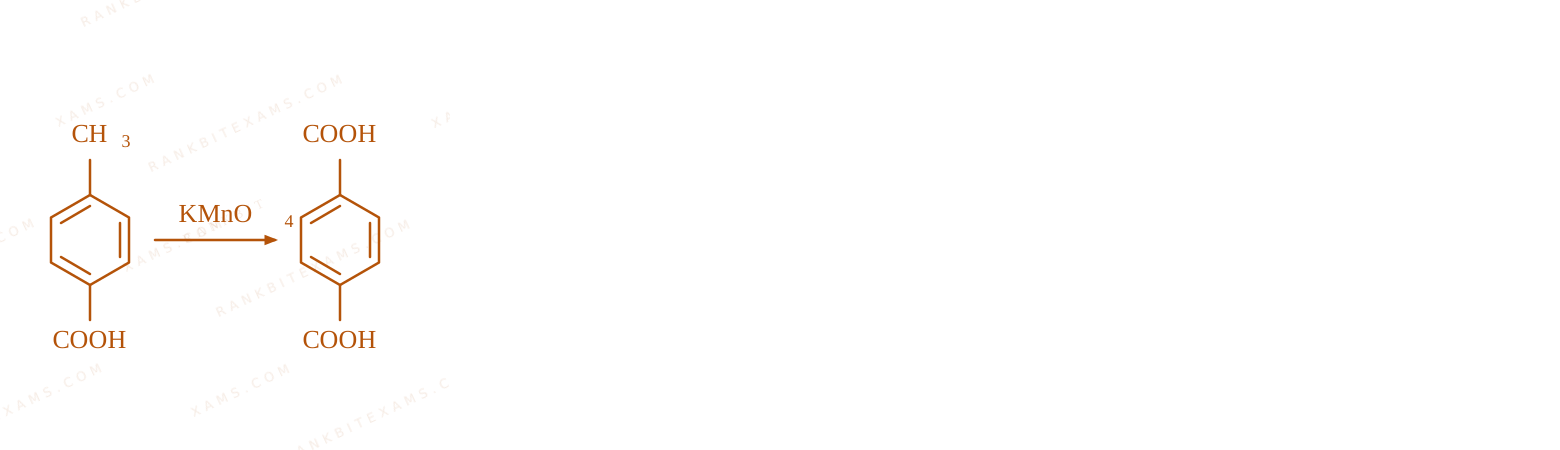
E is oxidized by acidified KMnO₄$KMnO_4$ to F. The methyl group on the benzene ring oxidizes to -COOH$-COOH$. Thus, F is a benzenedicarboxylic acid (HOOC-C₆H₄-COOH$HOOC-C_6H_4-COOH$).
Sequence of reactions for identifying Compound A
The problem states that F contains two different types of hydrogen atoms. Let's check the isomers of benzenedicarboxylic acid:
Phthalic acid (ortho): Contains 2 types of aromatic hydrogens + 1 type of COOH hydrogen = 3 types.
Isophthalic acid (meta): Contains 3 types of aromatic hydrogens + 1 type of COOH hydrogen = 4 types.
Terephthalic acid (para): Due to symmetry, all 4 aromatic hydrogens are equivalent. So it contains 1 type of aromatic hydrogen + 1 type of COOH hydrogen = 2 types.
Sequence of reactions for identifying Compound A
Since F has only two types of hydrogens, F must be terephthalic acid (para isomer). Thus, E is p-methylbenzoic acid, and A is p-methylbenzamide.
Step 1: Final Identification
Compound A is p-methylbenzamide. This corresponds to the structure in option (3).
Pattern Recognition
A classic sequence linking Hofmann bromamide, Sandmeyer, and side-chain oxidation. Symmetrical molecules like para-isomers minimize the number of unique proton environments (critical for NMR or simple counting).
Chapter Mix
Class 12 Chemistry: Amines
Class 12 Chemistry: Aldehydes Ketones and Carboxylic Acids
Q55jee_main_2026_22_january_eveningBenzoylation and Reduction of Amides
C₆H₅NH₂ [NaOH]C₆H₅COCl [A] [H₂O]LiAlH₄ [B]$$\mathrm{C}_6\mathrm{H}_5\mathrm{NH}_2 \xrightarrow[\mathrm{NaOH}]{\mathrm{C}_6\mathrm{H}_5\mathrm{COCl}} [\mathrm{A}] \xrightarrow[\mathrm{H}_2\mathrm{O}]{\mathrm{LiAlH}_4} [\mathrm{B}]$$
The final product [B] is:
Step 1: Reaction of aniline with benzoyl chloride (PhCOCl$\text{PhCOCl}$) in basic medium yields benzanilide (Ph-NH-CO-Ph$\text{Ph-NH-CO-Ph}$) as intermediate [A]$[A]$.
Step 2: Reduction of benzanilide using LiAlH₄$\text{LiAlH}_4$ converts the carbonyl group -C(=O)-$-\text{C}(=\text{O})-$ into a methylene group -CH₂-$-\text{CH}_2-$, forming dibenzylamine (Ph-NH-CH₂-Ph$\text{Ph-NH-CH}_2\text{-Ph}$) as final product [B]$[B]$.
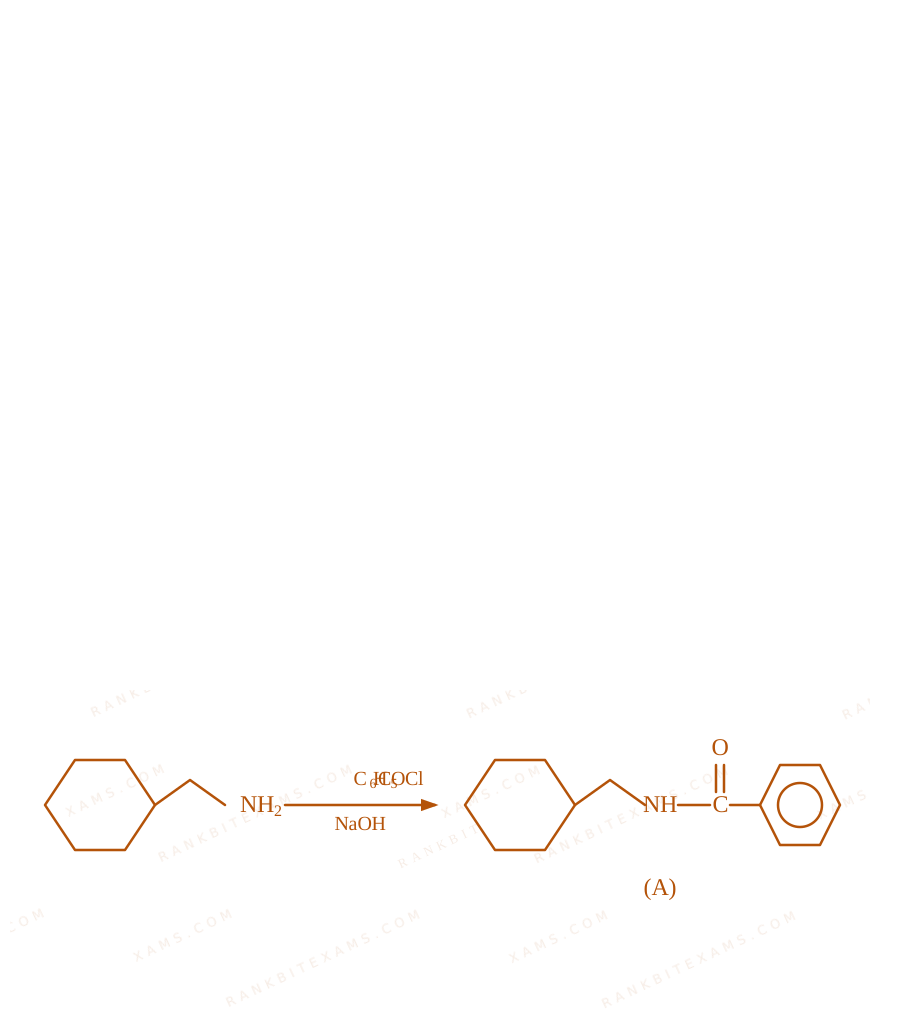
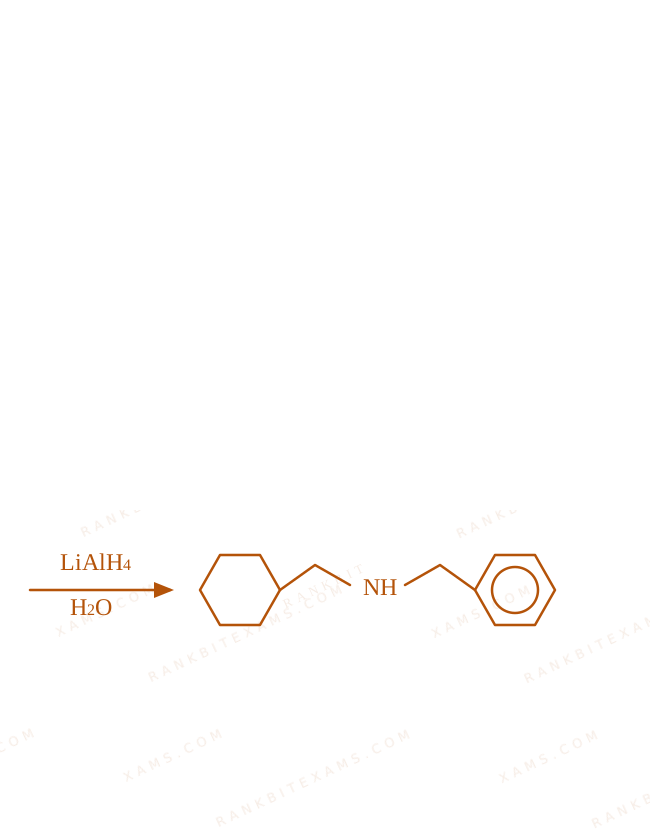
Reaction flow of Benzoylation and reduction for Q55 - JEE Main 2026 Evening
Reaction flow of Benzoylation and reduction for Q55 - JEE Main 2026 Evening
Reaction flow of Benzoylation and reduction for Q55 - JEE Main 2026 Evening
Pattern Recognition
Sees: Acylation followed by LiAlH₄$\text{LiAlH}_4$ reduction.
Shortcut: Amide carbonyl group reduces directly to -CH₂-$-\text{CH}_2-$, resulting in secondary amine structure (option 3).
Practice past-year questions one chapter at a time. Pick an exam → subject → chapter and get every PYQ for that topic — pulled together from all past papers — with the chapter's key formulas alongside.