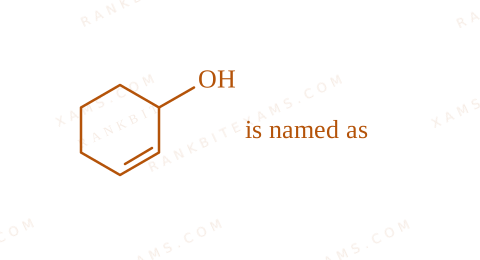
According to IUPAC system, the compound
IUPAC Nomenclature of Alkenols diagram for Q65 - JEE Main 2024 Evening
The diagram displays a cyclohexene ring structure with a hydroxyl (-OH) group substituted on the allylic position.
is named as :

Solution & Explanation

Related Formula

Principal functional group priority rules: -OH > Alkene.

Core Logic

According to IUPAC nomenclature priority rules, the principal functional group is the alcohol group (-OH). The ring numbering starts at the carbon containing the -OH group as C1.

Numbering then proceeds towards the double bond to give it the lowest possible position numbers. This designates C2 and C3 for the double bond carbons, making it a 'cyclohex-2-en-1-ol'.

Step 1: Final Assignment

Hence, combining the root and suffix gives the correct systematic designation: Cyclohex-2-en-1-ol.

Pattern Recognition

Always number functional cyclic systems to prioritize principal suffixes (-OH) first, then provide minimal numbers to unsaturation points.

Chapter Mix

Class 11 Chemistry: Nomenclature of Organic Compounds

More Nomenclature of Organic Compounds Previous-Year Questions — Page 10

Q32 jee_main_2025_03_april_morning Isomerism
Identify the correct statements from the following: A. Pentan-3-one and pentan-2-one are metamers B. Propyl cyanide and propyl isocyanide are functional isomers C. Ethanol and methanol are position isomers D. Methylamine and ethylamine are homologous Choose the correct answer from the options given below:
  • A. C & D only
  • B. B & C only
  • C. A & B only
  • D. A, B & C only

Solution

Related Formula

Metamers: Different alkyl chains attached to the same polyvalent functional group.

Functional Isomers: Same molecular formula, different functional groups.

Core Logic

Statement A: Pentan-3-one and pentan-2-one have different alkyl groups attached to the carbonyl carbon (diethyl vs methyl-propyl), so they are metamers. (Correct)

Statement B: Cyanides (-CN) and isocyanides (-NC) have different functional groups, making them functional isomers. (Correct)

Statement C: Ethanol and methanol differ by a -CH₂- unit; they are homologues, not position isomers. (Incorrect)

Statement D: Methylamine and ethylamine are homologues, but among the available options, option 3 (A & B only) represents the correct combination.

Step 1: Final Selection

Statements A and B are unambiguously correct.

Pattern Recognition

Pentan-2-one vs Pentan-3-one = Metamers. Cyanide vs Isocyanide = Functional isomers.

Chapter Mix

Class 11 Chemistry: Organic Chemistry - Some Basic Principles and Techniques
Q44 jee_main_2025_03_april_morning Acidity of Organic Compounds
The least acidic compound, among the following is: (A) EtO₂C-C ≡ CH (B) Ph-OH (C) Ph-SO₃H (D) Ph-COOH Choose the correct option:
  • A. (A)
  • B. (B)
  • C. (C)
  • D. (D)

Solution

Related Formula
Acid Strength ∝ Stability of Conjugate Base
Core Logic

Order of acidity among functional groups:

  • Benzenesulfonic acid (Ph-SO₃H) arrow Conjugate base stabilized by 3 equivalent resonance structures. (Most acidic)
  • Benzoic acid (Ph-COOH) arrow Conjugate base stabilized by 2 equivalent carboxylate resonance structures.
  • Phenol (Ph-OH) arrow Phenoxide ion resonance-stabilized over the aromatic ring.
  • Terminal alkyne (EtO₂C-C ≡ CH) arrow Proton lost from sp-hybridized carbon. Though electron-withdrawing ester group increases C-H acidity, terminal alkynes are significantly less acidic than phenols, carboxylic acids, and sulfonic acids (pKₐ ≈ 18--20 vs pKa ≈ 10 for phenol).
Step 1: Final Conclusion

Compound (A) is the least acidic among the given choices.

Pattern Recognition

Acidity order: -SO₃H > -COOH > -OH (phenol) > -C ≡ CH (terminal alkyne).

Chapter Mix

Class 11 Chemistry: Organic Chemistry - Some Basic Principles and Techniques
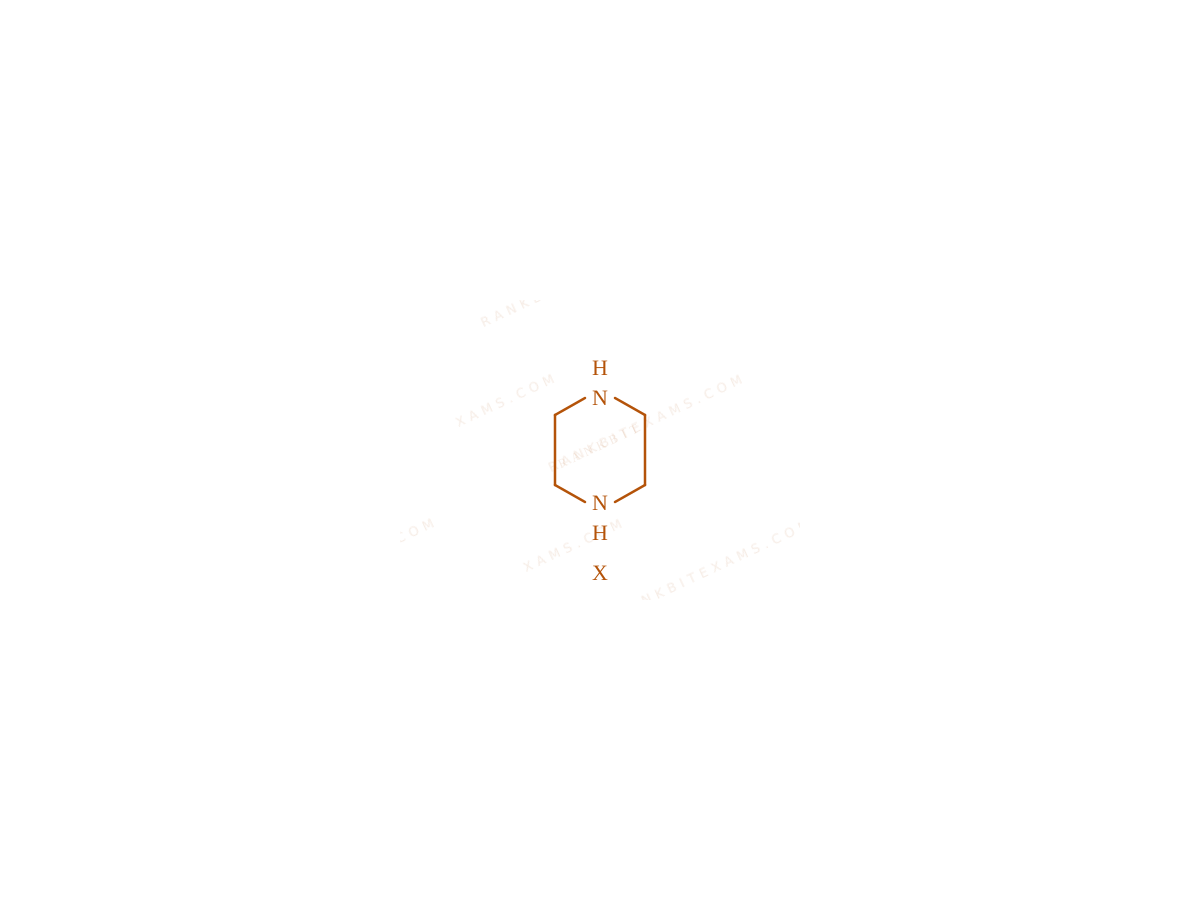
Q46 jee_main_2025_03_april_morning Quantitative Analysis - Dumas Method
During estimation of nitrogen by Dumas' method of compound X (0.42~g):
Compound X structure diagram for Q46 - JEE Main 2025 Morning
Structure diagram of compound X showing molecular formula C5H10N2.
____ mL of N₂ gas will be liberated at STP. (nearest integer) (Given molar mass in g~mol⁻¹ : C: 12, H: 1, N: 14)
Numerical Answer. Answer: 110 to 112

Solution

Related Formula
Moles of Compound X = Moles of N₂ VN₂ (at STP) = nN₂ × 22400~mL
Core Logic

From the molecular structure of compound X, its molecular formula is C₅H₁₀N₂.

Molar Mass of X = (5 × 12) + (10 × 1) + (2 × 14) = 60 + 10 + 28 = 86 ~g~mol⁻¹.

Step 1: Calculation

Moles of compound X in 0.42~g:

nX = (0.42)/(86)~mol

By Conservation of Atomic Mass (POAC) on Nitrogen atoms:

2 × nX = 2 × nN₂ nN₂ = nX = (0.42)/(86)~mol

Volume of N₂ liberated at STP:

VN₂ = (0.42)/(86) × 22400~mL ≈ 109.395~mL

Using 22.7~L standard STP molar volume: (0.42)/(86) × 22700 ≈ 110.88~mL ≈ 111~mL.

Pattern Recognition

Dumas method volume calculation: V = mMcompound × 22.4 L/mol × 1000 mL = 111 mL.

Chapter Mix

Class 11 Chemistry: Organic Chemistry - Some Basic Principles and Techniques

Q47 jee_main_2025_03_april_morning Quantitative Analysis - Liebig's Combustion Method
0.5~g of an organic compound on combustion gave 1.46~g of CO₂ and 0.9~g of H₂O. The percentage of carbon in the compound is _____. (Nearest integer) [Given: Molar mass (in g~mol⁻¹) C: 12, H: 1, O: 16]
Numerical Answer. Answer: 79 to 81

Solution

Related Formula
%C = (12)/(44) × Mass of CO₂Mass of Organic Compound × 100
Core Logic

Mass of CO₂ = 1.46~g. Mass of organic compound = 0.5~g.

Step 1: Calculation
%C = (12)/(44) × (1.46)/(0.5) × 100 %C = (12 × 1.46 × 2)/(44) × 100 = (35.04)/(44) × 100 = 79.636%

Rounding off to the nearest integer gives 80%.

Pattern Recognition

Combustion formula directly yields %C = 79.63% ≈ 80%.

Chapter Mix

Class 11 Chemistry: Organic Chemistry - Some Basic Principles and Techniques

Q jee_main_2025_04_april_evening Basicity of Organic Bases
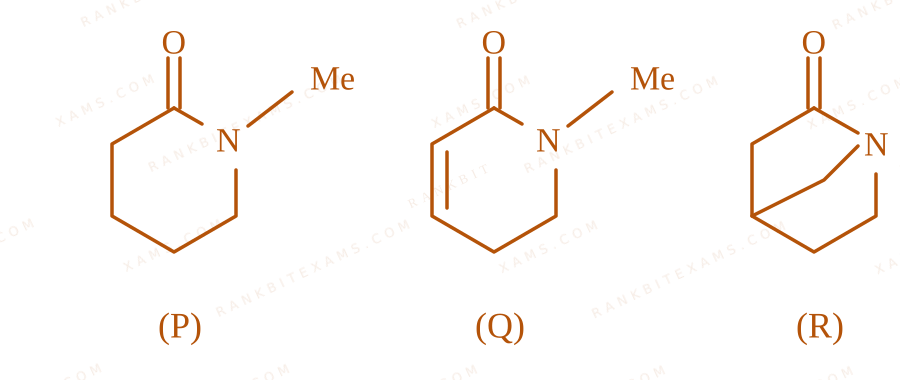
The correct order of basicity for the following molecules is:
Basicity of Organic Bases diagram for Q26 - JEE Main 2025 Evening
The diagram displays three nitrogen-containing organic structures labeled P, Q, and R for basicity comparison.
Basicity of Organic Bases diagram for Q26 - JEE Main 2025 Evening
The diagram displays three nitrogen-containing organic structures labeled P, Q, and R for basicity comparison.
Basicity of Organic Bases diagram for Q26 - JEE Main 2025 Evening
The diagram displays three nitrogen-containing organic structures labeled P, Q, and R for basicity comparison.
Basicity of Organic Bases diagram for Q26 - JEE Main 2025 Evening
The diagram displays three nitrogen-containing organic structures labeled P, Q, and R for basicity comparison.
  • A. P > Q > R
  • B. R > P > Q
  • C. Q > P > R
  • D. R > Q > P

Solution

Related Formula
Basicity ∝ Availability of lone pair of electrons on Nitrogen
Core Logic

Analyzing the molecules:

  • In molecule (R), according to Bredt's rule, the bridgehead nitrogen has a localized lone pair which cannot participate in resonance. Thus, it is highly available and most basic.
  • In molecule (Q), the nitrogen lone pair is involved in cross-conjugation with the carbonyl group, reducing its availability.
  • In molecule (P), the lone pair on nitrogen is directly conjugated with the carbonyl group (amide resonance), making it the least available.
  • Therefore, the correct basicity order is: R > Q > P

Step 1: Final Identification

Basicity breakdown explanation diagram for Q26
The diagram displays three nitrogen-containing organic structures labeled P, Q, and R for basicity comparison.

Basicity breakdown explanation diagram for Q26
The diagram displays three nitrogen-containing organic structures labeled P, Q, and R for basicity comparison.

Basicity breakdown explanation diagram for Q26
The diagram displays three nitrogen-containing organic structures labeled P, Q, and R for basicity comparison.

Comparing availability, structure R has localized electrons, Q has cross-conjugation, and P has standard amide resonance. Hence, option (4) is correct.

Pattern Recognition

Look for localized vs delocalized lone pairs on nitrogen. Bridgehead nitrogen lone pairs that violate Bredt's rule for double bond formation remain strictly localized, drastically increasing basicity compared to conjugated amides.

Chapter Mix

Class 11 Chemistry: Some Basic Principles of Organic Chemistry

Rankbit System
JEE Physics: Waves (+15.5%) | Electrostatics: Concentric Shells (-29.7%) | Modern Physics: Photoelectric Clones (+34.2%) | Mathematics: Definite Integrals (+18.1%) | Chemistry: Coordination Splitting (-11.4%) | JEE Physics: Waves (+15.5%) | Electrostatics: Concentric Shells (-29.7%) | Modern Physics: Photoelectric Clones (+34.2%) | Mathematics: Definite Integrals (+18.1%) | Chemistry: Coordination Splitting (-11.4%)
