JEE Main · Chemistry → Steady

Aldehydes, Ketones and Carboxylic Acids appeared 46 times across 3 years — 5.3% of Chemistry. This question is from Chemical Reactions of Aldehydes and Ketones.

Year 2026 2025 2024 Total
Questions 14 21 11 46

From the compounds given below, number of compounds which give positive Fehling's test is _____. Benzaldehyde, Acetaldehyde, Acetone, Acetophenone, Methanal, 4-nitrobenzaldehyde, cyclohexane carbaldehyde.

Numerical Answer Type:
Enter a numerical value Answer: 3 to 3 +4 marks

Solution & Explanation

Core Logic

Fehling's test is a mild oxidizing test used primarily to distinguish aliphatic aldehydes from ketones and aromatic aldehydes.

  • Aliphatic aldehydes (like methanal, acetaldehyde, cyclohexane carbaldehyde) give a positive Fehling's test (formation of red-brown precipitate of Cu₂O).
  • Aromatic aldehydes (like benzaldehyde, 4-nitrobenzaldehyde) lack alpha-hydrogens in a purely aliphatic environment and are not sufficiently easily oxidized to give a positive Fehling's test.
  • Ketones (like acetone, acetophenone) generally do not give a positive Fehling's test (except α-hydroxy ketones).
Step 1: Evaluation of Given Compounds
  • Benzaldehyde: Aromatic aldehyde arrow Negative
  • Acetaldehyde (CH₃CHO): Aliphatic aldehyde arrow Positive
  • Acetone: Ketone arrow Negative
  • Acetophenone: Ketone arrow Negative
  • Methanal (HCHO): Aliphatic aldehyde arrow Positive
  • 4-nitrobenzaldehyde: Aromatic aldehyde arrow Negative
  • Cyclohexane carbaldehyde: Aliphatic aldehyde arrow Positive
  • The compounds giving a positive test are Acetaldehyde, Methanal, and Cyclohexane carbaldehyde.

Pattern Recognition

Tollens' reagent oxidizes ALL aldehydes (aliphatic + aromatic). Fehling's reagent is weaker and only oxidizes ALIPHATIC aldehydes.

Chapter Mix

Class 12 Chemistry: Aldehydes Ketones and Carboxylic Acids

More Aldehydes Ketones and Carboxylic Acids Previous-Year Questions — Page 10

Q jee_main_2024_31_jan_morning Reactions with Grignard Reagent
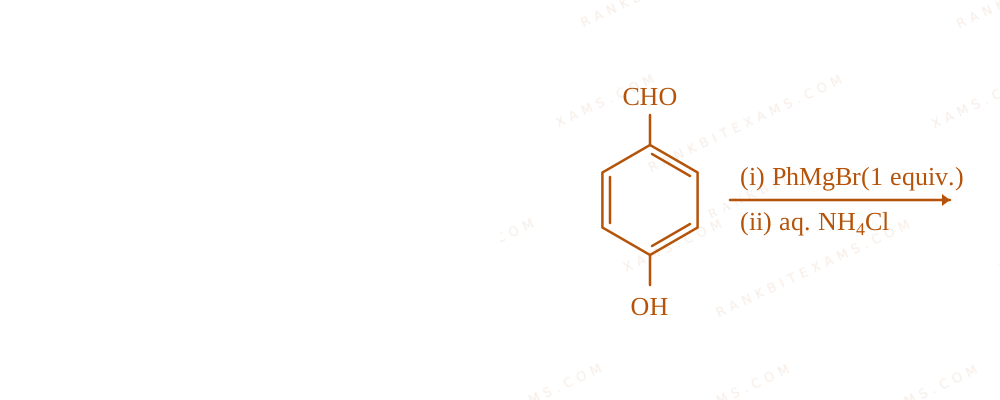
The product of the following reaction is P.
Reactions with Grignard Reagent diagram for Q84 - JEE Main 2024 Morning
The image shows p-hydroxybenzaldehyde reacting with one equivalent of PhMgBr followed by aqueous ammonium chloride.
The number of hydroxyl groups present in the product P is
Numerical Answer. Answer: 0 to 0

Solution

Core Logic

The given reactant is p-hydroxybenzaldehyde, which contains both a phenolic -OH group (acidic) and an aldehyde group (electrophilic).

When one equivalent of Grignard reagent (PhMgBr) is added, it behaves primarily as a strong base due to the presence of an acidic proton. Acid-base reactions are extremely fast compared to nucleophilic additions.

The acidic phenolic -OH reacts with PhMgBr:

PhMgBr + HO-C₆H₄-CHO arrow Ph-H (Benzene) + BrMg-O-C₆H₄-CHO

Upon workup with aq. NH₄Cl, the phenoxide ion simply regenerates the starting p-hydroxybenzaldehyde. However, the question asks for the number of hydroxyl groups present in the formed product (Benzene).
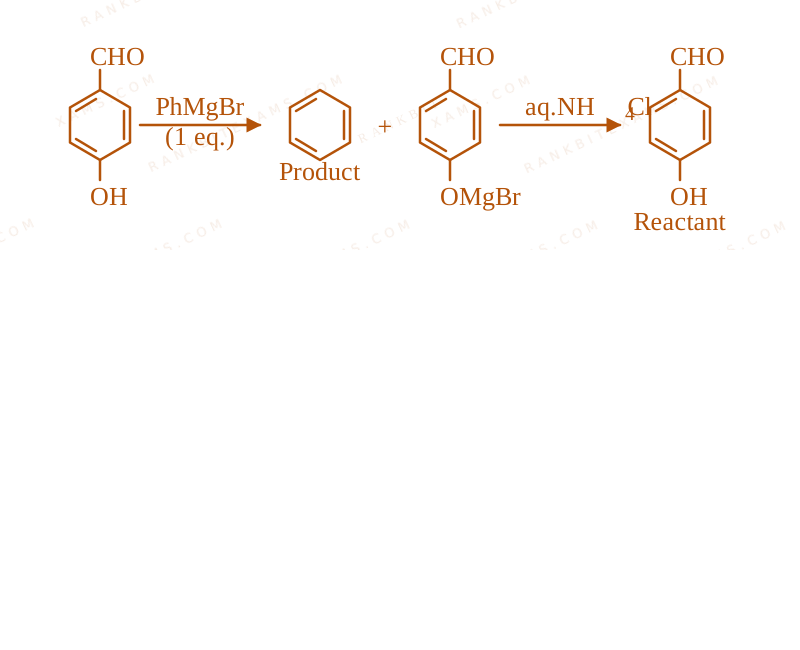
Reactions with Grignard Reagent diagram for Q84 - JEE Main 2024 Morning
The image shows p-hydroxybenzaldehyde reacting with one equivalent of PhMgBr followed by aqueous ammonium chloride.

The distinct product formed in the reaction is Benzene. Benzene has 0 hydroxyl groups.

Pattern Recognition

Whenever a Grignard reagent encounters a molecule with an acidic hydrogen (alcohol, phenol, amine, alkyne), it will invariably act as a base first. If only 1 equivalent is used, nucleophilic addition to carbonyls will NOT happen.

Chapter Mix

Class 12 Chemistry: Aldehydes, Ketones and Carboxylic Acids Class 12 Chemistry: Alcohols, Phenols and Ethers

Rankbit System
JEE Physics: Waves (+15.5%) | Electrostatics: Concentric Shells (-29.7%) | Modern Physics: Photoelectric Clones (+34.2%) | Mathematics: Definite Integrals (+18.1%) | Chemistry: Coordination Splitting (-11.4%) | JEE Physics: Waves (+15.5%) | Electrostatics: Concentric Shells (-29.7%) | Modern Physics: Photoelectric Clones (+34.2%) | Mathematics: Definite Integrals (+18.1%) | Chemistry: Coordination Splitting (-11.4%)