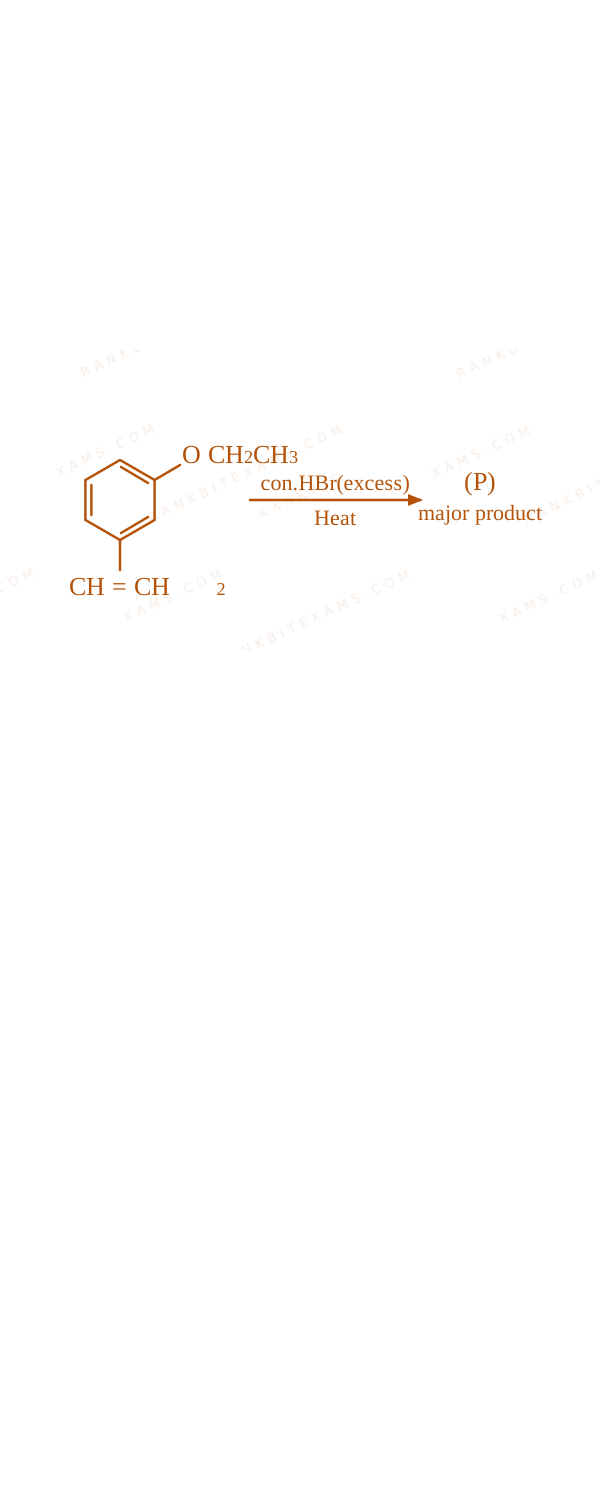
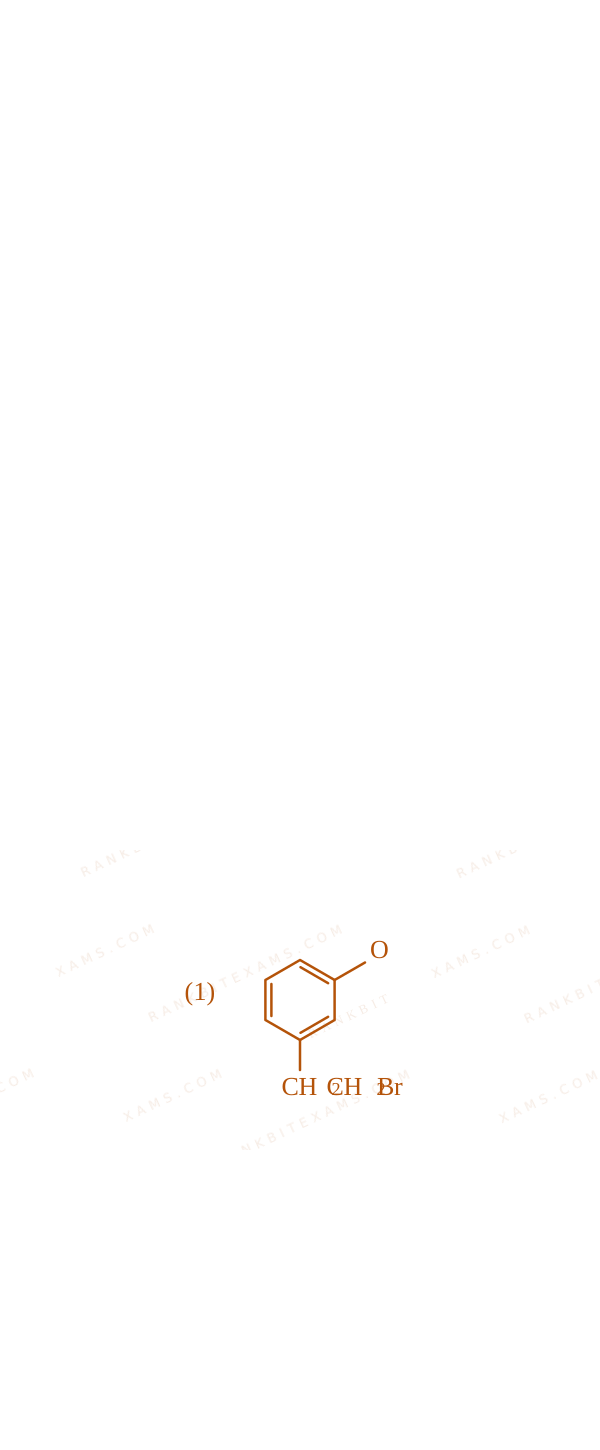
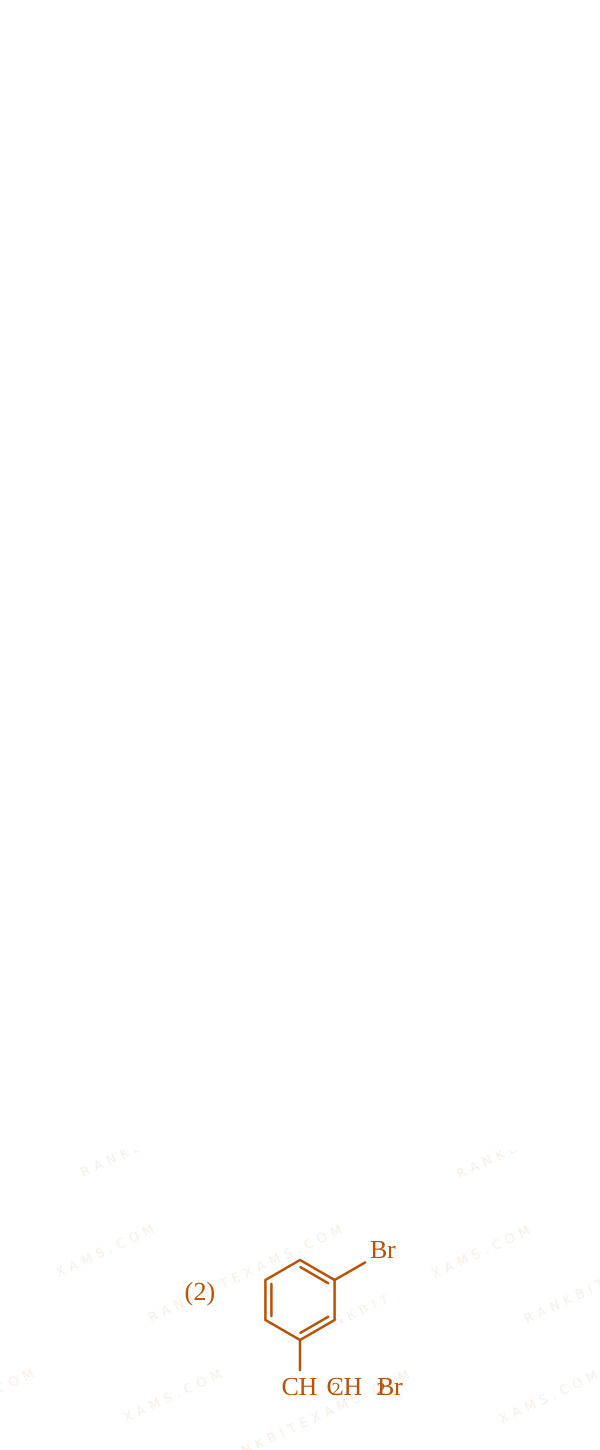
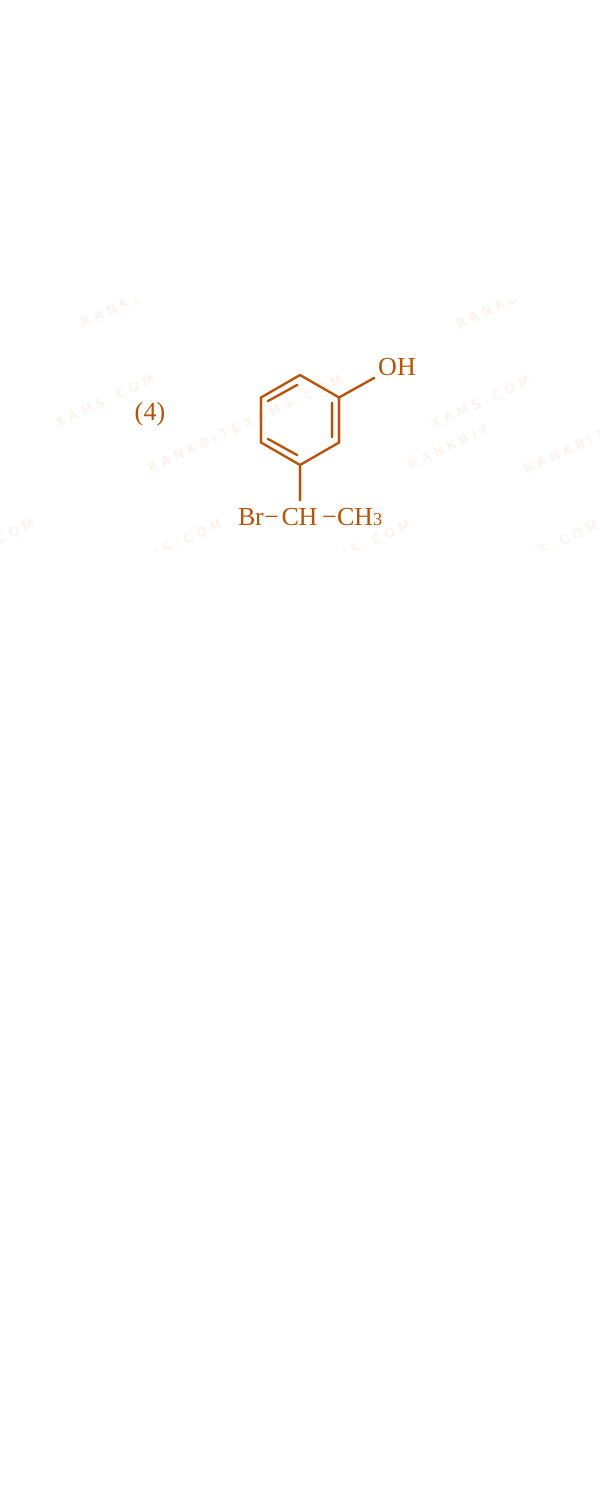
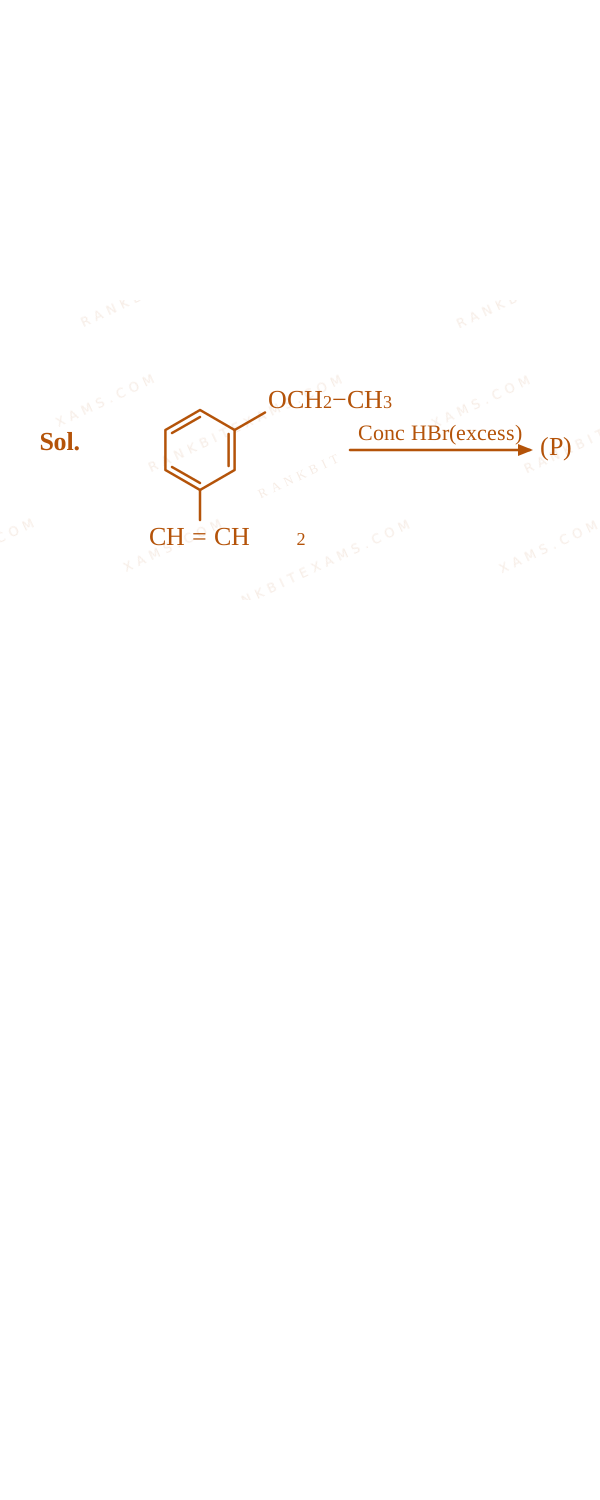
The major product(P) in the following reaction is
Reaction showing an aromatic ether with a vinyl group reacting with excess HBr.
A.""
Reaction showing an aromatic ether with a vinyl group reacting with excess HBr.
B.""
Reaction showing an aromatic ether with a vinyl group reacting with excess HBr.
C.""
Reaction showing an aromatic ether with a vinyl group reacting with excess HBr.
D.""
Reaction showing an aromatic ether with a vinyl group reacting with excess HBr.
Solution & Explanation
Core Logic
The substrate has two reactive functional groups towards HBr$HBr$ (in excess):
An aromatic ether (anisole-type) linkage: -O-CH₂-CH₃$-O-CH_2-CH_3$
An isolated alkene (vinyl) group attached to the aromatic ring: -CH=CH₂$-CH=CH_2$
Reaction 1: Ether Cleavage
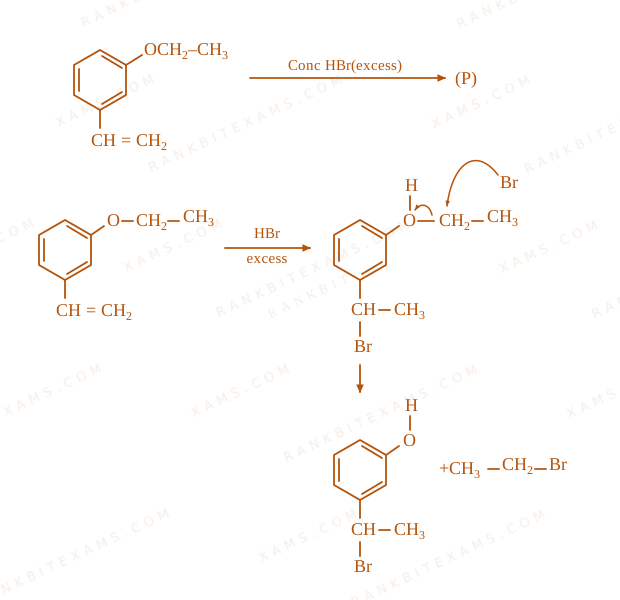
The ether linkage reacts with HBr$HBr$. Protonation of the ether oxygen occurs first, forming an oxonium ion. The Br^-$Br^-$ ion then attacks the less hindered (and sp³$sp^3$ hybridized) alkyl group (SN2$S_N2$ mechanism), specifically the ethyl group. The C(aryl)-O$C(\text{aryl})-O$ bond is much stronger due to partial double bond character from resonance, so it does NOT break.
This yields a phenol group on the ring and ethyl bromide (CH₃-CH₂-Br$CH_3-CH_2-Br$).
Reaction 2: Electrophilic Addition to Alkene
The vinyl group (-CH=CH₂$-CH=CH_2$) undergoes electrophilic addition with HBr$HBr$. Protonation yields the more stable secondary benzylic carbocation (Markovnikov's rule). The Br^-$Br^-$ then attacks this carbocation to form a 1$1$-bromoethyl group attached to the ring.
Step 1: Detailed Mechanism
Reaction showing an aromatic ether with a vinyl group reacting with excess HBr.
Reaction showing an aromatic ether with a vinyl group reacting with excess HBr.
Final product: The ring retains an -OH$-OH$ group (phenol) at the original ether position, and the vinyl group is converted into a -CH(Br)-CH₃$-CH(Br)-CH_3$ group.
Pattern Recognition
Excess HBr$HBr$ with an aryl-alkyl ether always cleaves the alkyl C-O$C-O$ bond to give phenol + alkyl bromide. Never break the aryl C-O$C-O$ bond.
Chapter Mix
Class 12 Chemistry: Alcohols Phenols and Ethers
Class 11 Chemistry: Hydrocarbons
Reaction showing an aromatic ether with a vinyl group reacting with excess HBr.
Keywords:#ether#alkene#HBr excess#cleavage
More Alcohols Phenols and Ethers Previous-Year Questions — Page 3
Q45jee_main_2025_29_jan_eveningCleavage of Ethers by Halogen Acids
Which one of the following, with HBr will give a phenol?
A. Benzyl methyl ether option (1)
B. Anisole (Methoxybenzene) option (2)
C. Dimethyl ether option (3)
D. Methyl phenyl ether derivative option (4)
Solution
Core Logic
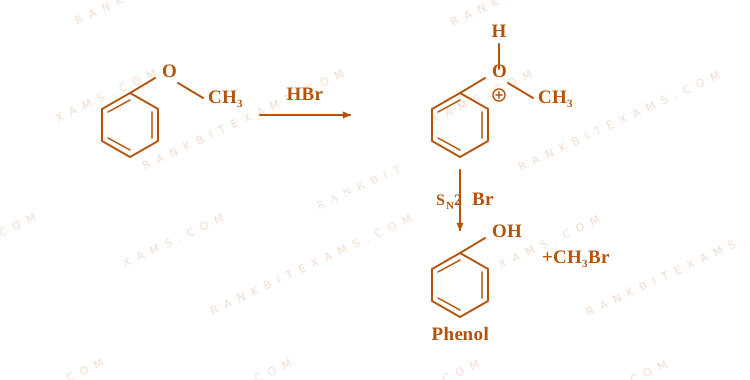
Anisole (Ph-O-CH₃$Ph-O-CH_3$) contains an aryl-oxygen bond which possesses partial double bond character due to resonance stabilization with the aromatic ring.
When treated with HBr$HBr$, protonation yields an oxonium ion. The nucleophile Br⁻$Br^{-}$ attacks via an SN2$S_N2$ pathway at the smaller, less hindered methyl group, cleaving the O-CH₃$O-CH_3$ bond to form Phenol (PhOH$PhOH$) and CH₃Br$CH_3Br$.
Cleavage of Ethers by Halogen Acids diagram for Q45 - JEE Main 2025 Evening
Pattern Recognition
Aromatic sp²$sp^2$C-O$C-O$ bonds are exceptionally strong and cannot be cleaved by nucleophilic attack from Hal⁻$Hal^{-}$. Therefore, the oxygen always stays attached to the benzene ring, yielding phenol.
Chapter Mix
Class 12 Chemistry: Alcohols, Phenols and Ethers
Q35jee_main_2025_04_april_eveningCommercial Preparation and Reactions
A toxic compound “A” when reacted with NaCN in aqueous acidic medium yields an edible cooking component and food preservative “B”. “B” is converted to “C” by diborane and can be used as an additive to petrol to reduce emission. “C” upon reaction with oleum at 140°C$140^{\circ}\mathrm{C}$ yields an inhalable anesthetic “D”. Identify “A”, “B”, “C” and “D”, respectively.
A. Methanol; formaldehyde; methyl chloride; chloroform
B. Ethanol; acetonitrile; ethylamine; ethylene
C. Methanol; acetic acid; ethanol; diethyl ether
D. Acetaldehyde; 2- hydroxypropanoic acid; propanoic acid; dipropyl ether
Solution
Core Logic
Let's track the conversions row by row based on the description:
Toxic compound A is methanol (CH₃OH$CH_3OH$). Reacting it via acidic NaCN sequences effectively converts it eventually into acetic acid (CH₃COOH$CH_3COOH$), which is an edible cooking component and food preservative (vinegar) B.
Reduction of acetic acid (B) with diborane (B₂H₆$B_2H_6$) yields ethanol (CH₃CH₂OH$CH_3CH_2OH$) C. Ethanol is used as a biofuel additive in petrol.
Ethanol (C) upon heating with oleum/concentrated sulfuric acid at 140°C$140^{\circ}\mathrm{C}$ undergoes intermolecular dehydration to yield diethyl ether (C₂H₅-O-C₂H₅$C_2H_5-O-C_2H_5$) D, which functions as an inhalable anesthetic.
Step 1: Chemical Reaction Sequence Flow
Chemical flow chart for sequential ether preparation
The full sequential progression corresponds exactly to:
Key temperature indicator: Dehydration of ethanol at 140°C$140^{\circ}\mathrm{C}$ yields diethyl ether (ether synthesis), whereas 170°C$170^{\circ}\mathrm{C}$ yields ethene gas. Combined with the food preservative clue (acetic acid), the sequence locks instantly to option (3).
Which of the following compound will most easily be attacked by an electrophile?
A. Chlorobenzene
B. Toluene
C. Benzoic acid
D. Phenol
Solution
Core Logic
An electrophile seeks electrons. Higher electron density in the benzene ring makes it more susceptible (reactive) to electrophilic attack. The ring's electron density is governed by the inductive (I) and mesomeric/resonance (M) effects of the attached groups.
Step 1: Evaluate Substituent Effects
Cl$Cl$ (in chlorobenzene): shows weak +M effect but strong -I effect, causing net deactivation.
CH₃$CH_3$ (in toluene): shows +I effect and hyperconjugation, slightly activating the ring.
COOH$COOH$ (in benzoic acid): shows strong -M and -I effect, highly deactivating.
OH$OH$ (in phenol): shows strong +M effect which dominates its weak -I effect, strongly activating the ring.
Step 2: Conclusion
Phenol has the highest electron density in the ring among the given options due to the strong +M effect of the -OH group. Thus, it is most easily attacked by an electrophile.
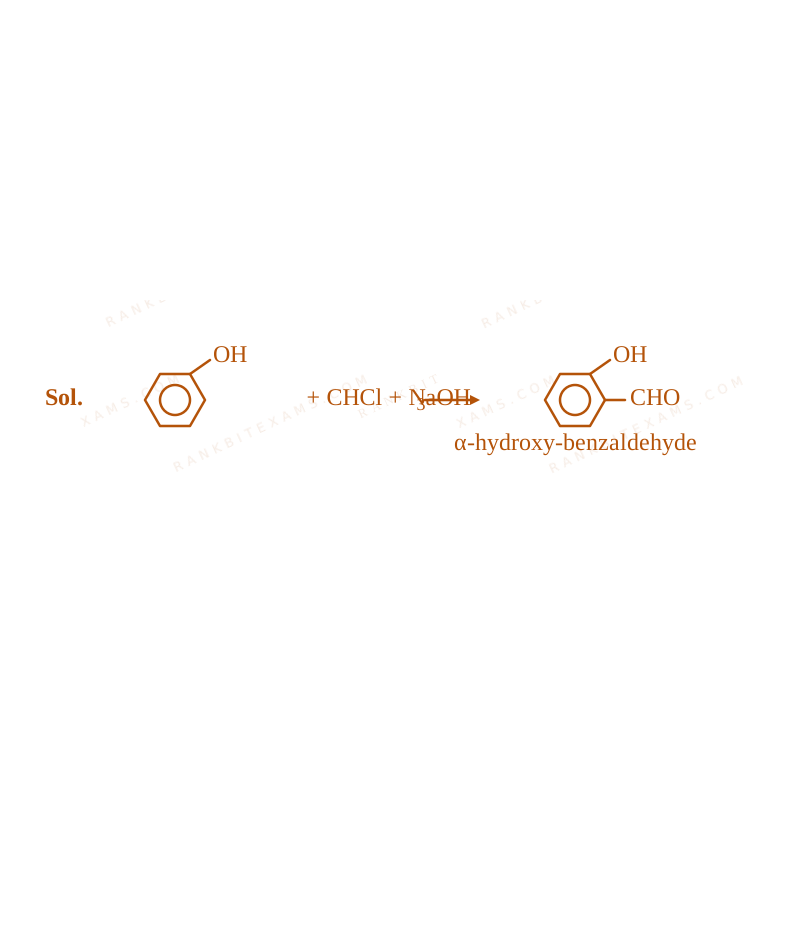
This chemical sequences details the well-known Reimer-Tiemann reaction mechanism. The treatment of phenol with alkaline chloroform generates a dichlorocarbene intermediate (:CCl₂$:\text{CCl}_2$), which acts as an electrophile and specifically attacks the ortho position of the phenoxide ring system.
Subsequent basic hydrolysis converts the functional intermediate to an aldehyde block, providing 2-hydroxybenzaldehyde as the major final product.
Step 1: Visual Pathway Validation
The step-by-step schematic transforms structural blocks through standard intermediates:
Reimer-Tiemann Reaction solution diagram for Q68 - JEE Main 2024 Evening
Pattern Recognition
Chloroform + Base + Phenol yields formylation at the ortho site, producing salicylaldehyde (2-hydroxybenzaldehyde).
Chapter Mix
Class 12 Chemistry: Organic Compounds Containing Oxygen
Qjee_main_2024_29_january_eveningSelective Reduction and Aldol Condensation
Identify the reagents used for the following conversion
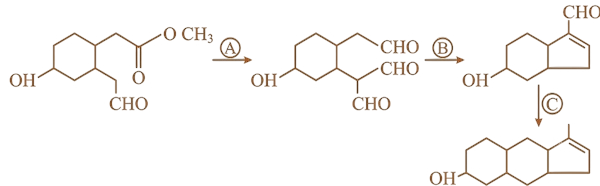
The diagram displays a complex organic multi-step conversion starting from an ester-aldehyde block to a bicyclic system.
A. A = LiAlH₄$\text{LiAlH}_4$, B = NaOH(aq)$\text{NaOH}_{\text{(aq)}}$, C = NH₂ - NH₂ / KOH$\text{NH}_2 - \text{NH}_2 / \text{KOH}$, ethylene glycol
B. A = LiAlH₄$\text{LiAlH}_4$, B = NaOH(alc)$\text{NaOH}_{\text{(alc)}}$, C = Zn/HCl$\text{Zn/HCl}$
C. A = DIBAL-H$\text{DIBAL-H}$, B = NaOH(aq)$\text{NaOH}_{\text{(aq)}}$, C = NH₂ - NH₂ / KOH$\text{NH}_2 - \text{NH}_2 / \text{KOH}$, ethylene glycol
D. A = DIBAL-H$\text{DIBAL-H}$, B = NaOH(alc)$\text{NaOH}_{\text{(alc)}}$, C = Zn/HCl$\text{Zn/HCl}$
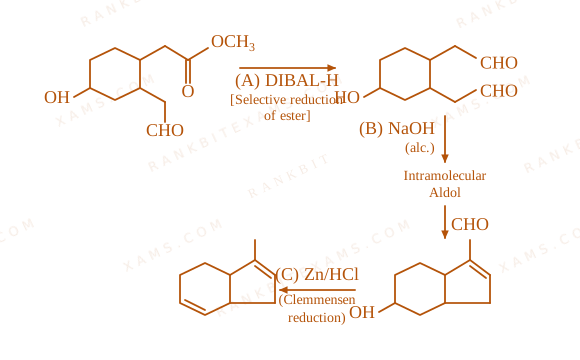
Step A: The ester group is selectively reduced to an aldehyde using DIBAL-H$\text{DIBAL-H}$ at low temperature without affecting other domains.
Step B: An intramolecular Aldol condensation occurs in the presence of base (NaOH$\text{NaOH}$) to generate the bicyclic α,β$\alpha,\beta$-unsaturated carbonyl framework.
Step C: Clemmensen reduction (using amalgamated zinc and hydrochloric acid, Zn(Hg)/HCl$\text{Zn(Hg)/HCl}$) reduces the ketone group to a hydrocarbon block.
Step 1: Verification
The step-by-step mechanism proceeds precisely as illustrated below:
The diagram displays a complex organic multi-step conversion starting from an ester-aldehyde block to a bicyclic system.
Pattern Recognition
DIBAL-H stops cleanly at the aldehyde phase from an ester precursor, preparing the molecule perfectly for subsequent aldol ring closures.
Chapter Mix
Class 12 Chemistry: Organic Compounds Containing Oxygen
Practice past-year questions one chapter at a time. Pick an exam → subject → chapter and get every PYQ for that topic — pulled together from all past papers — with the chapter's key formulas alongside.