Let f:Rarrow R and g:Rarrow R be defined as f(x)= cases ₑx & , & x>0 e-x & , & x≤0 cases and g(x)= casesx & , & x≥0 ex & , & x<0 cases Then, g ° f: Rarrow R is:

Solution & Explanation

Related Formula

For composite functions, g(f(x)) is determined by substituting the range of f(x) into the appropriate domain intervals of g(y):

g(f(x)) = cases f(x) & , & f(x) ≥ 0 ef(x) & , & f(x) < 0 cases
Core Logic

Let us analyze the definition of g(f(x)) branch-by-branch based on the domain of x:

  • Case 1: x ≤ 0
  • Here, f(x) = e-x. Since x ≤ 0, -x ≥ 0 e-x ≥ 1 > 0. Since f(x) ≥ 0, we use the upper branch of g(y):

g(f(x)) = f(x) = e-x
  • Case 2: x > 0
  • Here, f(x) = ₑ x.

  • Subcase (a): If f(x) ≥ 0 ₑ x ≥ 0 x ≥ 1.
  • Then, g(f(x)) = f(x) = ₑ x.

  • Subcase (b): If f(x) < 0 ₑ x < 0 0 < x < 1.
  • Then, g(f(x)) = ef(x) = eₑ x = x.

Step 1: Constructing the Composition Function

Combining the branches obtained, the composite function is:

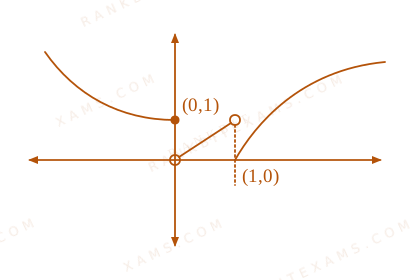
g(f(x)) = cases e-x & , & x ≤ 0 x & , & 0 < x < 1 ₑ x & , & x ≥ 1 cases

Composition function graph for Q11 - JEE Main 2024 01 February Morning
The graphic demonstrates the behavior of the piecewise composite function gof across its distinct linear and logarithmic domains.

Step 2: Injectivity and Surjectivity Analysis
  • Injectivity (One-One Check):
  • Let's test two different inputs: x₁ = 0 and x₂ = e.

g(f(0)) = e⁻⁰ = 1 g(f(e)) = ₑ e = 1

Since distinct inputs yield identical outputs (g(f(0)) = g(f(e)) = 1), the function is many-one (not one-one).

  • Surjectivity (Onto Check):
  • Evaluating the range across the branches:

  • For x ≤ 0, e-x in [1, ∞).
  • For 0 < x < 1, x in (0, 1).
  • For x ≥ 1, ₑ x in [0, ∞).
  • The union of these sets gives the total range as [0, ∞). Since the codomain is given as R, Range ≠ Codomain, so the function is into (not onto).

    Therefore, the function is neither one-one nor onto.

Pattern Recognition

Sees: Piecewise branch composition. Shortcut: Sketching the graph quickly shows that a horizontal line at y=1 intersects the function multiple times (not one-one) and no part of the graph goes below the x-axis (not onto). Trap: Always determine the range of the inner function first to select the correct branch of the outer function.

Chapter Mix

Class 12 Mathematics: Relations and Functions

More Relations and Functions Previous-Year Questions — Page 2

Q14 jee_main_2026_22_january_morning Domain of a Function
If the domain of the function f(x) = ⁻¹((5 - x)/(3 + 2x)) + (1)/( (10 - x)) is (- ∞, α] [β, γ) - δ, then 6(α + β + γ + δ) is equal to
  • A. 70
  • B. 66
  • C. 67
  • D. 68

Solution

Related Formula
Domain of ⁻¹(y) is -1 ≤ y ≤ 1 Domain of (1)/( (z)) is z > 0, z ≠ 1
Core Logic

For f(x) to be defined, two main conditions must hold:

  • -1 ≤ (5 - x)/(2x + 3) ≤ 1
  • 10 - x > 0 and 10 - x ≠ 1
Step 1: Solving the Logarithmic Domain

10 - x > 0 x < 10 10 - x ≠ 1 x ≠ 9

Step 2: Solving the Inverse Sine Domain

-1 ≤ (5 - x)/(2x + 3) ≤ 1 This is equivalent to |(5 - x)/(2x + 3)| ≤ 1, which means:

(5 - x)² ≤ (2x + 3)² (assuming x ≠ -1.5) (5 - x)² - (2x + 3)² ≤ 0

Factor as difference of squares:

(5 - x - (2x + 3))(5 - x + 2x + 3) ≤ 0 (2 - 3x)(x + 8) ≤ 0

Multiply by -1 and flip the inequality:

(3x - 2)(x + 8) ≥ 0

So, x in (-∞, -8] [(2)/(3), ∞).

Step 3: Intersection of Domains

Intersecting with x < 10 and x ≠ 9:

Domain = (-∞, -8] [(2)/(3), 10) - 9

Comparing with the given form (-∞, α] [β, γ) - δ, we have: α = -8, β = (2)/(3), γ = 10, δ = 9.

Step 4: Final Value Calculation

Evaluate 6(α + β + γ + δ):

6(-8 + (2)/(3) + 10 + 9) = 6(11 + (2)/(3)) = 6((35)/(3)) = 70
Pattern Recognition

Instead of solving two separate rational inequalities for ≤ 1 and ≥ -1, converting the absolute value fraction into a difference of squares quickly bypasses sign analysis pitfalls, delivering the required critical points effortlessly.

Chapter Mix

Class 11 Maths: Sets, Relations and Functions Class 12 Maths: Inverse Trigonometric Functions

Q3 jee_main_2026_22_january_evening Number of Elements in Relation
The number of elements in the relation R = (x,y) : 4x² + y² < 52, x, y in Z is
  • A. 77
  • B. 89
  • C. 67
  • D. 86

Solution

Related Formula

Count integer pairs (x, y) satisfying 4x² + y² < 52.

Core Logic

Systematically test possible integer values of x:

  • For x = 0: y² < 52 y in 0, ± 1, , ± 7 (15 values)
  • For x = ± 1: y² < 48 y in 0, ± 1, , ± 6 (2 × 13 = 26 values)
  • For x = ± 2: y² < 36 y in 0, ± 1, , ± 5 (2 × 11 = 22 values)
  • For x = ± 3: y² < 16 y in 0, ± 1, ± 2, ± 3 (2 × 7 = 14 values)
Step 1: Total Sum

Total elements = 15 + 26 + 22 + 14 = 77.

Pattern Recognition

Bound x first since its coefficient is larger, then sum valid values of y symmetrically.

Chapter Mix

Class 11 Maths: Sets and Relations

Q14 jee_main_2026_22_january_evening Domain of Composite Function
Let the domain of the function f(x) = ₃ ₅ (7 - ₂ (x² - 10x + 85)) + ⁻¹ (|(3x-7)/(17-x)|) be (α, β]. Then α + β is equal to:
  • A. 10
  • B. 12
  • C. 9
  • D. 8

Solution

Related Formula

For logarithmic domain: argument must be strictly positive. For inverse sine domain: argument must lie in [-1, 1].

Core Logic

Domain interval intersection for Q14 - JEE Main 2026 Evening

Let λ = x² - 10x + 85.

  • Logarithmic conditions:
  • λ > 0
  • 7 - ₂ λ > 0 λ < 2⁷
  • ₅ (7 - ₂ λ) > 0 7 - ₂ λ > 1 ₂ λ < 6 λ < 64
  • Combining: 0 < x² - 10x + 85 < 64 x² - 10x + 21 < 0 x in (3, 7).

Step 1: Inverse Sine Domain
|(3x-7)/(17-x)| ≤ 1 -1 ≤ (3x-7)/(17-x) ≤ 1 x in [-5, 6]
Step 2: Intersection of Domains

Intersection of x in (3, 7) and x in [-5, 6] is (3, 6]. Here α = 3, β = 6 α + β = 9.

Pattern Recognition

Unpack nested logarithms sequentially from outside in to determine tight bounds on inner quadratic.

Chapter Mix

Class 11 Maths: Functions and Graphs

Q18 jee_main_2026_22_january_evening Greatest Integer Function Properties
Let f(x) = [x]² - [x+3] - 3, x in R where [·] is the greatest integer function. Then:
  • A. f(x) > 0 only for x in [4,∞)
  • B. f(x) < 0 only for x in [-1,3)
  • C. ∫₀² f(x) dx = -6
  • D. f(x) = 0 for finitely many values of x.

Solution

Related Formula

Property of greatest integer function: [x+k] = [x] + k for integer k.

Core Logic

Simplify f(x):

f(x) = [x]² - ([x] + 3) - 3 = [x]² - [x] - 6 = ([x] + 2)([x] - 3)
  • f(x) < 0 -2 < [x] < 3 [x] in -1, 0, 1, 2 x in [-1, 3).
Step 1: Check Other Options
  • f(x) > 0 [x] < -2 or [x] > 3 x in (-∞, -2) [4, ∞) (Option 1 incorrect).
  • ∫₀² f(x) dx = ∫₀¹ (-6) dx + ∫₁² (-6) dx = -12 (Option 3 incorrect).
  • f(x) = 0 [x] = 3 or [x] = -2, which has infinitely many solutions (Option 4 incorrect).
Pattern Recognition

Factorize expression in terms of [x] to easily check intervals for positive/negative values.

Chapter Mix

Class 11 Maths: Functions and Graphs

Q6 jee_main_2026_23_january_morning Equivalence Relations
Let A = -2, -1, 0, 1, 2, 3, 4. Let R be a relation on A defined by xRy if and only if 2x + y ≤ 2. Let l be the number of elements in R. Let m and n be the minimum number of elements required to be added in R to make it reflexive and symmetric relations respectively. Then l + m + n is equal to:
  • A. 32
  • B. 34
  • C. 33
  • D. 35

Solution

Related Formula
Reflexive: (a,a) in R a in A Symmetric: (a,b) in R ⇒ (b,a) in R
Core Logic

Evaluate 2x + y ≤ 2 for all elements in A = -2, -1, 0, 1, 2, 3, 4 to find pairs (x,y) in R. For x = -2: y ≤ 6 ⇒ y in -2, -1, 0, 1, 2, 3, 4 (7 pairs) For x = -1: y ≤ 4 ⇒ y in -2, -1, 0, 1, 2, 3, 4 (7 pairs) For x = 0: y ≤ 2 ⇒ y in -2, -1, 0, 1, 2 (5 pairs) For x = 1: y ≤ 0 ⇒ y in -2, -1, 0 (3 pairs) For x = 2: y ≤ -2 ⇒ y in -2 (1 pair) For x = 3: y ≤ -4 ⇒ None For x = 4: y ≤ -6 ⇒ None

Total elements in R, l = 7 + 7 + 5 + 3 + 1 = 23.

Step 1: Calculate Minimum Additions for Reflexivity (m)

For R to be reflexive, we need (x,x) in R for all x in A. Let's check which are missing: 2(x) + x = 3x ≤ 2. This holds for x = -2, -1, 0. It fails for x = 1, 2, 3, 4. Thus, we need to add 4 elements: (1,1), (2,2), (3,3), (4,4). So, m = 4.

Step 2: Calculate Minimum Additions for Symmetry (n)

For R to be symmetric, if (x,y) in R, we must have (y,x) in R. Let's check elements where 2x+y ≤ 2 but 2y+x > 2. We list pairs where (x,y) in R but (y,x) R: For x = -2: ( -2, 3 ) and ( -2, 4 ) are in R. Inverse (3, -2) has 2(3)+(-2) = 4 > 2 (not in R). Add 2 elements. For x = -1: (-1, 2), (-1, 3), (-1, 4) are in R. Inverses: (2, -1) has 2(2)-1=3>2; (3, -1) has 2(3)-1=5>2; (4, -1) has 2(4)-1=7>2. Add 3 elements. For x = 0: (0, 2) is in R. Inverse (2, 0) has 2(2)+0=4>2. Add 1 element. Total pairs to add to make it symmetric, n = 2 + 3 + 1 = 6. (The pairs to add are (3,-2), (4,-2), (2,-1), (3,-1), (4,-1), (2,0)).

Step 3: Final Sum
l + m + n = 23 + 4 + 6 = 33
Pattern Recognition

Counting discrete relations systematically over a small finite set avoids oversight. Breaking it down by individual x constraints builds an exhaustive map.

Chapter Mix

Class 12 Maths: Relations and Functions
More Relations and Functions Questions — jee_main_2024_01_february_morning

Practice all Relations and Functions previous-year questions →

Rankbit System
JEE Physics: Waves (+15.5%) | Electrostatics: Concentric Shells (-29.7%) | Modern Physics: Photoelectric Clones (+34.2%) | Mathematics: Definite Integrals (+18.1%) | Chemistry: Coordination Splitting (-11.4%) | JEE Physics: Waves (+15.5%) | Electrostatics: Concentric Shells (-29.7%) | Modern Physics: Photoelectric Clones (+34.2%) | Mathematics: Definite Integrals (+18.1%) | Chemistry: Coordination Splitting (-11.4%)
