Let f:Rrightarrow R$f:R\rightarrow R$ and g:Rrightarrow R$g:R\rightarrow R$ be defined as
f(x)=begincaseslog_ex & , & x>0\\ e^-x & , & xle0endcases$f(x)=\begin{cases}\log_{e}x & , & x>0\\ e^{-x} & , & x\le0\end{cases}$
and
g(x)=begincasesx & , & xge0\\ e^x & , & x<0endcases$g(x)=\begin{cases}x & , & x\ge0\\ e^{x} & , & x<0\end{cases}$
Then, g circ f: Rrightarrow R$g \circ f: R\rightarrow R$ is:
A.textone-one but not onto$\text{one-one but not onto}$
B.textneither one-one nor onto$\text{neither one-one nor onto}$
C.textonto but not one-one$\text{onto but not one-one}$
D.textboth one-one and onto$\text{both one-one and onto}$
Solution & Explanation
### Related Formula
For composite functions, g(f(x))$g(f(x))$ is determined by substituting the range of f(x)$f(x)$ into the appropriate domain intervals of g(y)$g(y)$:
g(f(x)) = begincases f(x) & , & f(x) ge 0 \\ e^f(x) & , & f(x) < 0 endcases$g(f(x)) = \begin{cases} f(x) & , & f(x) \ge 0 \\ e^{f(x)} & , & f(x) < 0 \end{cases}$
### Core Logic
Let us analyze the definition of g(f(x))$g(f(x))$ branch-by-branch based on the domain of x$x$:
1. **Case 1: x le 0$x \le 0$**
Here, f(x) = e^-x$f(x) = e^{-x}$. Since x le 0$x \le 0$, -x ge 0 implies e^-x ge 1 > 0$-x \ge 0 \implies e^{-x} \ge 1 > 0$.
Since f(x) ge 0$f(x) \ge 0$, we use the upper branch of g(y)$g(y)$:
g(f(x)) = f(x) = e^-x$g(f(x)) = f(x) = e^{-x}$
2. **Case 2: x > 0$x > 0$**
Here, f(x) = log_e x$f(x) = \log_e x$.
- Subcase (a): If f(x) ge 0 implies log_e x ge 0 implies x ge 1$f(x) \ge 0 \implies \log_e x \ge 0 \implies x \ge 1$.
Then, g(f(x)) = f(x) = log_e x$g(f(x)) = f(x) = \log_e x$.
- Subcase (b): If f(x) < 0 implies log_e x < 0 implies 0 < x < 1$f(x) < 0 \implies \log_e x < 0 \implies 0 < x < 1$.
Then, g(f(x)) = e^f(x) = e^log_e x = x$g(f(x)) = e^{f(x)} = e^{\log_e x} = x$.
### Step 1: Constructing the Composition Function
Combining the branches obtained, the composite function is:
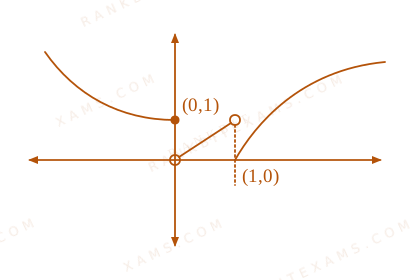
g(f(x)) = begincases e^-x & , & x le 0 \\ x & , & 0 < x < 1 \\ log_e x & , & x ge 1 endcases$g(f(x)) = \begin{cases} e^{-x} & , & x \le 0 \\ x & , & 0 < x < 1 \\ \log_e x & , & x \ge 1 \end{cases}$The graphic demonstrates the behavior of the piecewise composite function gof across its distinct linear and logarithmic domains.
### Step 2: Injectivity and Surjectivity Analysis
- **Injectivity (One-One Check):**
Let's test two different inputs: x_1 = 0$x_1 = 0$ and x_2 = e$x_2 = e$.
g(f(0)) = e^-0 = 1$g(f(0)) = e^{-0} = 1$g(f(e)) = log_e e = 1$g(f(e)) = \log_e e = 1$
Since distinct inputs yield identical outputs (g(f(0)) = g(f(e)) = 1$g(f(0)) = g(f(e)) = 1$), the function is **many-one** (not one-one).
- **Surjectivity (Onto Check):**
Evaluating the range across the branches:
- For x le 0$x \le 0$, e^-x in [1, infty)$e^{-x} \in [1, \infty)$.
- For 0 < x < 1$0 < x < 1$, x in (0, 1)$x \in (0, 1)$.
- For x ge 1$x \ge 1$, \log_e x in [0, infty)$\log_e x \in [0, \infty)$.
The union of these sets gives the total range as [0, infty)$[0, \infty)$. Since the codomain is given as mathbbR$\mathbb{R}$, textRange neq textCodomain$\text{Range} \neq \text{Codomain}$, so the function is **into** (not onto).
Therefore, the function is neither one-one nor onto.
### Pattern Recognition
Sees: Piecewise branch composition.
Shortcut: Sketching the graph quickly shows that a horizontal line at y=1$y=1$ intersects the function multiple times (not one-one) and no part of the graph goes below the x-axis (not onto).
Trap: Always determine the range of the inner function first to select the correct branch of the outer function.
### Evaluation Rubric / Model Answer
null
### Chapter Mix
Class 12 Mathematics: Relations and Functions
Keywords:#composite functions mappings#JEE Main 2024 Morning Q11#one one onto function checks#piecewise functions calculus#composite function graph#piecewise curve representation#injective surjective check
More Relations and Functions Previous-Year Questions — Page 10
Let A = \1, 2, 3, 4\$A = \{1, 2, 3, 4\}$ and R = \(1, 2), (2, 3), (1, 4)\$R = \{(1, 2), (2, 3), (1, 4)\}$ be a relation on A$A$. Let S$S$ be the equivalence relation on A$A$ such that R subset S$R \subset S$ and the number of elements in S$S$ is n$n$. Then, the minimum value of n$n$ is
Numerical Answer.Answer: 16 to 16
Solution
### Core Logic
S$S$ must be reflexive, symmetric, and transitive, containing (1,2)$(1,2)$, (2,3)$(2,3)$, and (1,4)$(1,4)$.
Symmetric property forces (2,1), (3,2), (4,1) in S$(2,1), (3,2), (4,1) \in S$.
Transitive property: (1,2)$(1,2)$ and (2,3) implies (1,3) in S$(2,3) \implies (1,3) \in S$. Symmetric implies (3,1) in S$\implies (3,1) \in S$.
(4,1)$(4,1)$ and (1,2) implies (4,2) in S$(1,2) \implies (4,2) \in S$. Symmetric implies (2,4) in S$\implies (2,4) \in S$.
(4,1)$(4,1)$ and (1,3) implies (4,3) in S$(1,3) \implies (4,3) \in S$. Symmetric implies (3,4) in S$\implies (3,4) \in S$.
### Step 1: Universal Relation
Since 1 is related to 2, 3, 4 and the relation is an equivalence relation (which creates partitions), all elements 1, 2, 3, and 4 must fall into the same single equivalence class.
Thus, S$S$ must contain all possible ordered pairs in A times A$A \times A$.
### Step 2: Final Count
Number of elements in A times A = 4 times 4 = 16$A \times A = 4 \times 4 = 16$.
Minimum value of n$n$ is 16$16$.
### Pattern Recognition
If a relation connects all elements in a set to each other through a chain, its equivalence closure is the universal relation A times A$A \times A$.
### Evaluation Rubric / Model Answer
null
### Chapter Mix
Class 12 Maths: Relations and Functions
More Relations and Functions Questions — jee_main_2024_01_february_morning
We Map Every Repeating Question in Competitive Exams.
Say goodbye to generic mock test fatigue. RankBit uses smart analysis to group past exam questions into their foundational Repeating Question Types. Find chapter weightage, track repeating questions, and score higher with targeted practice.
Select Your Target Exam
Choose an exam track below to find formulas per chapter and patterns.
Syncing Exam Intelligence
Mapping formulas and patterns across all tracks…
PATH A — FULL LENGTH PRACTICE
Full Mock Test Hub
Simulate real NTA exam conditions with fully tracked mocks. Time yourself against past papers.
Under Development
PATH B — TARGETED PRACTICE
Topic-wise Practice Hub
Practice past-year questions one chapter at a time. Pick an exam → subject → chapter and get every PYQ for that topic — pulled together from all past papers — with the chapter's key formulas alongside.
