Related Formula
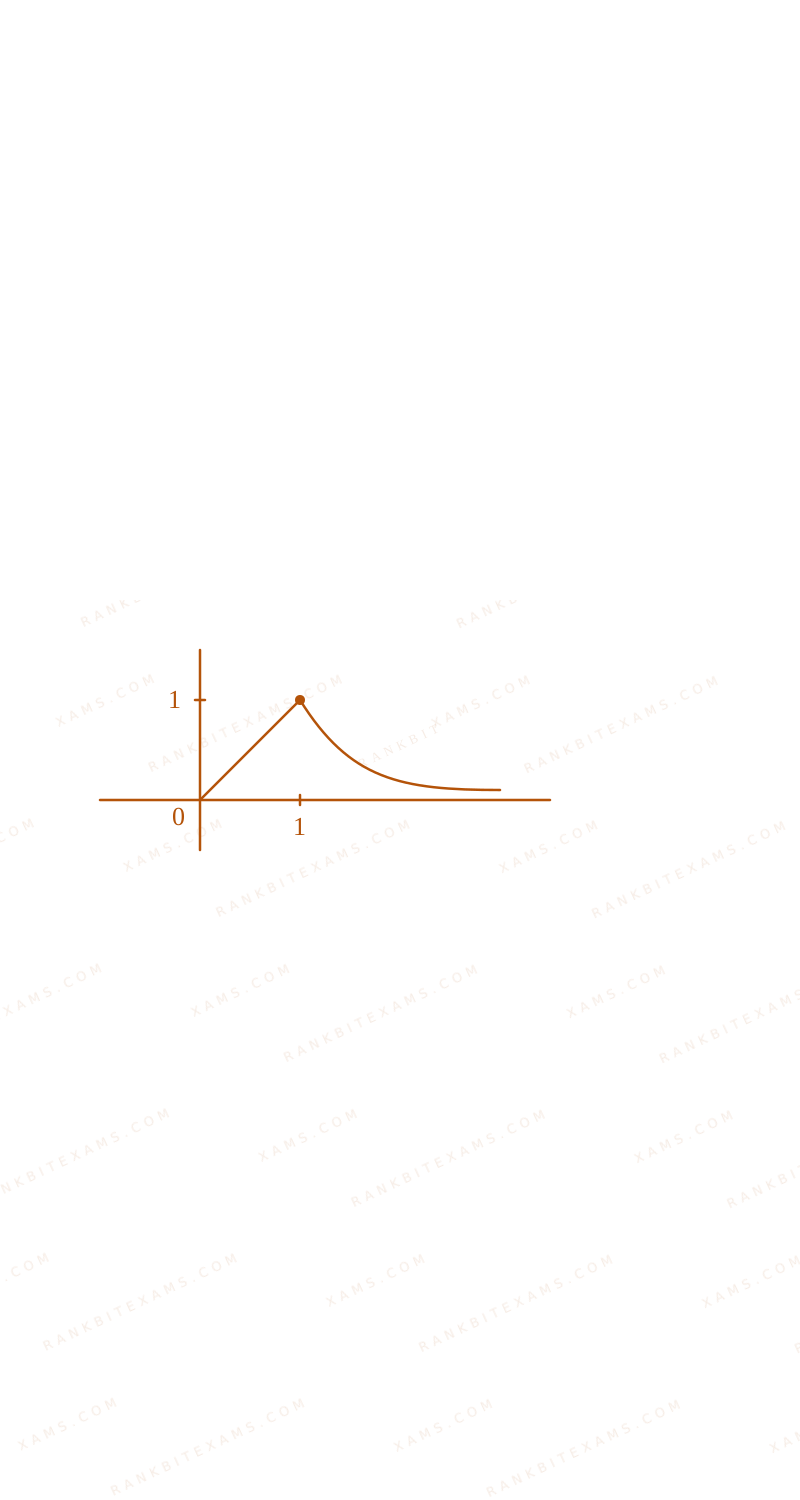
Definition of fractional part function:
- For x → 0^+$x \to 0^+$, x = x - 0 = x$\{x\} = x - 0 = x$.
- For x → 0^-$x \to 0^-$, x = x - (-1) = x + 1$\{x\} = x - (-1) = x + 1$.
Core Logic
Let's evaluate the left-hand limit (L$L$) and right-hand limit (R$R$) separately by setting up substitution parameters around the point x=0$x=0$.
Step 1: Evaluate Right Hand Limit (R)
As x → 0^+$x \to 0^+$, substitute x = h$\{x\} = h$ where h → 0$h \to 0$:
R = h → 0 ⁻¹(1-h²) ⁻¹(1-h)h(1-h²) = h → 0 ⁻¹(1-h²)h · ( ⁻¹11) = (π)/(2) h → 0 ⁻¹(1-h²)h$$R = \lim_{h \to 0} \frac{\cos^{-1}(1-h^2)\sin^{-1}(1-h)}{h(1-h^2)} = \lim_{h \to 0} \frac{\cos^{-1}(1-h^2)}{h} \cdot \left(\frac{\sin^{-1}1}{1}\right) = \frac{\pi}{2} \lim_{h \to 0} \frac{\cos^{-1}(1-h^2)}{h}$$
Let ⁻¹(1-h²) = θ 1-h² = θ h² = 1 - θ = 2 ²(θ/2)$\cos^{-1}(1-h^2) = \theta \implies 1-h^2 = \cos\theta \implies h^2 = 1 - \cos\theta = 2\sin^2(\theta/2)$.
As h → 0, θ → 0$h \to 0, \theta \to 0$, so h ≈ θ√(2)$h \approx \frac{\theta}{\sqrt{2}}$:
R = (π)/(2) θ → 0 θ θ√(2) = π√(2)$$R = \frac{\pi}{2} \lim_{\theta \to 0} \frac{\theta}{\frac{\theta}{\sqrt{2}}} = \frac{\pi}{\sqrt{2}}$$
Step 2: Evaluate Left Hand Limit (L)
As x → 0^-$x \to 0^-$, let x = -h x = 1-h$x = -h \implies \{x\} = 1-h$ where h → 0$h \to 0$:
L = h → 0 ⁻¹(1-(1-h)²) ⁻¹(1-(1-h))(1-h) - (1-h)³$$L = \lim_{h \to 0} \frac{\cos^{-1}(1-(1-h)^2)\sin^{-1}(1-(1-h))}{(1-h) - (1-h)^3}$$
L = h → 0 ⁻¹(2h-h²) ⁻¹h(1-h)[1 - (1-h)²] = h → 0 ⁻¹(0) ⁻¹h1 · (2h-h²)$$L = \lim_{h \to 0} \frac{\cos^{-1}(2h-h^2)\sin^{-1}h}{(1-h)[1 - (1-h)^2]} = \lim_{h \to 0} \frac{\cos^{-1}(0)\sin^{-1}h}{1 \cdot (2h-h^2)}$$
L = (π)/(2) h → 0 ( ⁻¹hh · (1)/(2-h) ) = (π)/(2) · 1 · (1)/(2) = (π)/(4)$$L = \frac{\pi}{2} \lim_{h \to 0} \left( \frac{\sin^{-1}h}{h} \cdot \frac{1}{2-h} \right) = \frac{\pi}{2} \cdot 1 \cdot \frac{1}{2} = \frac{\pi}{4}$$
Step 3: Calculate the Target Value
Substituting the computed limits L = (π)/(4)$L = \frac{\pi}{4}$ and R = π√(2)$R = \frac{\pi}{\sqrt{2}}$ into the target expression:
32π²(L²+R²) = (32)/(π²) ( (π²)/(16) + (π²)/(2) ) = 32 ( (1)/(16) + (1)/(2) ) = 2 + 16 = 18$$\frac{32}{\pi^{2}}(L^{2}+R^{2}) = \frac{32}{\pi^2} \left( \frac{\pi^2}{16} + \frac{\pi^2}{2} \right) = 32 \left( \frac{1}{16} + \frac{1}{2} \right) = 2 + 16 = 18$$
Pattern Recognition
Sees: Discontinuous fractional part function framing an indeterminate limit form.
Trap: Be extremely careful when managing fractional limits below zero: x → 1$\{x\} \to 1$ when x → 0^-$x \to 0^-$, transforming expressions significantly compared to right-hand approaches.
Chapter Mix
Class 12 Mathematics: Limits, Continuity and Differentiability
Class 11 Mathematics: Relations and Functions