Let P=zin C:|z+2-3i|≤1$P=\{z\in\mathbb{C}:|z+2-3i|\le1\}$ and Q=zin C:z(1+i)+ z(1-i)≤-8$Q=\{z\in\mathbb{C}:z(1+i)+\overline{z}(1-i)\le-8\}$. Let in P Q, |z-3+2i|$P \cap Q, |z-3+2i|$ be maximum and minimum at z₁$z_{1}$ and z₂$z_{2}$ respectively. If |z₁|²+2|z₂|²=α+β√(2)$|z_{1}|^{2}+2|z_{2}|^{2}=\alpha+\beta\sqrt{2}$, where α, β$\alpha, \beta$ are integers, then α+β$\alpha+\beta$ equals
Numerical Answer Type:
Enter a numerical valueAnswer: 36 to 36+4 marks
Solution & Explanation
Related Formula
For a complex coordinate transformation, substituting z = x + iy$z = x + iy$ and its conjugate z = x - iy$\overline{z} = x - iy$ maps a complex condition directly into rectangular Cartesian coordinates.
Core Logic
Let's translate the complex set properties into Cartesian geometry:
Set P$P$: |z - (-2 + 3i)| ≤ 1$|z - (-2 + 3i)| \le 1 \implies$ Interior and boundary of a circle with center C(-2, 3)$C(-2, 3)$ and radius r = 1$r = 1$.
Set Q$Q$: (x+iy)(1+i) + (x-iy)(1-i) ≤ -8 (x - y + ix + iy) + (x - y - ix - iy) ≤ -8$(x+iy)(1+i) + (x-iy)(1-i) \le -8 \implies (x - y + ix + iy) + (x - y - ix - iy) \le -8$
2(x - y) ≤ -8 x - y + 4 ≤ 0$$2(x - y) \le -8 \implies x - y + 4 \le 0$$
This defines a half-plane below or to the left of the boundary line L₂: x - y + 4 = 0$L_2: x - y + 4 = 0$.
Step 1: Identify Extreme Points for Distance from Point A
We want to find points in the region P Q$P \cap Q$ that minimize and maximize the distance to the external point A(3, -2)$A(3, -2)$, corresponding to |z - (3 - 2i)|$|z - (3 - 2i)|$.
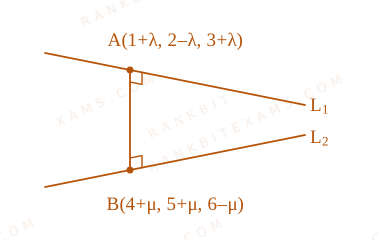
The line L₁$L_1$ connecting center C(-2, 3)$C(-2, 3)$ and point A(3, -2)$A(3, -2)$ has slope:
Equation of line L₁$L_1$: y - 3 = -1(x + 2) x + y - 1 = 0$y - 3 = -1(x + 2) \implies x + y - 1 = 0$.
The graphic details the intersection region bounded by the circular locus and the line inequality, showing points z1 and z2 relative to external reference point P.
Step 2: Calculate Coordinates for z₁$z_1$ and z₂$z_2$
Minimum Distance Point (z₂$z_2$): By geometric observation, the minimum distance from A$A$ to the bounded region is the intersection point of lines L₁$L_1$ and L₂$L_2$:
x - y + 4 = 0 and x + y - 1 = 0 2x + 3 = 0 x = -(3)/(2), y = (5)/(2)$$x - y + 4 = 0 \quad \text{and} \quad x + y - 1 = 0 \implies 2x + 3 = 0 \implies x = -\frac{3}{2}, \, y = \frac{5}{2}$$
So, z₂ = (-(3)/(2), (5)/(2))$z_2 = \left(-\frac{3}{2}, \frac{5}{2}\right)$.
Maximum Distance Point (z₁$z_1$): The maximum distance is at the far boundary edge of the circle along line L₁$L_1$. The vector path from C(-2, 3)$C(-2, 3)$ opposite to A$A$ has unit direction (- 1√(2), 1√(2))$\left(-\frac{1}{\sqrt{2}}, \frac{1}{\sqrt{2}}\right)$:
Sees: Locus intersection involving geometric complex inequalities.
Shortcut: Translating complex equations into standard 2D graphs reveals the geometry instantly, mapping extreme distances to line intersections or boundary nodes cleanly.
Chapter Mix
Class 11 Complex Numbers: Geometry
Class 11 Coordinate Geometry: Straight Lines
Keywords:#complex locus circle#half plane inequality intersection#maximum minimum distance geometry
More Complex Numbers Previous-Year Questions — Page 3
Q18jee_main_2026_28_january_eveningGeometry of Complex Regions
Let A = z in C : |z - 2| ≤ 4$A = \{z \in \mathbb{C} : |z - 2| \le 4\}$ and B = z in C : |z - 2| + |z + 2| = 5$B = \{z \in \mathbb{C} : |z - 2| + |z + 2| = 5\}$. Then the max |z₁ - z₂| : z₁ in A and z₂ in B$\{|z_{1} - z_{2}| : z_{1} \in A \text{ and } z_{2} \in B\}$ is
A.(15)/(2)$\frac{15}{2}$
B.8$8$
C.(17)/(2)$\frac{17}{2}$
D.9$9$
Solution
Core Logic
Analyze region A$A$:
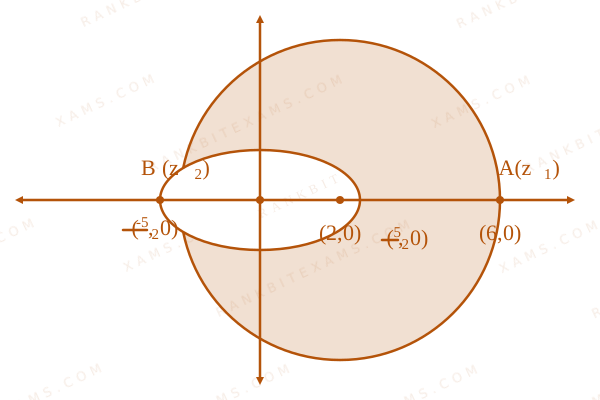
|z - 2| ≤ 4$|z - 2| \le 4$ represents a solid disk with center (2, 0)$(2, 0)$ and radius R=4$R=4$. Its rightmost point on the real axis is (6, 0)$(6, 0)$ and leftmost is (-2, 0)$(-2, 0)$.
Analyze locus B$B$:
|z - 2| + |z + 2| = 5$|z - 2| + |z + 2| = 5$ represents an ellipse with foci at (2, 0)$(2, 0)$ and (-2, 0)$(-2, 0)$, and major axis length 2a = 5 ⇒ a = (5)/(2)$2a = 5 \Rightarrow a = \frac{5}{2}$.
The equation of the ellipse is (x²)/((5/2)²) + (y²)/(b²) = 1$\frac{x^2}{(5/2)^2} + \frac{y^2}{b^2} = 1$.
Its leftmost vertex is at (-(5)/(2), 0)$(-\frac{5}{2}, 0)$.
Complex geometry loci map
Execution
To maximize |z₁ - z₂|$|z_1 - z_2|$, we need the maximum geometric distance between any point in the disk A$A$ and any point on the ellipse B$B$.
By visualizing the placement on the coordinate plane:
The rightmost point of the circle A$A$ is z₁ = 6$z_1 = 6$.
The leftmost point of the ellipse B$B$ is z₂ = -(5)/(2)$z_2 = -\frac{5}{2}$.
The distance between them is the maximum horizontal span since both shapes are symmetric around the real axis and their extremes occur on the real axis.
Maximum distance problems between loci in the complex plane almost always resolve to finding the extreme diametric points along their shared axis of symmetry (usually the real axis).
Chapter Mix
Class 11 Maths: Complex Numbers and Quadratic Equations
Class 11 Maths: Conic Sections
If the set of all a in R - 1$a \in \mathbb{R} - \{1\}$, for which the roots of the equation (1 - a)x² + 2(a - 3)x + 9 = 0$(1 - a)x^2 + 2(a - 3)x + 9 = 0$ are positive is (-∞, -α] [β, γ)$(-\infty, -\alpha] \cup [\beta, \gamma)$, then 2α + β + γ$2\alpha + \beta + \gamma$ is equal to ____________.
Numerical Answer.Answer: 7 to 7
Solution
Related Formula
For a quadratic equation A x² + B x + C = 0 to have two positive real roots:$$\text{For a quadratic equation } A x^2 + B x + C = 0 \text{ to have two positive real roots:}$$1. Real roots: D = B² - 4AC ≥ 0$$\text{1. Real roots: } D = B^2 - 4AC \ge 0$$2. Sum of roots: -(B)/(A) > 0$$\text{2. Sum of roots: } -\frac{B}{A} > 0$$3. Product of roots: (C)/(A) > 0$$\text{3. Product of roots: } \frac{C}{A} > 0$$
Core Logic
We write down three systems of inequalities based on real and positive root conditions, find their intersection, and map the boundaries to solve for the parameters.
Step 1: Apply the discriminant condition (Real roots)
Location of roots: When both roots are positive, checking sum and product signs along with D ≥ 0$D \ge 0$ is the standard and fastest set of inequalities, avoiding complex vertex projections.
Chapter Mix
Class 11 Chemistry: Practical Chemistry
Qjee_main_2025_02_april_morningGeometry of Complex Numbers
Let z$z$ be a complex number such that |z| = 1$|z| = 1$. If 2 + k²zk + z = kz, k in R$\frac{2 + k^2z}{k + \overline{z}} = kz, k \in \mathbb{R}$, then the maximum distance of k + ik²$k + ik^2$ from the circle |z - (1 + 2i)| = 1$|z - (1 + 2i)| = 1$ is:
A.√(5) + 1$\sqrt{5} + 1$
B.2$2$
C.3$3$
D.√(3) + 1$\sqrt{3} + 1$
Solution
Related Formula
For a complex number lying on the unit circle:
|z| = 1 z z = 1 z = (1)/(z)$$|z| = 1 \implies z\overline{z} = 1 \implies \overline{z} = \frac{1}{z}$$
Maximum distance from a point P$P$ to a circle with center C$C$ and radius r$r$ is:
d = PC + r$$d_{\max} = PC + r$$
Core Logic
Simplify the algebraic condition using z = 1/z$\overline{z} = 1/z$ to uniquely determine the value of the parameter k$k$, then compute geometric distances.
The maximum distance from the point to the circle boundary is:
d = PC + r = √(5) + 1$$d_{\max} = PC + r = \sqrt{5} + 1$$
Pattern Recognition
Notice how k²z$k^2z$ cancels perfectly on both sides during expansion due to the unique property of uni-modular complex numbers (z z=1$z\overline{z}=1$), rendering the calculation of k$k$ trivial.
Chapter Mix
Class 11 Mathematics: Complex Numbers and Quadratic Equations
Qjee_main_2025_02_april_morningTheory of Equations
Let Pₙ = αⁿ + βⁿ$P_n = \alpha^n + \beta^n$, n in N$n \in \mathbb{N}$. If P₁₀ = 123$P_{10} = 123$, P₉ = 76$P_9 = 76$, P₈ = 47$P_8 = 47$ and P₁ = 1$P_1 = 1$, then the quadratic equation having roots (1)/(α)$\frac{1}{\alpha}$ and (1)/(β)$\frac{1}{\beta}$ is:
A.x² - x + 1 = 0$x^2 - x + 1 = 0$
B.x² + x - 1 = 0$x^2 + x - 1 = 0$
C.x² - x - 1 = 0$x^2 - x - 1 = 0$
D.x² + x + 1 = 0$x^2 + x + 1 = 0$
Solution
Related Formula
Newton's Sums for the roots of a quadratic equation ax² + bx + c = 0$ax^2 + bx + c = 0$:
a Pₙ + b Pₙ₋₁ + c Pₙ₋₂ = 0$$a P_n + b P_{n-1} + c P_{n-2} = 0$$
Core Logic
Observe the recurrence relation from the given numerical values of Pₙ$P_n$ to construct the base quadratic equation satisfied by α$\alpha$ and β$\beta$, then invert the roots.
The recurrence pattern Pₙ = Pₙ₋₁ + Pₙ₋₂$P_n = P_{n-1} + P_{n-2}$ is the Fibonacci sequence recurrence line. Its roots generate the Golden Ratio layout from x²-x-1=0$x^2-x-1=0$. Inverting roots swaps the coefficients of x²$x^2$ and the constant term, yielding x²+x-1=0$x^2+x-1=0$ instantly.
Chapter Mix
Class 11 Mathematics: Complex Numbers and Quadratic Equations
Class 11 Mathematics: Sequences and Series
Q65jee_main_2025_03_april_eveningGeometry of Complex Numbers
If z₁, z₂, z₃ in C$z_1, z_2, z_3 \in \mathbb{C}$ are the vertices of an equilateral triangle, whose centroid is z₀$z_0$, then Σk=1³ (zk - z₀)²$\sum_{k=1}^{3} (z_k - z_0)^2$ is equal to
A.0$0$
B.1$1$
C.i$i$
D.-i$-i$
Solution
Related Formula
For any equilateral triangle with vertices z₁, z₂, z₃$z_1, z_2, z_3$:
Using condition (1) for equilateral triangles, the terms inside the parentheses equal 0$0$. Thus:
= 0$= 0$
Pattern Recognition
This is a standard invariant of equilateral triangles. Any translation to center of mass coordinates leaves the shape invariant, making the sum of squares of coordinate vectors relative to the centroid equal to zero.
Practice past-year questions one chapter at a time. Pick an exam → subject → chapter and get every PYQ for that topic — pulled together from all past papers — with the chapter's key formulas alongside.