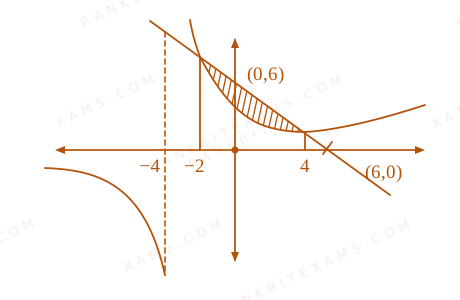
Between x = -2$x = -2$ and x = 4$x = 4$, the line y = 6 - x$y = 6 - x$ lies above the curve y = (16)/(x+4)$y = \frac{16}{x+4}$.
Therefore, the required enclosed area is:
Sees: Area bounded by a straight line and a shifting rectangular hyperbola.
Shortcut: The roots of the difference equation x² - 2x - 8 = 0$x^2 - 2x - 8 = 0$ directly give the limits. Always check graph orientations to place the upper linear equation before the curve equation inside the integral bracket to preserve absolute area values.
Chapter Mix
Class 12 Mathematics: Application of Integrals
Class 11 Mathematics: Conic Sections (Hyperbola)
Keywords:#hyperbola line intersection#enclosed shaded area#definite integral geometry representation
More Application of Integrals Previous-Year Questions — Page 2
Q19jee_main_2026_24_january_morningArea Under the Curve
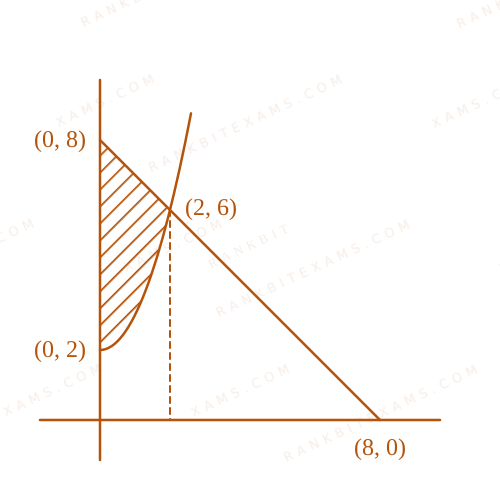
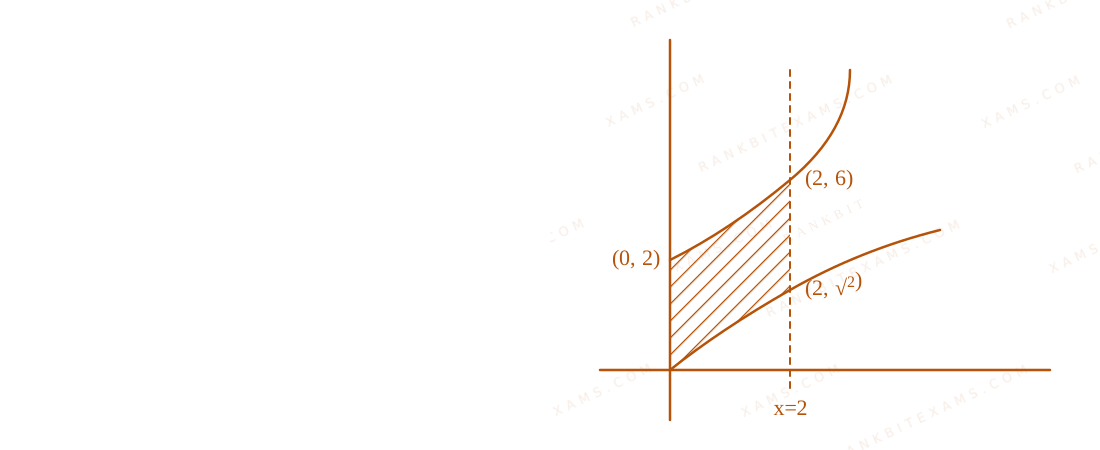
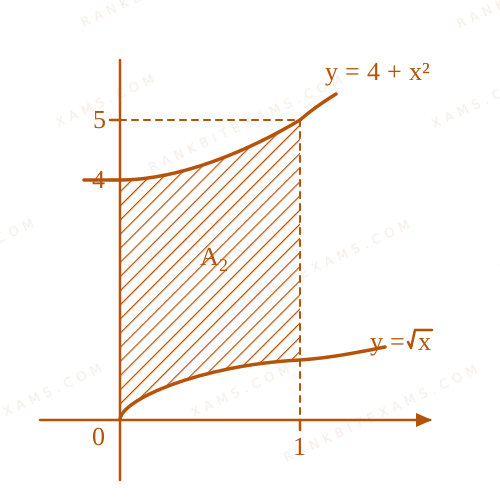
Let A₁$A_{1}$ be the bounded area enclosed by the curves y = x² + 2$y = x^{2} + 2$, x + y = 8$x + y = 8$ and y-axis that lies in the first quadrant. Let A₂$A_{2}$ be the bounded area enclosed by the curves y = x² + 2$y = x^{2} + 2$, y² = x$y^{2} = x$, x = 2$x = 2$, and y-axis that lies in the first quadrant. Then A₁ - A₂$A_{1} - A_{2}$ is equal to
For A₁$A_1$: Intersection of y = x² + 2$y = x^2 + 2$ and x + y = 8$x + y = 8$.
x + (x² + 2) = 8 ⇒ x² + x - 6 = 0 ⇒ (x+3)(x-2) = 0$x + (x^2 + 2) = 8 \Rightarrow x^2 + x - 6 = 0 \Rightarrow (x+3)(x-2) = 0$.
In first quadrant, x = 2$x = 2$. Intersection point is (2, 6)$(2, 6)$.
Area A1 boundaries visualization
For A₂$A_2$: Enclosed by y = x² + 2$y = x^2 + 2$, y = √(x)$y = \sqrt{x}$, x=2$x=2$ and y-axis.
Upper curve: y = x²+2$y = x^2+2$, Lower curve: y = √(x)$y = \sqrt{x}$.
Area A1 boundaries visualization
Carefully identify the bounding regions. A₁$A_1$ uses a line as the upper bound, A₂$A_2$ strips away a root curve as its lower bound. Integrating separately before subtracting avoids algebraic alignment errors.
Chapter Mix
Class 12 Maths: Application of Integrals
Q12jee_main_2026_24_january_eveningArea bounded by Modulus and Parabola
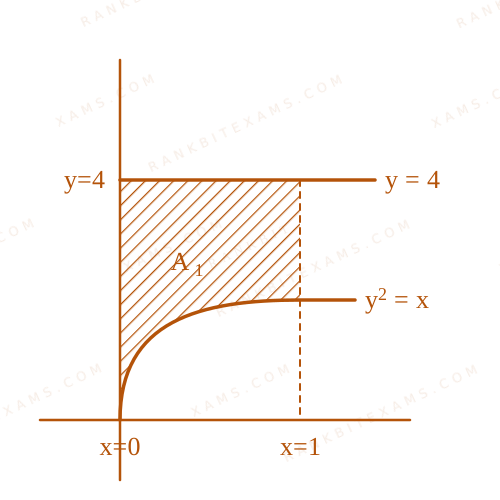
Let f(α)$f(\alpha)$ denote the area of the region in the first quadrant bounded by x = 0$x = 0$, x = 1$x = 1$, y² = x$y^2 = x$ and y = |α x - 5| - |1 - α x| + α x²$y = |\alpha x - 5| - |1 - \alpha x| + \alpha x^2$. Then (f(0) + f(1))$(f(0) + f(1))$ is equal to
Modulus functions combined with parametric limits should be instantly resolved by plugging in the bounds of x$x$ (here [0,1]$[0,1]$) to drop the absolute value signs before attempting any integral.
Chapter Mix
Class 12 Maths: Area Under the Curve
Class 11 Maths: Modulus Function
Q13jee_main_2026_28_january_morningArea under Curves
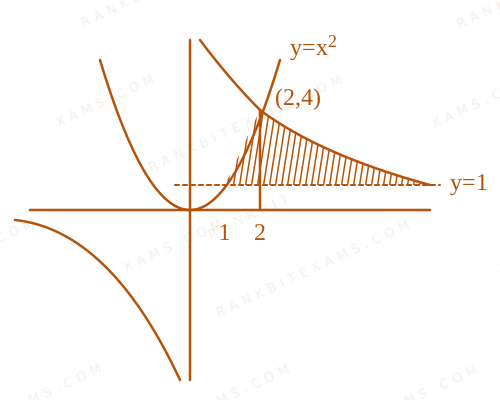
The area of the region R=(x,y):xy≤ 8, 1≤ y≤ x², x≥ 0$R=\{(x,y):xy\leq 8, 1\leq y\leq x^{2}, x\geq 0\}$ is
Area under Curves
The region is bounded by three primary curves in the first quadrant (x≥0$x\ge0$):
y ≥ 1$y \geq 1$ (horizontal line)
y ≤ x²$y \leq x^2$ (upward-opening parabola)
xy ≤ 8 y ≤ (8)/(x)$xy \leq 8 \implies y \leq \frac{8}{x}$ (rectangular hyperbola)
Find points of intersection:
Intersection of y = x²$y = x^2$ and y = (8)/(x)$y = \frac{8}{x}$:
x² = (8)/(x) x³ = 8 x = 2$$x^2 = \frac{8}{x} \implies x^3 = 8 \implies x = 2$$
At x = 2$x = 2$, y = 4$y = 4$. So they meet at (2, 4)$(2, 4)$.
Intersection of y = x²$y = x^2$ and y = 1$y = 1$:
x² = 1 x = 1$$x^2 = 1 \implies x = 1$$
Intersection of y = (8)/(x)$y = \frac{8}{x}$ and y = 1$y = 1$:
1 = (8)/(x) x = 8$$1 = \frac{8}{x} \implies x = 8$$
The region spans from x = 1$x = 1$ to x = 8$x = 8$. The upper boundary changes at x = 2$x = 2$.
Step 1: Set up Integrals
For x in [1, 2]$x \in [1, 2]$, the upper curve is y = x²$y = x^2$ and the lower is y = 1$y = 1$.
For x in [2, 8]$x \in [2, 8]$, the upper curve is y = (8)/(x)$y = \frac{8}{x}$ and the lower is y = 1$y = 1$.
Q11jee_main_2026_28_january_eveningArea Bounded by Parabolas and Lines
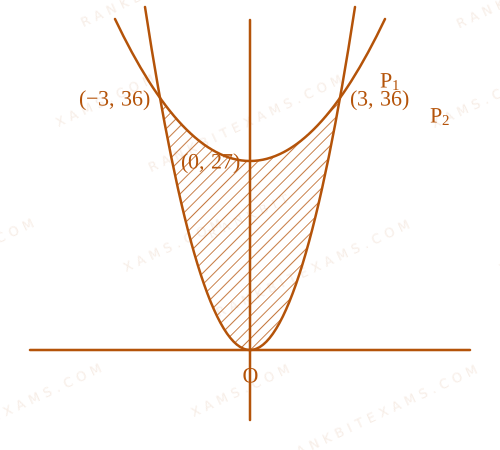
Let P₁: y = 4x²$P_{1}: y = 4x^{2}$ and P₂: y = x² + 27$P_{2}: y = x^{2} + 27$ be two parabolas. If the area of the bounded region enclosed between P₁$P_{1}$ and P₂$P_{2}$ is six times the area of the bounded region enclosed between the line y = α x, α > 0$y = \alpha x, \alpha > 0$ and P₁$P_{1}$, then α$\alpha$ is equal to:
A.8$8$
B.15$15$
C.12$12$
D.6$6$
Solution
Related Formula
Area enclosed by y = f(x)$y = f(x)$ and y = g(x)$y = g(x)$ from x=a$x=a$ to x=b$x=b$:
Area between P₁$P_1$ and y = α x$y = \alpha x$ is given as 108 / 6 = 18$108 / 6 = 18$ sq. units.
For x² = 4ay$x^2 = 4ay$ and x = my$x = my$, area is (8a²)/(3m³)$\frac{8a^2}{3m^3}$.
Here, the parabola is x² = (y)/(4)$x^2 = \frac{y}{4}$ and line is x = (y)/(α)$x = \frac{y}{\alpha}$.
Thus, 4a = (1)/(4) ⇒ a = (1)/(16)$4a = \frac{1}{4} \Rightarrow a = \frac{1}{16}$, and m = (1)/(α)$m = \frac{1}{\alpha}$.
Using the standard result (8a²)/(3m³)$\frac{8a^2}{3m^3}$ for the area bounded between x²=4ay$x^2=4ay$ and x=my$x=my$ avoids tedious integration for straight lines intersecting parabolas at the origin.
Chapter Mix
Class 12 Maths: Application of Integrals
Q73jee_main_2025_02_april_morningArea Between Curves
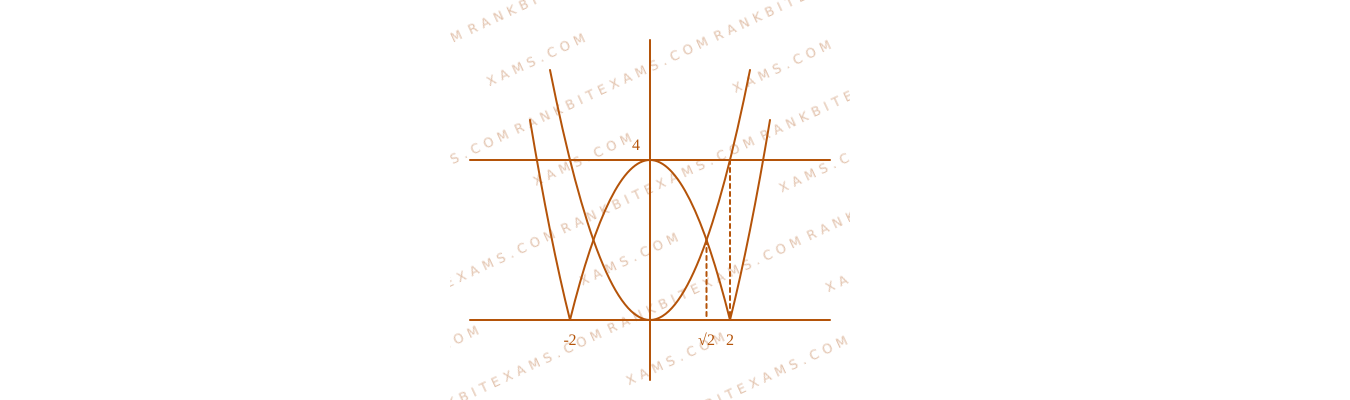
If the area of the region (x, y): | 4 - x ^ 2 | ≤ y ≤ x ^ 2, y ≤ 4, x ≥ 0$\left\{(x, y): \left| 4 - x ^ {2} \right| \le y \le x ^ {2}, y \le 4, x \ge 0 \right\}$ is ( 80√(2)α - β), α, β in N$\left(\frac{80\sqrt{2}}{\alpha} - \beta\right), \alpha, \beta \in \mathbb{N}$, then α + β$\alpha + \beta$ is equal to ________.
Numerical Answer.Answer: 22 to 22
Solution
Related Formula
Area bounded by functions integrated with respect to y$y$ axis:
Identify the bounding graphs and intersection coordinates in the first quadrant, then construct standard definite integrals along the vertical axis. Area Between Curves diagram for Q73 - JEE Main 2025 Morning
Step 1: Unpack Bounding Curves
The condition |4-x²| ≤ y$|4-x^2| \le y$ splits into two sections at x=2$x=2$:
For 0 ≤ x ≤ 2 4 - x² ≤ y x² ≥ 4 - y x = √(4-y)$0 \le x \le 2 \implies 4 - x^2 \le y \implies x^2 \ge 4 - y \implies x = \sqrt{4-y}$
For x ≥ 2 x² - 4 ≤ y x² ≤ 4 + y x = √(4+y)$x \ge 2 \implies x^2 - 4 \le y \implies x^2 \le 4 + y \implies x = \sqrt{4+y}$
Also bounded by y ≤ x² x ≥ √(y)$y \le x^2 \implies x \ge \sqrt{y}$, and the outer cap constraint y ≤ 4$y \le 4$.
Step 2: Construct the Integral Area Formula
Integrating with respect to y$y$ covers the region bounded on the left by √(y)$\sqrt{y}$ and √(4-y)$\sqrt{4-y}$, and on the right by √(4+y)$\sqrt{4+y}$:
A = ∫₀⁴ √(4+y) dy - ∫₀² √(4-y) dy - ∫₂⁴ √(y) dy$$A = \int_{0}^{4} \sqrt{4+y} \, \mathrm{d}y - \int_{0}^{2} \sqrt{4-y} \, \mathrm{d}y - \int_{2}^{4} \sqrt{y} \, \mathrm{d}y$$
Integrating along the vertical axis (y$y$-direction) is significantly faster here because it avoids splitting the domain across multiple vertical segments on the horizontal x$x$-axis.
Practice past-year questions one chapter at a time. Pick an exam → subject → chapter and get every PYQ for that topic — pulled together from all past papers — with the chapter's key formulas alongside.