
Rankbit System
JEE Physics: Waves (+15.5%) | Electrostatics: Concentric Shells (-29.7%) | Modern Physics: Photoelectric Clones (+34.2%) | Mathematics: Definite Integrals (+18.1%) | Chemistry: Coordination Splitting (-11.4%) | JEE Physics: Waves (+15.5%) | Electrostatics: Concentric Shells (-29.7%) | Modern Physics: Photoelectric Clones (+34.2%) | Mathematics: Definite Integrals (+18.1%) | Chemistry: Coordination Splitting (-11.4%)

Ionic reactions with organic compounds proceed through: (A) Homolytic bond cleavage (B) Heterolytic bond cleavage (C) Free radical formation (D) Primary free radical (E) Secondary free radical Choose the correct answer from the options given below:

Solution & Explanation

### Core Logic Bond fission in organic chemistry can happen in two ways: 1. Homolytic cleavage: The shared pair of electrons gets distributed equally, leading to free radical formation. 2. Heterolytic cleavage: The shared pair of electrons goes completely to one of the bonded atoms, leading to the formation of positive (cation) and negative (anion) ions. ### Step 1: Match Definition Since ionic reactions involve ions, they inherently proceed through heterolytic bond cleavage where ionic intermediates (carbocations, carbanions, or leaving groups) are formed. ### Pattern Recognition Ionic reactions rightarrow Ions formed rightarrow Heterolytic cleavage. Radical reactions rightarrow Free radicals formed rightarrow Homolytic cleavage. ### Evaluation Rubric / Model Answer null ### Chapter Mix Class 11 Chemistry: Organic Chemistry Some Basic Principles and Techniques

More Organic Chemistry Some Basic Principles and Techniques Previous-Year Questions — Page 15

Q75 jee_main_2024_31_jan_evening Purification of Organic Compounds
The fragrance of flowers is due to the presence of some steam volatile organic compounds called essential oils. These are generally insoluble in water at room temperature but are miscible with water vapour in vapour phase. A suitable method for the extraction of these oils from the flowers is -
  • A. text1. crystallisation
  • B. text2. distillation under reduced pressure
  • C. text3. distillation
  • D. text4. steam distillation

Solution

### Core Logic Steam distillation technique is applied to separate substances which are steam volatile and are immiscible with water. Since the essential oils in flowers are steam volatile and insoluble in water, steam distillation is the perfect technique for their extraction. ### Evaluation Rubric / Model Answer null ### Chapter Mix Class 11 Chemistry: Organic Chemistry - Some Basic Principles and Techniques
Q66 jee_main_2024_31_jan_morning Reaction Intermediates
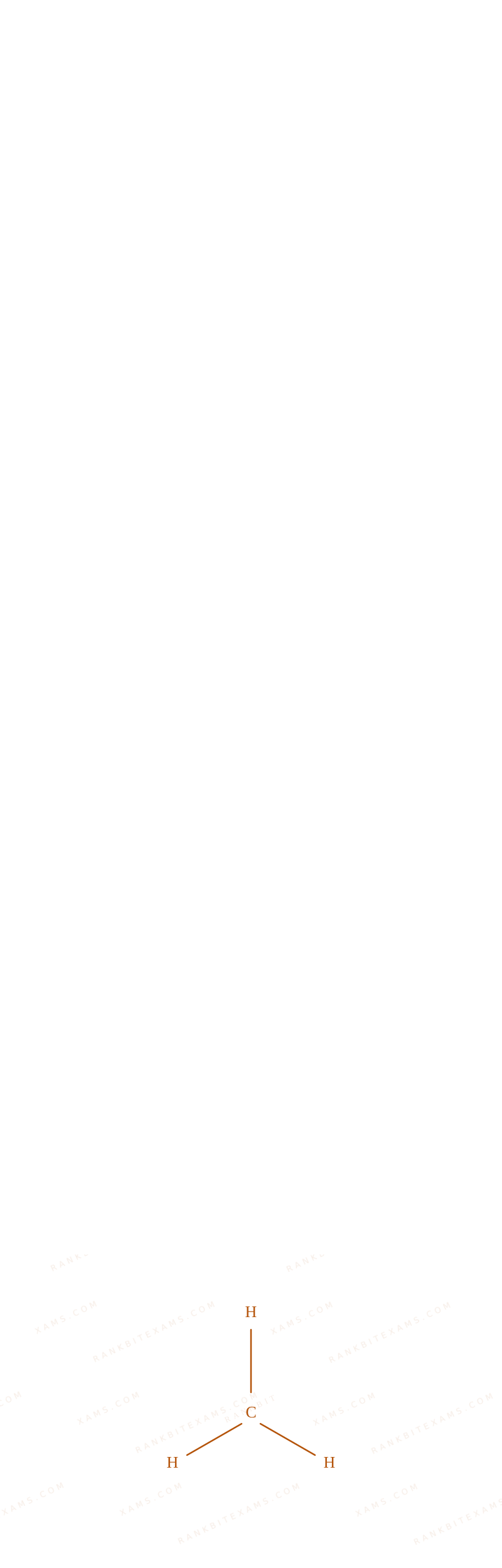
A species having carbon with sextet of electrons and can act as electrophile is called
  • A. textcarbon free radical
  • B. textcarbanion
  • C. textcarbocation
  • D. textpentavalent carbon

Solution

### Core Logic
Reaction Intermediates diagram for Q66 - JEE Main 2024 Morning
A carbocation has three bonds and an empty p-orbital, yielding a sextet (6) of electrons in its valence shell. Due to its electron deficiency, it acts as a strong electrophile. ### Evaluation Rubric / Model Answer null ### Chapter Mix Class 11 Chemistry: Organic Chemistry - Some Basic Principles and Techniques
Q72 jee_main_2024_31_jan_morning Purification Methods
'Adsorption' principle is used for which of the following purification method?
  • A. textExtraction
  • B. textChromatography
  • C. textDistillation
  • D. textSublimation

Solution

### Core Logic The fundamental principle used in chromatography (such as column chromatography or thin-layer chromatography) is adsorption. Different components of a mixture are adsorbed to different extents on an adsorbent stationary phase. ### Evaluation Rubric / Model Answer null ### Chapter Mix Class 11 Chemistry: Organic Chemistry - Some Basic Principles and Techniques
Q80 jee_main_2024_31_jan_morning Purification Methods
Match List I with List II
LIST-I (Technique)LIST-II (Application)
A. DistillationI. Separation of glycerol from spent-lye
B. Fractional distillationII. Aniline - Water mixture
C. Steam distillationIII. Separation of crude oil fractions
D. Distillation under reduced pressureIV. Chloroform-Aniline
Choose the correct answer from the options given below:
  • A. textA-IV, B-I, C-II, D-III
  • B. textA-IV, B-III, C-II, D-I
  • C. textA-I, B-II, C-IV, D-III
  • D. textA-II, B-III, C-I, D-IV

Solution

### Core Logic (A) Simple distillation is used to separate a mixture of miscible liquids with a sufficiently large difference in their boiling points, such as chloroform and aniline. (A rightarrow IV) (B) Fractional distillation is used to separate crude oil fractions. (B rightarrow III) (C) Steam distillation is used to separate steam-volatile substances that are immiscible with water, like an aniline-water mixture. (C rightarrow II) (D) Distillation under reduced pressure is used for liquids that decompose at or below their normal boiling points, like separating glycerol from spent lye. (D rightarrow I) ### Evaluation Rubric / Model Answer null ### Chapter Mix Class 11 Chemistry: Organic Chemistry - Some Basic Principles and Techniques

More Organic Chemistry Some Basic Principles and Techniques Questions — jee_main_2024_01_february_morning

Practice all Organic Chemistry Some Basic Principles and Techniques previous-year questions →

YOUR FIRST PREP STEP STARTS HERE

We Map Every Repeating Question in Competitive Exams.

Say goodbye to generic mock test fatigue. RankBit uses smart analysis to group past exam questions into their foundational Repeating Question Types. Find chapter weightage, track repeating questions, and score higher with targeted practice.

Select Your Target Exam

Choose an exam track below to find formulas per chapter and patterns.

Syncing Exam Intelligence

Mapping formulas and patterns across all tracks…

PATH A — FULL LENGTH PRACTICE

Full Mock Test Hub

Simulate real NTA exam conditions with fully tracked mocks. Time yourself against past papers.

Under Development
PATH B — TARGETED PRACTICE

Topic-wise Practice Hub

Practice past-year questions one chapter at a time. Pick an exam → subject → chapter and get every PYQ for that topic — pulled together from all past papers — with the chapter's key formulas alongside.

Loading Questions... Browse Topics
Latest from the Blog
View all →

Loading articles...