(B) The Match List displays chemical transformations side-by-side with their respective named organic chemical reactions.
(II) Gatterman-Koch reaction
(C) The Match List displays chemical transformations side-by-side with their respective named organic chemical reactions.
(III) Rosenmund reduction
(D) The Match List displays chemical transformations side-by-side with their respective named organic chemical reactions.
(IV) Stephen reaction
Choose the correct answer from the options given below:
A.\text{(A)-(IV), (B)-(III), (C)-(I), (D)-(II)}
B.\text{(A)-(III), (B)-(IV), (C)-(II), (D)-(I)}
C.\text{(A)-(I), (B)-(III), (C)-(II), (D)-(IV)}
D.\text{(A)-(III), (B)-(IV), (C)-(I), (D)-(II)}
Solution & Explanation
### Core Logic
Let's match each aldehyde preparation method with its official named organic reaction:
* **(A) mathrmRCN
ightarrow mathrmRCHO$\mathrm{RCN}
ightarrow \mathrm{RCHO}$ using mathrmSnCl_2/mathrmHCl$\mathrm{SnCl}_{2}/\mathrm{HCl}$ followed by hydrolysis:** This is the classic **Stephen reaction**
ightarrow$
ightarrow$ **(IV)**.
* **(B) Reducing an acyl chloride (mathrmRCOCl$\mathrm{RCOCl}$) to an aldehyde using mathrmH_2$\mathrm{H}_{2}$ over mathrmPd-BaSO_4$\mathrm{Pd-BaSO}_{4}$:** This partial reduction is known as the **Rosenmund reduction**
ightarrow$
ightarrow$ **(III)**.
* **(C) Oxidizing toluene to benzaldehyde using chromyl chloride (mathrmCrO_2mathrmCl_2$\mathrm{CrO}_{2}\mathrm{Cl}_{2}$) in mathrmCS_2$\mathrm{CS}_{2}$:** This selective oxidation method is the **Etard reaction**
ightarrow$
ightarrow$ **(I)**.
* **(D) Converting benzene to benzaldehyde using mathrmCO$\mathrm{CO}$ and mathrmHCl$\mathrm{HCl}$ in the presence of anhydrous mathrmAlCl_3/mathrmCuCl$\mathrm{AlCl}_{3}/\mathrm{CuCl}$:** This formylation process is the **Gatterman-Koch reaction**
ightarrow$
ightarrow$ **(II)**.
Combining these assignments yields the final sequence: (A)-(IV), (B)-(III), (C)-(I), (D)-(II).
### Step-by-Step Layout
The visual reaction components correspond directly to the official structural transformations:
The Match List displays chemical transformations side-by-side with their respective named organic chemical reactions.The Match List displays chemical transformations side-by-side with their respective named organic chemical reactions.The Match List displays chemical transformations side-by-side with their respective named organic chemical reactions.
### Pattern Recognition
Quick identification keys:
- Nitrile
ightarrow$
ightarrow$ Aldehyde = Stephen
- Acid Chloride
ightarrow$
ightarrow$ Aldehyde = Rosenmund
- Toluene
ightarrow$
ightarrow$ Chromyl Complex = Etard
- Benzene
ightarrow$
ightarrow$ Carbon Monoxide = Gatterman-Koch
### Evaluation Rubric / Model Answer
null
### Chapter Mix
Class 12 Chemistry: Aldehydes, Ketones and Carboxylic Acids
Keywords:#rosenmund reduction stephen reaction#etard reaction mechanism#JEE Main 2025 Evening Q42#Aldehydes Ketones preparation#named organic pathways#stephen rosenmund reduction#etard gatterman koch aromatic schemes
More Aldehydes, Ketones and Carboxylic Acids Previous-Year Questions — Page 5
Q502025Chemical Reactions of Carbonyl Compounds
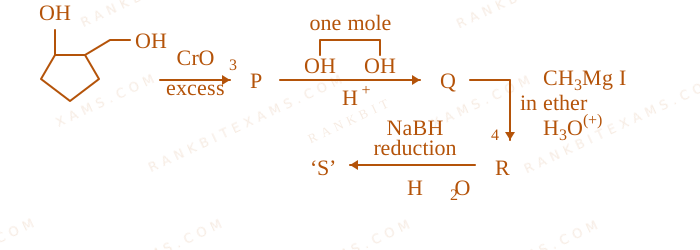
Based on the reaction sequence:
A structural flow charts the transformation of a cyclic dialcohol into final product S.
0.1 mole of compound 'S' will weigh ________ g.
(Given molar mass in mathrmg \, mol^-1$\mathrm{g \, mol^{-1}}$ C:12, H:1, O:16)
Numerical Answer.Answer: 13 to 13
Solution
### Related Formula
textMass = textMoles cdot textMolar Mass$\text{Mass} = \text{Moles} \cdot \text{Molar Mass}$
### Core Logic
Let us trace the reaction scheme row-by-row:
1. Reactant: 2-(hydroxymethyl)cyclopentan-1-ol.
2. Step 1: Excess mathrmCrO_3$\mathrm{CrO}_3$ (Jones oxidation) oxidizes the secondary alcohol to a ketone and the primary alcohol to a carboxylic acid
ightarrow$
ightarrow$ Product P.
3. Step 2: Reaction with 1 mole of glycol protects the ketone selectively as a cyclic ketal
ightarrow$
ightarrow$ Product Q.
4. Step 3: Treatment with mathrmCH_3mathrmMgI$\mathrm{CH}_3\mathrm{MgI}$ targets the free carboxylic acid (or ester equivalent) to form a methyl ketone after workup
ightarrow$
ightarrow$ Product R.
5. Step 4: mathrmNaBH_4$\mathrm{NaBH}_4$ reduces the methyl ketone to a secondary alcohol, and acid workup deprotects the ketal back to the original ketone
ightarrow$
ightarrow$ Compound S .
Chemical structural formula of S: 2-(1-hydroxyethyl)cyclopentan-1-one (mathrmC_7mathrmH_12mathrmO_2$\mathrm{C}_7\mathrm{H}_{12}\mathrm{O}_2$) .
Molar mass of S (mathrmC_7mathrmH_12mathrmO_2$\mathrm{C}_7\mathrm{H}_{12}\mathrm{O}_2$) :
M = (7 cdot 12) + (12 cdot 1) + (2 cdot 16) = 84 + 12 + 32 = 130 \, mathrmg/mol$M = (7 \cdot 12) + (12 \cdot 1) + (2 \cdot 16) = 84 + 12 + 32 = 130 \, \mathrm{g/mol}$textMass of 0.1 mole = 0.1 cdot 130 = 13 \, mathrmg$\text{Mass of 0.1 mole} = 0.1 \cdot 130 = 13 \, \mathrm{g}$
### Pattern Recognition
Ketal groups serve as stable protective masks that shield ketones, allowing selective organometallic reactions to take place elsewhere on the molecule.
### Evaluation Rubric / Model Answer
null
### Chapter Mix
Class 12 Chemistry: Aldehydes, Ketones and Carboxylic Acids
More Aldehydes, Ketones and Carboxylic Acids Questions — jee_main_2025_24_jan_evening
We Map Every Repeating Question in Competitive Exams.
Say goodbye to generic mock test fatigue. RankBit uses smart analysis to group past exam questions into their foundational Repeating Question Types. Find chapter weightage, track repeating questions, and score higher with targeted practice.
Select Your Target Exam
Choose an exam track below to find formulas per chapter and patterns.
Syncing Exam Intelligence
Mapping formulas and patterns across all tracks…
PATH A — FULL LENGTH PRACTICE
Full Mock Test Hub
Simulate real NTA exam conditions with fully tracked mocks. Time yourself against past papers.
Under Development
PATH B — TARGETED PRACTICE
Topic-wise Practice Hub
Practice past-year questions one chapter at a time. Pick an exam → subject → chapter and get every PYQ for that topic — pulled together from all past papers — with the chapter's key formulas alongside.

 "named organic pathways, stephen rosenmund reduction, etard gatterman koch aromatic schemes")
 "named organic pathways, stephen rosenmund reduction, etard gatterman koch aromatic schemes")
 "named organic pathways, stephen rosenmund reduction, etard gatterman koch aromatic schemes")
 "named organic pathways, stephen rosenmund reduction, etard gatterman koch aromatic schemes")
 "named organic pathways, stephen rosenmund reduction, etard gatterman koch aromatic schemes")
 "named organic pathways, stephen rosenmund reduction, etard gatterman koch aromatic schemes")