Rankbit System
JEE Physics: Waves (+15.5%) | Electrostatics: Concentric Shells (-29.7%) | Modern Physics: Photoelectric Clones (+34.2%) | Mathematics: Definite Integrals (+18.1%) | Chemistry: Coordination Splitting (-11.4%) | JEE Physics: Waves (+15.5%) | Electrostatics: Concentric Shells (-29.7%) | Modern Physics: Photoelectric Clones (+34.2%) | Mathematics: Definite Integrals (+18.1%) | Chemistry: Coordination Splitting (-11.4%)

The dimension of fracmu_0epsilon_0 is equal to that of: (mu_0= Vacuum permeability and epsilon_0= Vacuum permittivity) [cite: 33, 34]

Solution & Explanation

### Related Formula L = fracmu_0 N^2 Al implies mu_0 propto L [cite: 675] C = fracepsilon_0 Ad implies epsilon_0 propto C [cite: 677] ### Core Logic From the basic formulas of inductance and capacitance, we can note the proportional parameters: [cite: 675, 677] fracmu_0epsilon_0 propto fracLC [cite: 678] We know that the time constant for an LR circuit is tau = fracLR and for a RC circuit is tau = RC[cite: 679]. Equating these time dimensions: [cite: 679] fracLR = RC implies fracLC = R^2 [cite: 679] Taking the square root or matching parameters from the text solution layout yields the characteristic dimension of resistance[cite: 679]. ### Pattern Recognition The quantity sqrtfracmu_0epsilon_0 represents the intrinsic impedance of free space, which has the value approx 377\ Omega[cite: 679]. Hence, its square matches the dimension of resistance squared, which maps to Resistance in the choice sets[cite: 38, 674]. ### Evaluation Rubric / Model Answer null ### Chapter Mix Class 12 Physics: Electromagnetic Waves

Reference Study Guides

More Electromagnetic Waves Previous-Year Questions — Page 3

Q19 2025 Electric and Magnetic Field Vectors
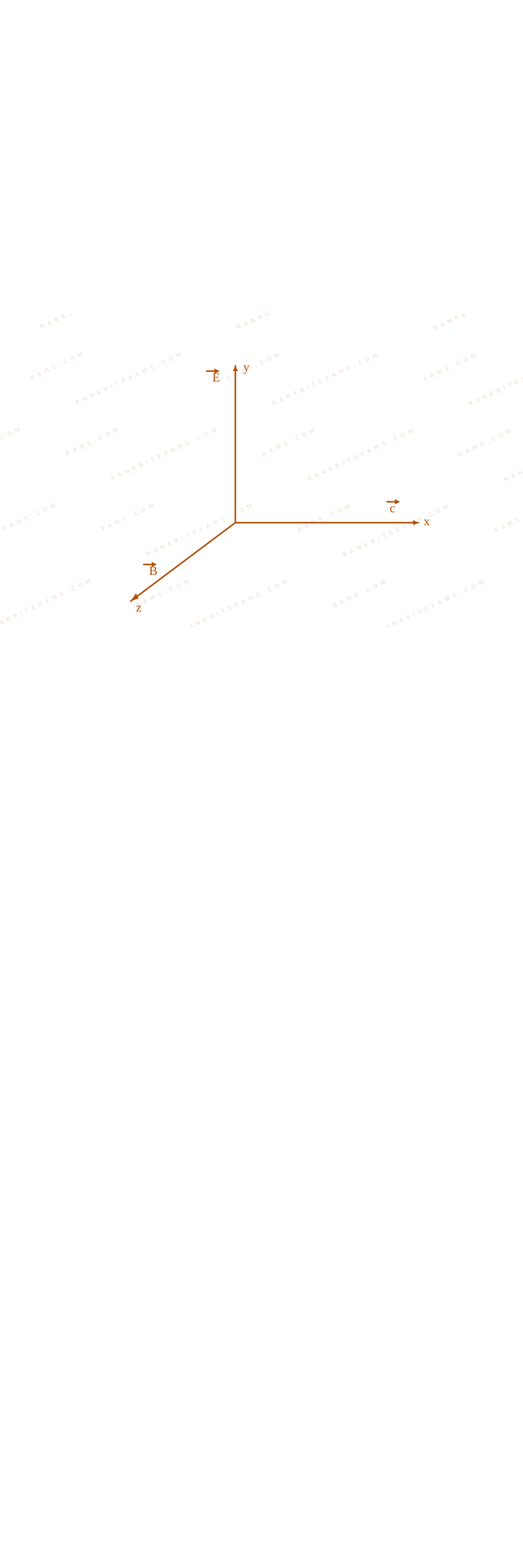
The magnetic field of an E.M. wave is given by vecB=left(fracsqrt32hati+frac12hatjright)30~sinleft[omegaleft(t-fraczcright)right] (S.I. Units). The corresponding electric field in S.I. units is:
  • A. vecmathrmE = left(frac12hatmathrmi -fracsqrt32hatmathrmjright)30mathrmcsin left[omega left(mathrmt - fracmathrmzmathrmcright)right]
  • B. vecmathrmE = left(frac34\i +frac14hatmathrmjright)30mathrmccos left[omega left(mathrmt - fracmathrmzmathrmcright)right]
  • C. vecmathrmE = left(frac12hatmathrmi +fracsqrt32hatmathrmjright)30mathrmcsin left[omega left(mathrmt + fracmathrmzmathrmcright)right]
  • D. vecmathrmE = left(fracsqrt32hatmathrmi -frac12hatmathrmjright)30mathrmcsin left[omega left(mathrmt + fracmathrmzmathrmcright)right]

Solution

### Related Formula For a plane electromagnetic wave propagating in a given direction: 1. Peak electric field amplitude relates to peak magnetic field amplitude via: E_0 = B_0 cdot c 2. The directional orientation unit vectors satisfy the cross product relation: hatE = hatB times hatc where hatc points along the wave propagation vector direction. ### Core Logic Given the wave equation format, the phase term left(t - fraczcright) shows that propagation is along the positive z-axis : hatc = hatk The magnetic field direction unit vector is : hatB = fracsqrt32hati + frac12hatj Compute the electric field direction vector using the cross product relation : hatE = hatB times hatk = left(fracsqrt32hati + frac12hatjright) times hatk hatE = fracsqrt32(hati times hatk) + frac12(hatj times hatk) Using unit vector properties (hati times hatk = -hatj and hatj times hatk = hati): hatE = -fracsqrt32hatj + frac12hati = frac12hati - fracsqrt32hatj quad text With peak amplitude E_0 = 30c , the resulting vector equation is: vecE = left(frac12hati - fracsqrt32hatjright)30csinleft[omegaleft(t-fraczcright)right] ### Pattern Recognition The vectors vecE, vecB, and the propagation direction are always mutually perpendicular. Since vecE cdot vecB = 0, you can quickly double-check your answer by verifying that the \dot product of the final vecE and vecB direction options equals zero. ### Evaluation Rubric / Model Answer null ### Chapter Mix Class 12 Physics: Electromagnetic Waves
Q20 2025 Properties of EM Waves
Given below are two statements : one is labelled as Assertion (A) and other is labelled as Reason (R). Assertion (A) : Electromagnetic waves carry energy but not momentum. [cite: 1, 2] Reason (R): Mass of a photon is zero. [cite: 1, 2] In the light of the above statements, choose the most appropriate answer from the options given below:
  • A. (A) is true but (R) is false.
  • B. (A) is false but (R) is true.
  • C. Both (A) and (R) are true but (R) is not the correct explanation of (A).
  • D. Both (A) and (R) are true and (R) is the correct explanation of (A).

Solution

### Related Formula p = fracEc ### Core Logic Assertion (A) is false because electromagnetic waves carry both energy and finite radiation momentum (p = E/c)[cite: 708, 709]. Reason (R) is correct because the rest mass of a photon equals zero. ### Chapter Mix Class 12 Physics: Electromagnetic Waves

More Electromagnetic Waves Questions — jee_main_2025_07_april_evening

Practice all Electromagnetic Waves previous-year questions →

YOUR FIRST PREP STEP STARTS HERE

We Map Every Repeating Question in Competitive Exams.

Say goodbye to generic mock test fatigue. RankBit uses smart analysis to group past exam questions into their foundational Repeating Question Types. Find chapter weightage, track repeating questions, and score higher with targeted practice.

Select Your Target Exam

Choose an exam track below to find formulas per chapter and patterns.

Syncing Exam Intelligence

Mapping formulas and patterns across all tracks…

PATH A — FULL LENGTH PRACTICE

Full Mock Test Hub

Simulate real NTA exam conditions with fully tracked mocks. Time yourself against past papers.

Under Development
PATH B — TARGETED PRACTICE

Topic-wise Practice Hub

Practice past-year questions one chapter at a time. Pick an exam → subject → chapter and get every PYQ for that topic — pulled together from all past papers — with the chapter's key formulas alongside.

Loading Questions... Browse Topics
Latest from the Blog
View all →

Loading articles...