Rankbit System
JEE Physics: Waves (+15.5%) | Electrostatics: Concentric Shells (-29.7%) | Modern Physics: Photoelectric Clones (+34.2%) | Mathematics: Definite Integrals (+18.1%) | Chemistry: Coordination Splitting (-11.4%) | JEE Physics: Waves (+15.5%) | Electrostatics: Concentric Shells (-29.7%) | Modern Physics: Photoelectric Clones (+34.2%) | Mathematics: Definite Integrals (+18.1%) | Chemistry: Coordination Splitting (-11.4%)

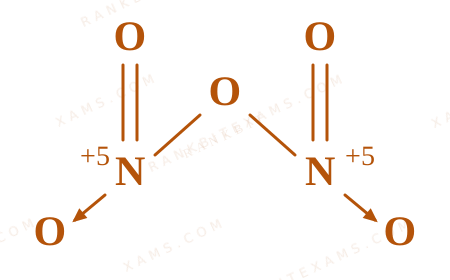
Given below are two statements: Statement I: Nitrogen forms oxides with +1 to +5 oxidation states due to the formation of ppi - ppi bond with oxygen. Statement II: Nitrogen does not form halides with +5 oxidation state due to the absence of d-orbital in it. In the light of given statements, choose the correct answer from the options given below:

Solution & Explanation

### Core Logic * **Statement I is true:** Nitrogen has a small atomic size and high electronegativity, allowing it to form strong multiple ppi - ppi bonds with oxygen atoms. This enables stable oxide forms across a wide range of oxidation numbers spanning +1 to +5 (e.g., N_2O_5). * **Statement II is true:** Nitrogen is a second-period element with a valence shell configuration of 2s^2 2p^3. It completely lacks vacant 2d orbitals. As a result, it cannot expand its octet beyond a covalency of 4, preventing the synthesis of pentahalides like NX_5. ### Pattern Recognition Second-period elements are structurally bounded by a maximum covalency of 4 due to the complete absence of d-orbitals. This explains why NF_5 is unstable/non-existent while PF_5 is easily synthesized. ### Evaluation Rubric / Model Answer null ### Chapter Mix Class 12 Chemistry: The p-Block Elements
Nitrogen oxide bonding structure diagram for Q37

Reference Study Guides

More The p-Block Elements Previous-Year Questions

Q43 2025 Periodic Trends in Group 13 Elements
The correct orders among the following are : - Atomic radius: mathrmB < mathrmAl < mathrmGa < mathrmIn < mathrmTl - Electronegativity: mathrmAl < mathrmGa < mathrmIn < mathrmTl < mathrmB - Density: mathrmTl < mathrmIn < mathrmGa < mathrmAl < mathrmB - 1^mathrmst Ionisation Energy: mathrmIn < mathrmAl < mathrmGa < mathrmTl < mathrmB Choose the correct answer from the options given below :
  • A. B and D Only
  • B. A and C Only
  • C. C and D Only
  • D. A and B Only

Solution

### Related Formula Group 13 elements (mathrmB, mathrmAl, mathrmGa, mathrmIn, mathrmTl) show highly anomalous periodic trends due to the intervention of filled d-orbitals (d-block contraction in mathrmGa) and f-orbitals (lanthanoid contraction in mathrmTl). ### Core Logic Evaluate each specified trend against official physical constants: - **Atomic radius**: Due to d-block contraction, gallium (mathrmGa) is smaller than aluminum (mathrmAl): textRadius (pm): mathrmB(88) < mathrmGa(135) < mathrmAl(143) < mathrmIn(167) < mathrmTl(170) Hence, the given order is *Incorrect*. - **Electronegativity**: Electronegativity first decreases from mathrmB to mathrmAl, then increases down the group due to poor shielding of d and f electrons: textElectronegativity: mathrmAl(1.5) < mathrmGa(1.6) < mathrmIn(1.7) < mathrmTl(1.8) < mathrmB(2.0) Hence, this order is *Correct*. ### Step 1: Analyze density and ionization energy trends - **Density**: Increases down the group as atomic mass increases much faster than atomic volume: textDensity (g/cm^3text): mathrmB(2.35) < mathrmAl(2.70) < mathrmGa(5.90) < mathrmIn(7.31) < mathrmTl(11.85) Hence, the given order is *Incorrect* (it is completely reversed). - **1^mathrmst Ionisation Energy**: Shows an irregular trend due to ineffective shielding by d and f electrons: textIE_1mathrm~(kJ/mol): mathrmIn(558) < mathrmAl(577) < mathrmGa(579) < mathrmTl(589) < mathrmB(801) Hence, this order is *Correct*. ### Step 2: Conclusion Only the Electronegativity (B) and 1^mathrmst Ionisation Energy (D) orders are correct, matching Option (1). ### Pattern Recognition Group 13 elements do not follow monotonic trends. The poor shielding of 3d^10 and 4f^14 electrons increases the effective nuclear charge on valence electrons, causing anomalies in atomic radius (mathrmGa < mathrmAl) and pulling electronegativities and ionization energies upward as you go further down. ### Evaluation Rubric / Model Answer null ### Chapter Mix Class 11 Chemistry: The p-Block Elements Class 11 Chemistry: Classification of Elements and Periodicity in Properties
Q41 2025 Inert Pair Effect and Ionization Enthalpy
Consider the following elements In, Tl, Al, Pb, Sn and Ge. The most stable oxidation states of elements with highest and lowest first ionisation enthalpies, respectively, are
  • A. +2 text and +3
  • B. +4 text and +3
  • C. +4 text and +1
  • D. +1 text and +4

Solution

### Core Logic Let us check the trends for the provided main group elements (mathrmAl, In, Tl from Group 13 and mathrmGe, Sn, Pb from Group 14): - **Highest First Ionization Enthalpy (mathrmIE_1):** Out of these options, Germanium (mathrmGe) sits highest and further right along its period layout, demonstrating the highest mathrmIE_1 value among this set. Its most stable oxidation state is **+4**. - **Lowest First Ionization Enthalpy (mathrmIE_1):** Indium (mathrmIn) lies lowest leftward among these relative coordinates, maintaining the lowest mathrmIE_1. Its most stable group oxidation state is **+3** (as the inert pair effect is much more pronounced for the heavier element mathrmTl which prefers +1). ### Pattern Recognition Sees: mathrmIE_1 extrema vs stable oxidation state profiles. Trap: Forgetting that inert pair shifts display max stability values at +1 for mathrmTl and +2 for mathrmPb, while lighter counterparts like mathrmIn favor +3 and mathrmGe favors +4. ### Evaluation Rubric / Model Answer null ### Chapter Mix Class 11 Chemistry: The p-Block Elements Class 12 Chemistry: The p-Block Elements
Q27 2025 Group 15 Elements
Given below are two statements: Statement I: The N-N single bond is weaker and longer than that of P-P single bond Statement II: Compounds of group 15 elements in +3 oxidation states readily undergo disproportionation reactions. In the light of above statements, choose the correct answer from the options given below:
  • A. Statement I is true but statement II is false
  • B. Both statement I and statement II are false
  • C. Statement I is false but statement II is true
  • D. Both statement I and statement II are true

Solution

### Core Logic Let us analyze both statements systematically: * **Statement I:** The textN-textN single bond is indeed weaker than the textP-textP single bond due to high inter-electronic repulsion between non-bonding lone pairs on the small nitrogen atoms. However, nitrogen has a smaller atomic size than phosphorus, making the textN-textN single bond shorter (140text pm) compared to the textP-textP single bond (221text pm). Thus, Statement I is false because it incorrectly claims it is longer. * **Statement II:** In Group 15, only nitrogen and phosphorus compounds in the +3 oxidation state readily undergo disproportionation. As we go down the group (As, Sb, Bi), the +3 oxidation state becomes increasingly stable due to the inert pair effect, meaning they do not readily undergo disproportionation. Hence, Statement II is false as a general trend across all group 15 elements. ### Step 1: Verification of Conclusions Since the textN-textN bond is shorter and heavier elements in the +3 state do not disproportionate readily, both statements are evaluated to be false. ### Pattern Recognition Sees: "textN-textN single bond longer" ightarrow Absolute error. Small atoms form short bonds, always. Inert pair effect stabilizes +3 lower down the group, preventing disproportionation reactions. ### Evaluation Rubric / Model Answer null ### Chapter Mix Class 12 Chemistry: p-Block Elements
Q39 2025 Group 13 and 14 Periodic Trends
Given below are two statements : Statement (I): The first ionisation enthalpy of group 14 elements is higher than the corresponding elements of group 13. Statement (II) : Melting points and boiling points of group 13 elements are in general much higher than those the corresponding elements of group 14. In the light of the above statements, choose the most appropriate answer from the options given below:
  • A. Statement I is correct but Statement II is incorrect
  • B. Statement I is incorrect but Statement II is correct
  • C. Both Statement I and Statement II are incorrect
  • D. Both Statement I and Statement II are correct

Solution

### Core Logic - **Statement I is correct:** Moving left-to-right across a period from Group 13 to Group 14 increases the effective nuclear charge (Z_texteff) and decreases the atomic radius. Consequently, more energy is required to extract an electron, so Group 14 elements exhibit higher first ionisation enthalpies. - **Statement II is incorrect:** Group 14 elements (like Carbon, Silicon, Germanium) build robust, highly stable three-dimensional covalent network crystal structures. As a result, the melting and boiling points of Group 14 elements are generally much higher than those of the corresponding Group 13 elements. ### Pattern Recognition Covalent network solids (Group 14) create huge upward steps in phase transition energy compared to Group 13 frameworks (e.g., Gallium, which melts at nearly room temperature). ### Evaluation Rubric / Model Answer null ### Chapter Mix Class 11 Chemistry: The p-Block Elements
Q42 2025 Group 13 and 14 Periodic Trends
The elements of Group 13 with highest and lowest first ionisation enthalpies are respectively:
  • A. B & Ga
  • B. B & T1
  • C. T1 & B
  • D. B & In

Solution

### Related Formula textGroup 13 Ionisation Enthalpy Order: B > Tl > Ga > Al > In ### Core Logic The first ionisation enthalpy trend for Group 13 elements is irregular due to poor shielding by d and f electrons: - **Boron (B)** is the smallest atom in the group with no d-orbital shielding issues, so it has the **highest** ionisation enthalpy. - As we move down, poor shielding by 3d electrons causes a slight increase at Gallium (Ga). Poor shielding by 4f electrons causes a sharp increase at Thallium (Tl). - **Indium (In)** ends up with the weakest effective attraction for its outermost valence electron, giving it the **lowest** first ionisation enthalpy. Therefore, the highest and lowest elements are **B & In** respectively. ### Pattern Recognition Group 13 does not follow a linear downward trend. Remember the characteristic 'W' shape or zig-zag pattern of its ionisation energies. Indium sits at the absolute minimum point of this curve. ### Evaluation Rubric / Model Answer null ### Chapter Mix Class 11 Chemistry: The p-Block Elements

More The p-Block Elements Questions — jee_main_2025_04_april_morning

Practice all The p-Block Elements previous-year questions →

YOUR FIRST PREP STEP STARTS HERE

We Map Every Repeating Question in Competitive Exams.

Say goodbye to generic mock test fatigue. RankBit uses smart analysis to group past exam questions into their foundational Repeating Question Types. Find chapter weightage, track repeating questions, and score higher with targeted practice.

Select Your Target Exam

Choose an exam track below to find formulas per chapter and patterns.

Syncing Exam Intelligence

Mapping formulas and patterns across all tracks…

PATH A — FULL LENGTH PRACTICE

Full Mock Test Hub

Simulate real NTA exam conditions with fully tracked mocks. Time yourself against past papers.

Under Development
PATH B — TARGETED PRACTICE

Topic-wise Practice Hub

Practice past-year questions one chapter at a time. Pick an exam → subject → chapter and get every PYQ for that topic — pulled together from all past papers — with the chapter's key formulas alongside.

Loading Questions... Browse Topics
Latest from the Blog
View all →

Loading articles...
