Number of molecules from below which cannot give iodoform reaction is:
Ethanol, Isopropyl alcohol, Bromoacetone, 2-Butanol, 2-Butanone, Butanal, 2-Pentanone, 3-Pentanone, Pentanal and 3-Pentanol
A.5
B.4
C.3
D.2
Solution & Explanation
### Core Logic
The iodoform test requires compounds containing either a methyl ketone group (textCH_3textCO-$\text{CH}_3\text{CO}-$) or a methyl carbinol structural unit (textCH_3textCH(OH)-$\text{CH}_3\text{CH(OH)}-$).
Let us audit the provided compounds:
1. **Ethanol** (textCH_3textCH_2textOH$\text{CH}_3\text{CH}_2\text{OH}$): Contains textCH_3textCH(OH)-$\text{CH}_3\text{CH(OH)}-$
ightarrow$
ightarrow$ **Positive**
2. **Isopropyl alcohol** (textCH_3textCH(OH)CH_3$\text{CH}_3\text{CH(OH)CH}_3$): Contains textCH_3textCH(OH)-$\text{CH}_3\text{CH(OH)}-$
ightarrow$
ightarrow$ **Positive**
3. **Bromoacetone** (textCH_3textCOCH_2textBr$\text{CH}_3\text{COCH}_2\text{Br}$): Contains textCH_3textCO-$\text{CH}_3\text{CO}-$
ightarrow$
ightarrow$ **Positive**
4. **2-Butanol** (textCH_3textCH(OH)CH_2textCH_3$\text{CH}_3\text{CH(OH)CH}_2\text{CH}_3$): Contains textCH_3textCH(OH)-$\text{CH}_3\text{CH(OH)}-$
ightarrow$
ightarrow$ **Positive**
5. **2-Butanone** (textCH_3textCOCH_2textCH_3$\text{CH}_3\text{COCH}_2\text{CH}_3$): Contains textCH_3textCO-$\text{CH}_3\text{CO}-$
ightarrow$
ightarrow$ **Positive**
6. **Butanal** (textCH_3textCH_2textCH_2textCHO$\text{CH}_3\text{CH}_2\text{CH}_2\text{CHO}$): **Negative**
7. **2-Pentanone** (textCH_3textCOCH_2textCH_2textCH_3$\text{CH}_3\text{COCH}_2\text{CH}_2\text{CH}_3$): Contains textCH_3textCO-$\text{CH}_3\text{CO}-$
ightarrow$
ightarrow$ **Positive**
8. **3-Pentanone** (textCH_3textCH_2textCOCH_2textCH_3$\text{CH}_3\text{CH}_2\text{COCH}_2\text{CH}_3$): **Negative**
9. **Pentanal** (textCH_3textCH_2textCH_2textCH_2textCHO$\text{CH}_3\text{CH}_2\text{CH}_2\text{CH}_2\text{CHO}$): **Negative**
10. **3-Pentanol** (textCH_3textCH_2textCH(OH)CH_2textCH_3$\text{CH}_3\text{CH}_2\text{CH(OH)CH}_2\text{CH}_3$): **Negative**
### Step 1: Summation
The molecules that **cannot** give the iodoform reaction are: Butanal, 3-Pentanone, Pentanal, and 3-Pentanol. This gives a total count of exactly 4 molecules.
### Pattern Recognition
Shortcut: Filter for names ending with '-anal' or having ketones/alcohols at positions higher than 2 (e.g., 3-pentanone, 3-pentanol). These lack the vital terminal methyl group adjacent to the functional group.
### Evaluation Rubric / Model Answer
null
### Chapter Mix
Class 12 Chemistry: Aldehydes, Ketones and Carboxylic Acids
Keywords:#Iodoform reaction positive criteria#Methyl ketone structure functional test#Aldehydes and Ketones JEE Main 2025#JEE Main 2025 Morning Q36
More Aldehydes, Ketones and Carboxylic Acids Previous-Year Questions — Page 5
Q502025Chemical Reactions of Carbonyl Compounds
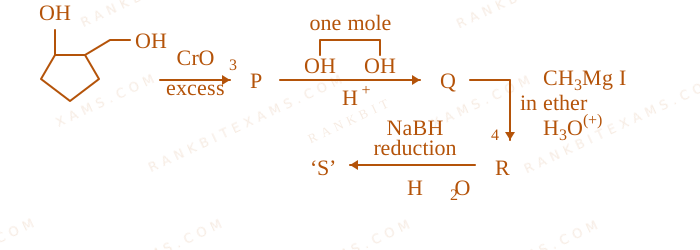
Based on the reaction sequence:
A structural flow charts the transformation of a cyclic dialcohol into final product S.
0.1 mole of compound 'S' will weigh ________ g.
(Given molar mass in mathrmg \, mol^-1$\mathrm{g \, mol^{-1}}$ C:12, H:1, O:16)
Numerical Answer.Answer: 13 to 13
Solution
### Related Formula
textMass = textMoles cdot textMolar Mass$\text{Mass} = \text{Moles} \cdot \text{Molar Mass}$
### Core Logic
Let us trace the reaction scheme row-by-row:
1. Reactant: 2-(hydroxymethyl)cyclopentan-1-ol.
2. Step 1: Excess mathrmCrO_3$\mathrm{CrO}_3$ (Jones oxidation) oxidizes the secondary alcohol to a ketone and the primary alcohol to a carboxylic acid
ightarrow$
ightarrow$ Product P.
3. Step 2: Reaction with 1 mole of glycol protects the ketone selectively as a cyclic ketal
ightarrow$
ightarrow$ Product Q.
4. Step 3: Treatment with mathrmCH_3mathrmMgI$\mathrm{CH}_3\mathrm{MgI}$ targets the free carboxylic acid (or ester equivalent) to form a methyl ketone after workup
ightarrow$
ightarrow$ Product R.
5. Step 4: mathrmNaBH_4$\mathrm{NaBH}_4$ reduces the methyl ketone to a secondary alcohol, and acid workup deprotects the ketal back to the original ketone
ightarrow$
ightarrow$ Compound S .
Chemical structural formula of S: 2-(1-hydroxyethyl)cyclopentan-1-one (mathrmC_7mathrmH_12mathrmO_2$\mathrm{C}_7\mathrm{H}_{12}\mathrm{O}_2$) .
Molar mass of S (mathrmC_7mathrmH_12mathrmO_2$\mathrm{C}_7\mathrm{H}_{12}\mathrm{O}_2$) :
M = (7 cdot 12) + (12 cdot 1) + (2 cdot 16) = 84 + 12 + 32 = 130 \, mathrmg/mol$M = (7 \cdot 12) + (12 \cdot 1) + (2 \cdot 16) = 84 + 12 + 32 = 130 \, \mathrm{g/mol}$textMass of 0.1 mole = 0.1 cdot 130 = 13 \, mathrmg$\text{Mass of 0.1 mole} = 0.1 \cdot 130 = 13 \, \mathrm{g}$
### Pattern Recognition
Ketal groups serve as stable protective masks that shield ketones, allowing selective organometallic reactions to take place elsewhere on the molecule.
### Evaluation Rubric / Model Answer
null
### Chapter Mix
Class 12 Chemistry: Aldehydes, Ketones and Carboxylic Acids
More Aldehydes, Ketones and Carboxylic Acids Questions — jee_main_2025_03_april_morning
We Map Every Repeating Question in Competitive Exams.
Say goodbye to generic mock test fatigue. RankBit uses smart analysis to group past exam questions into their foundational Repeating Question Types. Find chapter weightage, track repeating questions, and score higher with targeted practice.
Select Your Target Exam
Choose an exam track below to find formulas per chapter and patterns.
Syncing Exam Intelligence
Mapping formulas and patterns across all tracks…
PATH A — FULL LENGTH PRACTICE
Full Mock Test Hub
Simulate real NTA exam conditions with fully tracked mocks. Time yourself against past papers.
Under Development
PATH B — TARGETED PRACTICE
Topic-wise Practice Hub
Practice past-year questions one chapter at a time. Pick an exam → subject → chapter and get every PYQ for that topic — pulled together from all past papers — with the chapter's key formulas alongside.