Rankbit System
JEE Physics: Waves (+15.5%) | Electrostatics: Concentric Shells (-29.7%) | Modern Physics: Photoelectric Clones (+34.2%) | Mathematics: Definite Integrals (+18.1%) | Chemistry: Coordination Splitting (-11.4%) | JEE Physics: Waves (+15.5%) | Electrostatics: Concentric Shells (-29.7%) | Modern Physics: Photoelectric Clones (+34.2%) | Mathematics: Definite Integrals (+18.1%) | Chemistry: Coordination Splitting (-11.4%)

Number of molecules from below which cannot give iodoform reaction is: Ethanol, Isopropyl alcohol, Bromoacetone, 2-Butanol, 2-Butanone, Butanal, 2-Pentanone, 3-Pentanone, Pentanal and 3-Pentanol

Solution & Explanation

### Core Logic The iodoform test requires compounds containing either a methyl ketone group (textCH_3textCO-) or a methyl carbinol structural unit (textCH_3textCH(OH)-). Let us audit the provided compounds: 1. **Ethanol** (textCH_3textCH_2textOH): Contains textCH_3textCH(OH)- ightarrow **Positive** 2. **Isopropyl alcohol** (textCH_3textCH(OH)CH_3): Contains textCH_3textCH(OH)- ightarrow **Positive** 3. **Bromoacetone** (textCH_3textCOCH_2textBr): Contains textCH_3textCO- ightarrow **Positive** 4. **2-Butanol** (textCH_3textCH(OH)CH_2textCH_3): Contains textCH_3textCH(OH)- ightarrow **Positive** 5. **2-Butanone** (textCH_3textCOCH_2textCH_3): Contains textCH_3textCO- ightarrow **Positive** 6. **Butanal** (textCH_3textCH_2textCH_2textCHO): **Negative** 7. **2-Pentanone** (textCH_3textCOCH_2textCH_2textCH_3): Contains textCH_3textCO- ightarrow **Positive** 8. **3-Pentanone** (textCH_3textCH_2textCOCH_2textCH_3): **Negative** 9. **Pentanal** (textCH_3textCH_2textCH_2textCH_2textCHO): **Negative** 10. **3-Pentanol** (textCH_3textCH_2textCH(OH)CH_2textCH_3): **Negative** ### Step 1: Summation The molecules that **cannot** give the iodoform reaction are: Butanal, 3-Pentanone, Pentanal, and 3-Pentanol. This gives a total count of exactly 4 molecules. ### Pattern Recognition Shortcut: Filter for names ending with '-anal' or having ketones/alcohols at positions higher than 2 (e.g., 3-pentanone, 3-pentanol). These lack the vital terminal methyl group adjacent to the functional group. ### Evaluation Rubric / Model Answer null ### Chapter Mix Class 12 Chemistry: Aldehydes, Ketones and Carboxylic Acids

More Aldehydes, Ketones and Carboxylic Acids Previous-Year Questions — Page 3
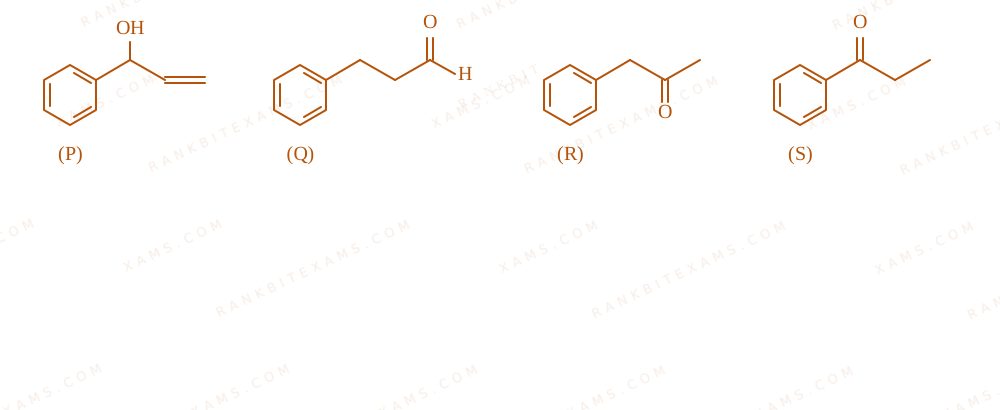
Q29 2025 Aldol Condensation
Aldol condensation is a popular and classical method to prepare alpha, beta-unsaturated carbonyl compounds. This reaction can be both intermolecular and intramolecular. Predict which one of the following is not a product of intramolecular aldol condensation?
  • A. textProduct 1
  • B. textProduct 2
  • C. textProduct 3
  • D. textProduct 4

Solution

### Core Logic Intramolecular aldol condensation involves a dicarbonyl compound reacting within itself to yield stable cyclic alpha, beta-unsaturated rings (most commonly 5- or 6-membered rings due to minimal ring strain). * Products (1), (2), and (3) can all be cleanly synthesized via intramolecular cyclization path workflows from their respective dialdehyde/diketone precursors. * Product (4) features an exo-cyclic group structure arrangement formed strictly through an **intermolecular** condensation sequence step between two distinct reactant units, rather than an internal cyclization path layout. ### Pattern Recognition Look closely at the ring substitution system. Intermolecular steps are forced when intramolecular cyclization path workflows would generate highly strained small rings or structurally impossible orientations. ### Evaluation Rubric / Model Answer null ### Chapter Mix Class 12 Chemistry: Aldehydes, Ketones and Carboxylic Acids
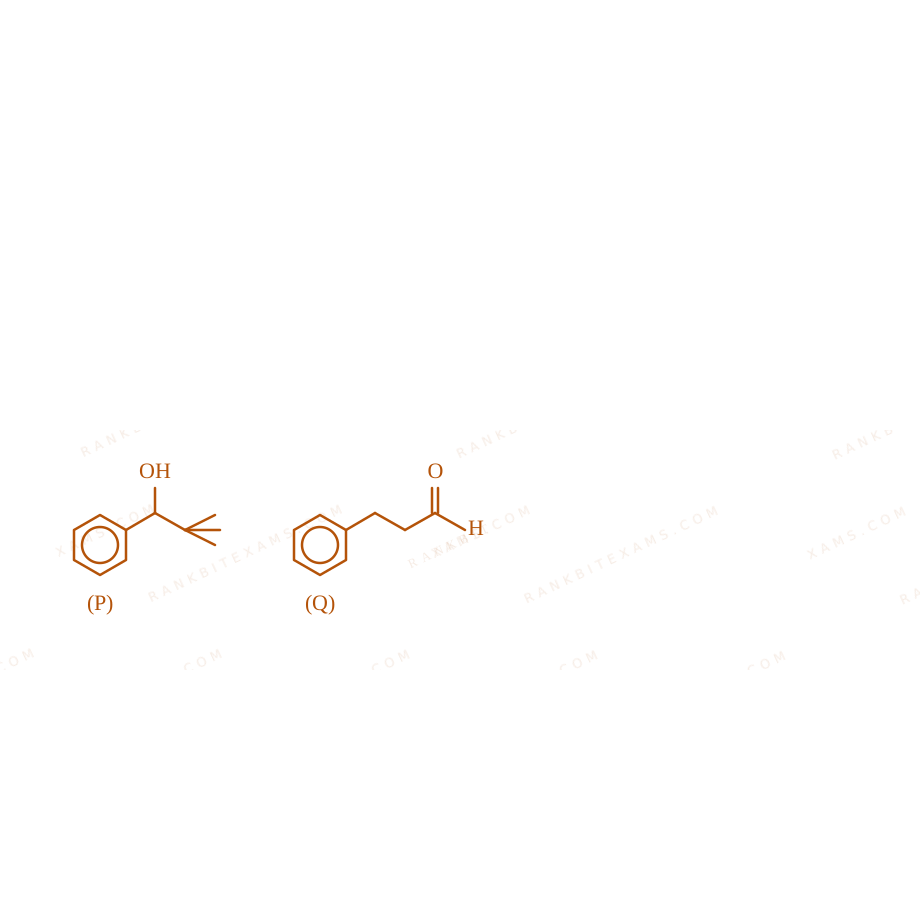
Q41 2025 Chemical Properties of Ketones
An organic compound (X) with molecular formula C_3H_6O is not readily oxidised. On reduction it gives C_3H_8O (Y) which reacts with HBr to give a bromide (Z) which is converted to Grignard reagent. This Grignard reagent on reaction with (X) followed by hydrolysis gives 2, 3-dimethylbutan-2-ol. Compounds (X), (Y) and (Z) respectively are:
  • A. mathrmCH_3mathrmCOCH_3, mathrmCH_3mathrmCH_2mathrmCH_2mathrmOH, mathrmCH_3mathrmCH(Br)CH_3
  • B. mathrmCH_3mathrmCOCH_3, mathrmCH_3mathrmCH(OH)CH_3, mathrmCH_3mathrmCH(Br)CH_3
  • C. mathrmCH_3mathrmCH_2mathrmCHO, mathrmCH_3mathrmCH_2mathrmCH_2mathrmOH, mathrmCH_3mathrmCH_2mathrmCH_2mathrmBr
  • D. mathrmCH_3mathrmCH_2mathrmCHO, mathrmCH_3mathrmCH=CH_2, mathrmCH_3mathrmCH(Br)CH_3

Solution

### Core Logic Let's deduce the identities stepwise: 1. Compound (X) has the formula C_3H_6O and is resistant to mild oxidation, which identifies it as a ketone: **Acetone** (CH_3COCH_3). 2. Reduction of Acetone yields a secondary alcohol, Propan-2-ol (CH_3CH(OH)CH_3, Compound Y). 3. Treatment of Propan-2-ol with HBr substitutes the hydroxyl group to form 2-Bromopropane (CH_3CH(Br)CH_3, Compound Z). 4. Reacting 2-Bromopropane with Magnesium in ether creates the branched Grignard reagent, Isopropylmagnesium bromide ((CH_3)_2CHMgBr). 5. Finally, nucleophilic addition of this Grignard reagent to Acetone followed by aqueous workup yields the highly branched tertiary alcohol: **2,3-dimethylbutan-2-ol**. ### Pattern Recognition Resistance to mild oxidation immediately distinguishes ketones from isomeric aldehydes. Nucleophilic addition of an isopropyl Grignard to acetone cleanly yields the 2,3-dimethylbutan-2-ol framework. ### Evaluation Rubric / Model Answer null ### Chapter Mix Class 12 Chemistry: Aldehydes, Ketones and Carboxylic Acids Class 12 Chemistry: Alcohols, Phenols and Ethers
Q30 2025 Identification of Carbonyl Compounds
"P" is an optically active compound with molecular formula textC_6textH_12textO. When "P" is treated with 2,4-dinitrophenylhydrazine, it gives a positive test. However, in presence of Tollens reagent, "P" gives a negative test. Predict the structure of "P".
  • A. textCH_3text-C(=textO)text-CH_2text-CH_2text-CH_2text-CH_3
  • B. textCH_3text-C(=textO)text-CH(textCH_2text-CH_3)text-CH_3
  • C. textH-C(=textO)text-CH_2text-CH(textCH_2text-CH_3)text-CH_3
  • D. textCH_3text-C(=textO)text-CH_2text-CH(textCH_3)_2

Solution

### Related Formula textCarbonyl compound + text2,4-DNP ightarrow textHydrazone derivative (Positive test) textAldehyde + textTollens' Reagent ightarrow textSilver Mirror (Positive test) textKetone + textTollens' Reagent ightarrow textNo reaction (Negative test) ### Core Logic Analyzing individual functional constraints: - Positive 2,4-DNP test shows compound contains a carbonyl group (aldehyde or ketone). - Negative Tollens' test clarifies it is not an aldehyde; hence it must be a ketone. - The compound is optically active, meaning it must possess a chiral center (carbon with 4 distinct groups). Let's evaluate the options via structural configurations:
Identification of Carbonyl Compounds diagram for Q30 - JEE Main 2025 Evening
### Step 1: Structural Verification Option (2) represents 3-methylpentan-2-one: textCH3-textC(=textO)-oversetasttextCH(textCH3)(textCH2textCH3) The third carbon (C3) is linked to: -textH, -textCH_3, -textCH_2textCH_3, and -textCOCH_3. It has 4 distinct structural fields, making it chiral and optically active. ### Pattern Recognition Tollens' negative + DNP positive = Ketone. Once categorized as a ketone, look directly for the structure holding a carbon with four unique groups to secure the optical activity constraint. ### Evaluation Rubric / Model Answer null ### Chapter Mix Class 12 Chemistry: Aldehydes, Ketones and Carboxylic Acids Class 11 Chemistry: Organic Chemistry - Some Basic Principles and Techniques
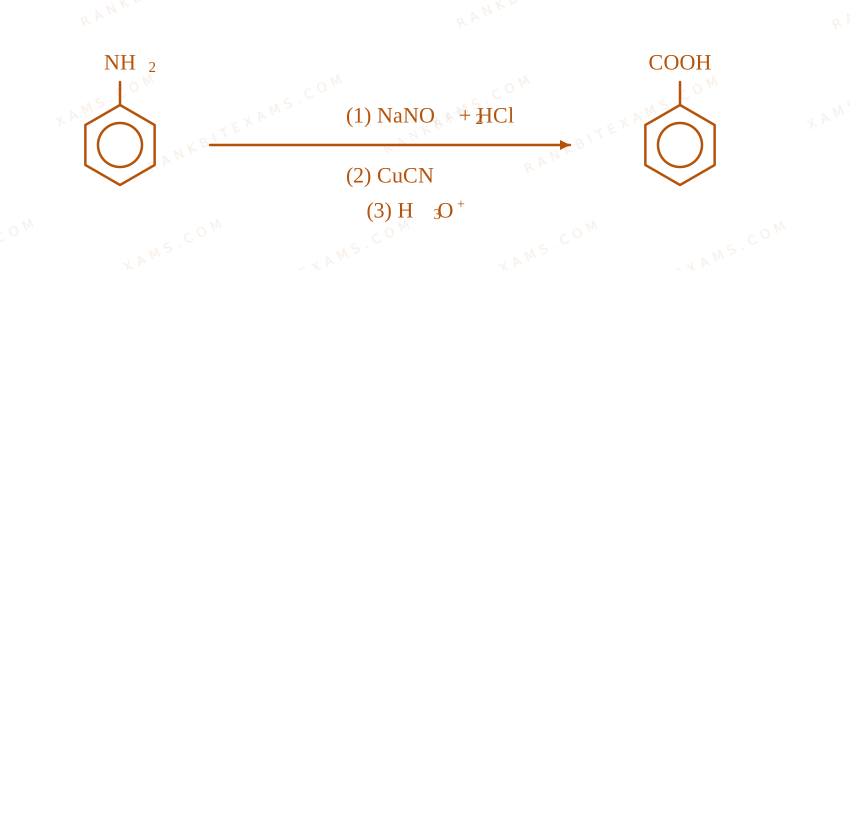
Q42 2025 Preparation of Aldehydes
Match List-I with List-II
List-IList-II (Name of Reaction)
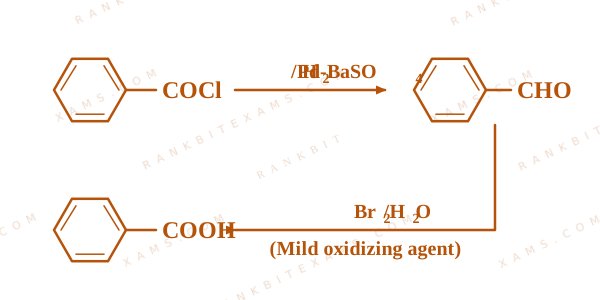
(A) mathrmRCN xrightarrow[text(ii)mathrmH_3mathrmO^+]text(i)mathrmSnCl_2, mathrmHCl mathrmRCHO(I) Etard reaction
(B)
Preparation of Aldehydes diagram for Q42 - JEE Main 2025 Evening
The Match List displays chemical transformations side-by-side with their respective named organic chemical reactions.
(II) Gatterman-Koch reaction
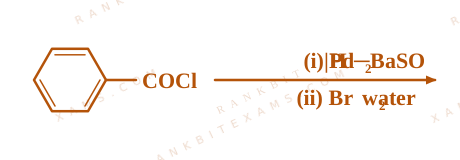
(C)
Preparation of Aldehydes diagram for Q42 - JEE Main 2025 Evening
The Match List displays chemical transformations side-by-side with their respective named organic chemical reactions.
(III) Rosenmund reduction
(D)
Preparation of Aldehydes diagram for Q42 - JEE Main 2025 Evening
The Match List displays chemical transformations side-by-side with their respective named organic chemical reactions.
(IV) Stephen reaction
Choose the correct answer from the options given below:
  • A. \text{(A)-(IV), (B)-(III), (C)-(I), (D)-(II)}
  • B. \text{(A)-(III), (B)-(IV), (C)-(II), (D)-(I)}
  • C. \text{(A)-(I), (B)-(III), (C)-(II), (D)-(IV)}
  • D. \text{(A)-(III), (B)-(IV), (C)-(I), (D)-(II)}

Solution

### Core Logic Let's match each aldehyde preparation method with its official named organic reaction: * **(A) mathrmRCN ightarrow mathrmRCHO using mathrmSnCl_2/mathrmHCl followed by hydrolysis:** This is the classic **Stephen reaction** ightarrow **(IV)**. * **(B) Reducing an acyl chloride (mathrmRCOCl) to an aldehyde using mathrmH_2 over mathrmPd-BaSO_4:** This partial reduction is known as the **Rosenmund reduction** ightarrow **(III)**. * **(C) Oxidizing toluene to benzaldehyde using chromyl chloride (mathrmCrO_2mathrmCl_2) in mathrmCS_2:** This selective oxidation method is the **Etard reaction** ightarrow **(I)**. * **(D) Converting benzene to benzaldehyde using mathrmCO and mathrmHCl in the presence of anhydrous mathrmAlCl_3/mathrmCuCl:** This formylation process is the **Gatterman-Koch reaction** ightarrow **(II)**. Combining these assignments yields the final sequence: (A)-(IV), (B)-(III), (C)-(I), (D)-(II). ### Step-by-Step Layout The visual reaction components correspond directly to the official structural transformations:
Preparation of Aldehydes solution diagram for Q42 - JEE Main 2025 Evening
The Match List displays chemical transformations side-by-side with their respective named organic chemical reactions.
Preparation of Aldehydes solution diagram for Q42 - JEE Main 2025 Evening
The Match List displays chemical transformations side-by-side with their respective named organic chemical reactions.
Preparation of Aldehydes solution diagram for Q42 - JEE Main 2025 Evening
The Match List displays chemical transformations side-by-side with their respective named organic chemical reactions.
### Pattern Recognition Quick identification keys: - Nitrile ightarrow Aldehyde = Stephen - Acid Chloride ightarrow Aldehyde = Rosenmund - Toluene ightarrow Chromyl Complex = Etard - Benzene ightarrow Carbon Monoxide = Gatterman-Koch ### Evaluation Rubric / Model Answer null ### Chapter Mix Class 12 Chemistry: Aldehydes, Ketones and Carboxylic Acids
Q40 2025 Reactivity towards Nucleophilic Addition
Which of the following arrangements with respect to their reactivity in nucleophilic addition reaction is correct?
  • A. benzaldehyde < acetophenone < p-nitrobenzaldehyde < p-tolualdehyde
  • B. acetophenone < benzaldehyde < p-tolualdehyde < p-nitrobenzaldehyde
  • C. acetophenone < p-tolualdehyde < benzaldehyde < p-nitrobenzaldehyde
  • D. p-nitrobenzaldehyde < benzaldehyde < p-tolualdehyde < acetophenone

Solution

### Core Logic Reactivity in nucleophilic addition reactions is governed by a combination of **steric hindrance** and **electronic effects** around the electrophilic carbonyl carbon: 1. Ketones are significantly less reactive than aldehydes due to the bulkiness and electron-donating inductive effect (+I) of their two alkyl/aryl groups. Thus, **acetophenone** has the lowest reactivity. 2. For substituted benzaldehydes, electron-withdrawing groups heighten the partial positive charge on the carbonyl carbon, accelerating nucleophilic attack. Conversely, electron-donating groups suppress reactivity. Symmetry breakdown structures are shown below: - Acetophenone:
Acetophenone structure for reactivity comparison
- p-tolualdehyde:
Acetophenone structure for reactivity comparison
- Benzaldehyde:
Acetophenone structure for reactivity comparison
- p-nitrobenzaldehyde:
Acetophenone structure for reactivity comparison
- Methoxy/methyl donors decrease reactivity: textp-tolualdehyde < textbenzaldehyde - Nitro group (-mathrmNO_2) acts as a strong electron-withdrawing agent via both -M and -I pathways, maximizing the electrophilic nature of the carbonyl site. Therefore, **p-nitrobenzaldehyde** is the most reactive. Thus, the correct order of reactivity is: textacetophenone < textp-tolualdehyde < textbenzaldehyde < textp-nitrobenzaldehyde ### Pattern Recognition Aldehydes naturally exhibit higher reactivity than ketones. Electron-withdrawing groups (-mathrmNO_2) accelerate addition pathways, whereas electron-donating groups (-mathrmCH_3) impede them. ### Evaluation Rubric / Model Answer null ### Chapter Mix Class 12 Chemistry: Aldehydes, Ketones and Carboxylic Acids
More Aldehydes, Ketones and Carboxylic Acids Questions — jee_main_2025_03_april_morning

Practice all Aldehydes, Ketones and Carboxylic Acids previous-year questions →

YOUR FIRST PREP STEP STARTS HERE

We Map Every Repeating Question in Competitive Exams.

Say goodbye to generic mock test fatigue. RankBit uses smart analysis to group past exam questions into their foundational Repeating Question Types. Find chapter weightage, track repeating questions, and score higher with targeted practice.

Select Your Target Exam

Choose an exam track below to find formulas per chapter and patterns.

Syncing Exam Intelligence

Mapping formulas and patterns across all tracks…

PATH A — FULL LENGTH PRACTICE

Full Mock Test Hub

Simulate real NTA exam conditions with fully tracked mocks. Time yourself against past papers.

Under Development
PATH B — TARGETED PRACTICE

Topic-wise Practice Hub

Practice past-year questions one chapter at a time. Pick an exam → subject → chapter and get every PYQ for that topic — pulled together from all past papers — with the chapter's key formulas alongside.

Loading Questions... Browse Topics
Latest from the Blog
View all →

Loading articles...